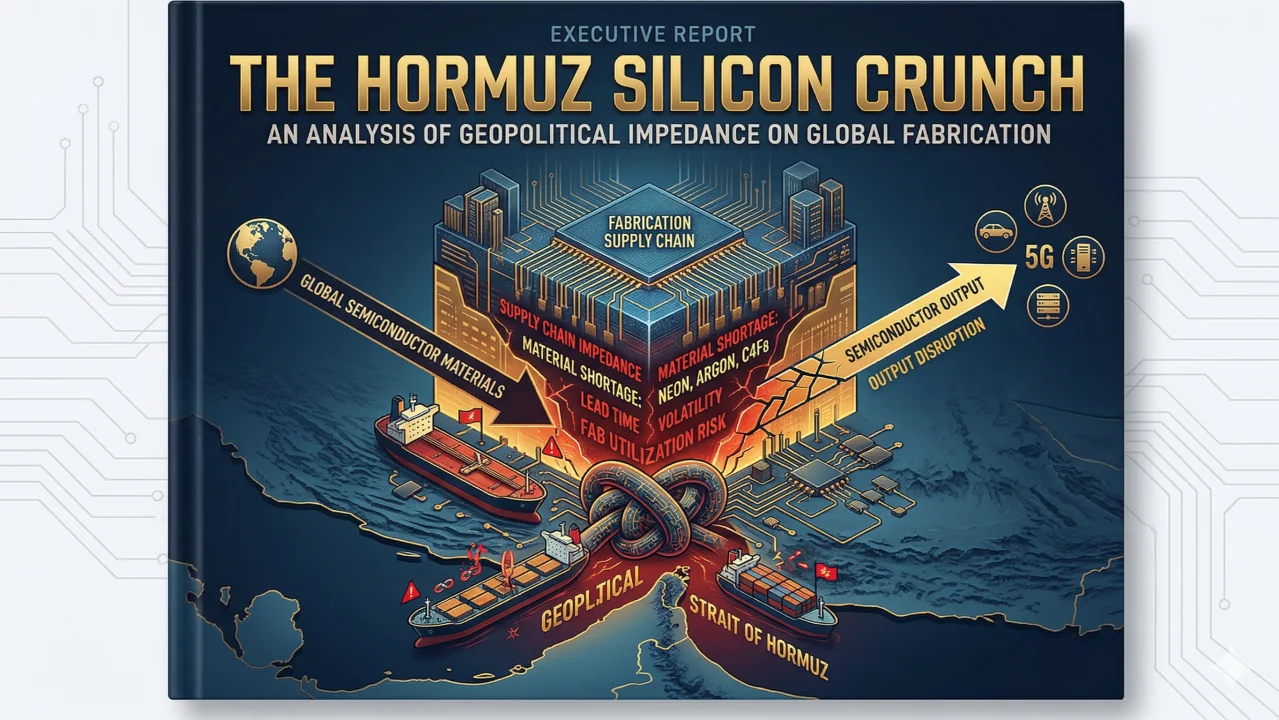
The Hormuz Crisis Isn’t Just an Oil Story, It’s a Semiconductor Materials Crisis Most People Aren’t Tracking Yet
Image File
Original HTML

The Hormuz Crisis Isn’t Just an Oil Story, It’s a Semiconductor Materials Crisis Most People Aren’t Tracking Yet

The materials nobody is talking about

Helium — The silent backbone of chip fabrication

This isn’t about party balloons. Inside a semiconductor fab, helium performs three functions that no other gas can replicate:

• It cools wafers during ion implantation, where temperatures would otherwise distort the silicon substrate.

• It serves as a carrier gas in chemical vapour deposition (CVD), transporting reactive gases across wafers with a precision that nitrogen and argon cannot match.

• It detects microscopic leaks in vacuum systems through helium mass spectrometry. Undetected leaks destroy chip yield silently.

The supply picture: Qatar produced roughly one-third of the world’s helium, extracted as a byproduct of LNG processing at the Ras Laffan Industrial City. That facility took direct hits from Iranian strikes. QatarEnergy declared force majeure. Repairs are estimated at three to five years.

Spot helium prices have doubled. Roughly 200 specialised cryogenic containers are stranded near the Strait. These containers keep helium liquid for only 35 to 48 days before it warms and escapes. The clock is ticking — and for Asian fabs, the last scheduled shipments are arriving now. After that, the pipeline is empty.

Bromine — The photoresist ingredient you’ve never heard of

Bromine is used in photoresist chemistry for circuit pattern formation on wafers. It is not optional. When your photoresist chemistry chain breaks, your lithography line doesn’t slow down. It stops.

The supply picture: Israel and Jordan together supply roughly two-thirds of global bromine production. Israel is a direct party to the current conflict. South Korea sources 90% of its bromine imports from Israel. This is a single point of failure that did not appear on most supply chain risk assessments until five weeks ago.

Sulphur and Sulphuric Acid — The upstream bottleneck

The Strait is a major chokepoint for Gulf sulphur exports. Sulphuric acid derived from sulphur is essential for leaching and refining critical metals used in semiconductor manufacturing and battery production. Prices were climbing before February. The Hormuz closure adds a structural supply risk on top of what was already a pricing problem.

Aluminium — Packaging, frames, and the 18-month qualification trap

The Middle East accounts for roughly 9% of global aluminium smelting capacity. Aluminium goes into lead frames, IC packaging, server chassis, and heat exchangers. European and Japanese manufacturers are panic-buying and drawing down inventories.

Here is the part that semiconductor professionals will recognise immediately: automotive manufacturers report that qualifying new aluminium suppliers takes up to 18 months. The same qualification timeline applies to semiconductor packaging materials. You cannot simply switch suppliers overnight when material specifications are measured in parts per billion.

LNG — The power behind the fabs

Not a direct fab material, but LNG powers the energy grids that power the fabs. Twenty percent of global LNG trade moves through Hormuz. Taiwan and South Korea — where most of the world’s advanced chips are manufactured — are heavily exposed. An unreliable grid means unreliable fabs.

Monoethylene Glycol (MEG) — The packaging chain disruptor

A key input for polyester fibres and packaging materials. Around 6.5 million tonnes were shipped from the Gulf in 2025 alone. China is the largest consumer. Shortages are already rippling into the packaging materials used across the electronics supply chain.

Who supplies what — and where the concentration risk sits

The uncomfortable truth: the semiconductor supply chain was optimised for cost efficiency, not geopolitical resilience.

Helium: Qatar (~30% of global supply, now offline), United States (largest producer, but cannot cover the gap), Algeria (modest output), Russia (sanctioned; Amur Gas Processing Plant still running below capacity after repeated explosions and technical failures). Two of four major sources are either offline or restricted.

Bromine: Israel (dominant supplier to Asian semiconductor manufacturers). South Korea’s 90% import dependence on Israeli bromine is a textbook single-point-of-failure.

Helium distribution: Linde, Air Liquide, and Iwatani are the major intermediaries. All three are now being forced to rework their logistics, contract structures, and equipment deployment. Even if Hormuz reopens tomorrow, unwinding those emergency arrangements could take months.

Overall GCC dependency: For specialty chemicals, petrochemical feedstocks, and process gases, the Gulf Cooperation Council countries collectively represent a supply concentration that makes “diversified supply chain” sound like a marketing slogan rather than an operational reality.

Who gets hurt

South Korea imported 64.7% of its helium from Qatar in 2025. Samsung and SK Hynix are directly exposed. SK Hynix has stated they have diversified and secured inventory, but industry analysts estimate that buffer is measured in weeks, not months. South Korea’s Ministry of Trade has launched an investigation into supply and demand for 14 semiconductor materials with high Middle Eastern dependence.

Taiwan relies on Qatari helium for its foundry operations. TSMC says no near-term impact, but their CoWoS advanced packaging capacity was already sold out through mid-2026 before this crisis began. Any upstream helium constraint adds pressure to an already oversubscribed pipeline.

Any fab running EUV lithography is helium-dependent. Helium cools the extreme heat generated by EUV machines. There is currently no viable substitute at the required purity and scale. As chip geometries shrink and EUV adoption grows, per-wafer helium consumption is actually increasing.

HDD manufacturers using helium-sealed drives are also exposed. Western Digital has already sold out through 2026 with prices up 46% since September 2025. A helium shortage on top of that existing demand crunch compounds at both the production and pricing level.

What are the alternatives — and how realistic are they

Let me be straightforward about what “diversification” actually looks like in practice versus in a strategy deck.

Alternative helium sources

The United States is the world’s largest helium exporter, but it cannot compensate for a 30% global supply loss. The Federal Helium Reserve was wound down starting in 2023. New exploration projects exist — Pulsar Helium in Minnesota, Helium One in Tanzania, projects in Saskatchewan and South Africa — but these are early-stage. Production-scale output is years away, not months.

Russia’s Amur Gas Processing Plant was designed to supply up to 25% of global demand. As of 2026, it is still running well below capacity. Western sanctions further limit its commercial viability.

Algeria produces helium, but its output is modest relative to the gap that needs filling.

Substitute gases

Recommended by LinkedIn

Hydrogen and neon are being explored for select applications. But helium’s unique combination of inertness, thermal conductivity, and atomic size makes it irreplaceable for EUV cooling and helium mass spectrometry leak detection.

And the neon supply chain has its own vulnerability. Before Russia’s invasion of Ukraine, roughly half of the world’s semiconductor-grade neon came from two Ukrainian companies in Odessa and Mariupol. The industry already learned this lesson once. Replacing one geopolitically concentrated input with another is not diversification.

Helium recycling

Closed-loop helium recovery systems exist, and some fabs are implementing them. But the technology is not yet efficient enough to close the supply gap at the scale that modern high-volume manufacturing demands. Capital investment, installation, and qualification timelines apply.

Alternative shipping routes

Rerouting around the Cape of Good Hope adds approximately 3,500 nautical miles, roughly $1 million in additional fuel costs per voyage, and 10 to 14 days of transit time.

For cryogenic helium with a 35-to-48-day shelf life, those extra days are not just a cost problem. They are a physics problem. You could load a container on the US Gulf Coast and watch it begin evaporating before it reaches Hsinchu.

The real bottleneck nobody outside a fab understands: qualification

Here is where the conversation needs to go deeper than most supply chain analyses are willing to go.

Even if you find an alternative helium supplier tomorrow, you cannot plug it into a running fab tomorrow. Every new material source — every gas, every chemical, every substrate — must go through a formal qualification process before it touches a production wafer. This is where fabs face a painful tradeoff: qualification takes time, but the crisis does not wait.

In semiconductor manufacturing, qualification exists because a seemingly identical material from a different supplier can behave differently at the atomic level. Trace impurities measured in parts per billion can shift etch rates, alter film stress, or introduce defects that only show up weeks later in device reliability testing. The industry learned this the hard way, repeatedly.

So what are the realistic paths to faster qualification during a crisis like this?

1. Accelerated qualification with rigorous inline data

The standard approach relies heavily on end-of-line electrical testing — you run production with the new material and wait to see if finished devices pass. This is slow. It can take weeks or months depending on the product cycle.

The faster path: design a thorough inline data collection plan that validates the material’s behaviour at each critical process step, not just at the end. Monitor film thickness, particle counts, etch uniformity, deposition rates, and defect density in real time.


Class (B2B/B2C)
B2B
Ingest Status
Rewritten
Dedupe hash
3097073aee10c2f6fa8c1302a93087ee
Press Eligible
Yes
Press Eligible Reason
Manuelle Prüfung nötig. Risiko: MEDIUM. Flags: ['finance', 'numbers']. Stichprobe: False
Source Name
GlobalFoundries Newsroom
Image URL
https://media.licdn.com/dms/image/v2/D5612AQFFMLbAh00rrA/article-cover_image-shrink_720_1280/B56Z1jLFplH8AI-/0/1775485349183?e=2147483647&v=beta&t=X_T2XHXiM4100-kaYAPyqVlboJ59yFGOKwZZvNLSiY8
Content Hash (SHA-256, erste 32 hex)
c4b91519f539036ae0e6cdd6d1b246bb
The AI Inference platform
Image File
Original HTML

The AI Inference platform

Workers AI lets you run AI inference globally with one API call. No GPUs to manage, no capacity planning. Just intelligent machine learning models running where they're needed, on Cloudflare's global network.

Serverless pricing

Pay-per-inference pricing with no idle costs. No guessing what.

Rich model catalog

50+ models running close to users in 200+ cities

Widely compatible

One API call, works with any OpenAI SDK or task type

Scale up, and down

Inference is hard to predict and spiky in nature, unlike training. GPU utilization is, on average, only 20-40% — with one-third of organizations utilizing less than 15%. Workers AI allows customers to save by only paying for usage. No guessing or committing to hardware that goes unused.

on a hyperscaler

on Cloudflare

AI models easily accessible via code, OpenAI SDK or API

Test, prototype, and evaluate the latest LLMs with the speed and reliability of a production environment, accessible in seconds.

Kimi K2.6

Powerful vision and agentic tool calling model

GLM 4.7 Flash

Rapid multilingual agent with expert tool calling

GPT-OSS-120B

Specialized for coding and debugging

Llama 4 Scout

Balanced generalist for everyday tasks

Run any AI model with one API call

Call any model directly from your code using a single endpoint. Workers AI handles provisioning, scaling, and latency optimization automatically.

const response = await env.AI.run('@cf/moonshotai/kimi-k2.6', { messages: [ { role: 'system', content: 'You are a friendly assistant' }, { role: 'user', content: 'What is the origin of the phrase Hello, World' }, ],});curl https://api.cloudflare.com/client/v4/accounts/$CLOUDFLARE_ACCOUNT_ID/ai/run/@cf/moonshotai/kimi-k2.6 \ -X POST \ -H "Authorization: Bearer $CLOUDFLARE_AUTH_TOKEN" \ -d '{ "messages": [{ "role": "system", "content": "You are a friendly assistant" }, { "role": "user", "content": "Why is pizza so good" }]}'export interface Env { AI: Ai;}

export default { async fetch(request, env): Promise { const response = await env.AI.run('@cf/black-forest-labs/flux-1-schnell', { prompt: 'a bengal cat vibe coding to music', seed: Math.floor(Math.random() * 10), }); // Convert from base64 string const binaryString = atob(response.image); // Create byte representation const img = Uint8Array.from(binaryString, (m) => m.codePointAt(0)); return new Response(img, { headers: { 'Content-Type': 'image/jpeg', }, }); },} satisfies ExportedHandler;curl https://api.cloudflare.com/client/v4/accounts/$CLOUDFLARE_ACCOUNT_ID/ai/run/@cf/black-forest-labs/flux-1-schnell \ -X POST \ -H "Authorization: Bearer $CLOUDFLARE_API_TOKEN" \ -d '{ "prompt": "cyberpunk cat", "seed": "Random positive integer" }'

Practical AI at the Edge

Run real-world AI workloads directly on Cloudflare's global network — from LLMs to image generation and embeddings. No GPU clusters, no orchestration layers — just fast, scalable inference wherever your users are.

Image generation

Speech-to-text, in real-time

Embeddings

LLMs

Shopify

"

For Shopify, the real challenge is not about how many different pieces of complex technology we can use but the opposite. Cloudflare helps us find a simple way to achieve something very complex that we can scale and maintain. "

Workers AI Pricing

50+ models running at the edge. View AI pricing details

Neurons

10,000 neurons / day

$0.011 / thousand neurons

Powerful primitives, seamlessly integrated

Built on systems powering 20% of the Internet, Workers AI runs on the same infrastructure Cloudflare uses to build Cloudflare. Enterprise-grade reliability, security, and performance are standard.

Build without boundaries

Join thousands of developers who've eliminated infrastructure complexity and deployed globally with Cloudflare. Start building for free — no credit card required.

Class (B2B/B2C)
B2B
Ingest Status
Rewritten
Dedupe hash
3e8c67ce2854214f75f965af566bda04
Press Eligible
Yes
Press Eligible Reason
Manuelle Prüfung nötig. Risiko: MEDIUM. Flags: ['finance', 'numbers']. Stichprobe: False
Source Name
Brandi AI
Image URL
https://www.cloudflare.com/preview.png
Source Node
Content Hash (SHA-256, erste 32 hex)
3e3185166bf04d078d9aca6c20c97b54
Brandi AI News
Image File
Original HTML

Cloudflare AS13335 operates a global anycast network, spanning over 335 cities, in more than 125 countries. We have an open peering policy, and will peer with networks that have a presence in mutual locations, in accordance with the policies described below. Exceptions to these policies may be granted.

These requirements apply to all peers.

All peers must maintain a complete and updated PeeringDB entry. We use this for automated provisioning and network notifications. Please ensure your record includes accurate peering locations, IPv4 and IPv6 prefix limits, and contact information.

Peers must operate a 24x7 Network Operations Center (NOC) that is responsive to peering related issues.

Peers are expected to adhere to industry best practices to secure BGP sessions. This includes BCP-38 and robust route filtering using a well-defined route-set or AS-SET.

Peers are highly recommended to perform RPKI validation, and generate RPKI ROAs for their own routes.

Our PNI requirements are focused on maintaining high-capacity, low-latency interconnections.

Networks that exchange more than 10 Gbps of peak traffic with Cloudflare in a single location may request a PNI.

We currently support Nx100G LR4 interconnections. We typically do not allow new 10G connections. 100G LR1 and 400G are not supported at this time.

To ensure a congestion free experience, both parties are expected to upgrade port capacity in a timely manner.

Cloudflare will supply an LOA (letter of authorization) and point-to-point (P2P) addresses to the requesting party for completing the cross connect.

To request a PNI, please contact peering@cloudflare.com. Include your ASN, desired interconnection location(s), and traffic estimates.

Public peering is automated through the Cloudflare Peering Portal. We recommend establishing sessions in all mutual locations. Use PeeringDB OIDC to authenticate.

If we have multiple IP addresses at a single IX, we highly recommend configuring BGP sessions with all available addresses.

We recommend establishing bilateral BGP sessions for optimal traffic delivery, as we advertise a limited number of prefixes over route servers.

Networks that exchange at least 10 Gbps of traffic with Cloudflare may also be eligible for our embedded cache program. For more information, please email epp@cloudflare.com. We can sometimes accommodate smaller networks.

To ensure the quality and stability of our network, we reserve the following rights:

To alter our peering policy and requirements at any time.

To accept or decline a peering request at any time, for any reason.

To suspend, without notice, any peering connection experiencing severe quality of service issues.

To terminate any peering connection at any time.

For a full list of peering locations, please see our PeeringDB record: https://www.peeringdb.com/asn/13335.

If you have questions about these terms or anything else about Cloudflare, please don't hesitate to contact us:

Contact the team

1 (888) 99 FLARE

1 (888) 993 5273

UK callers:

+44 (0)20 3514 6970

Singapore callers:

+65 3158 3954

International callers:

+1 (650) 319 8930

101 Townsend St.

San Francisco, CA 94107

USA

Policy date: December 1, 2025

Class (B2B/B2C)
B2B
Ingest Status
Rewritten
Dedupe hash
089949cc694be4d3fca235502f9fc51a
Press Eligible
Yes
Press Eligible Reason
Manuelle Prüfung nötig. Risiko: MEDIUM. Flags: ['numbers']. Stichprobe: False
Source Name
Brandi AI
Image URL
https://cf-assets.www.cloudflare.com/slt3lc6tev37/53qCYhQbir5WtIU0VDWESo/954a48bfb17f429acf469e5f14345d83/unnamed-3.png
Source Node
Content Hash (SHA-256, erste 32 hex)
c11f274e42e385f6481e1630a523d99e
Build without boundaries
Image File
Original HTML

Learning Center

Resources on cyber security and how the Internet works.

Learn about DDoS attacks

In a distributed denial-of-service (DDoS) attack, a network of computers work in tandem to overflow an access point and prevent legitimate users from accessing a service.

Learn about CDNs

In a content delivery network (CDN), a set of distributed servers work together to efficiently deliver Internet content, improving loading speed and reliability.

Learn about DNS

The domain name system (DNS) is often referred to as a phone book for the Internet. It's the worldwide network that connects users to web content via domain names.

Learn about web application security

The nature of the Internet makes web applications vulnerable to a number of attacks. Web application security involves using a holistic approach to mitigate attacks.

Learn about performance

Web applications that load quickly see higher conversion rates and better SEO performance. Learn about the factors that impact application performance.

Learn about serverless

Serverless computing allows users to write and deploy code without the hassle of worrying about the underlying infrastructure. Learn why more developers are opting for serverless.

Learn about SSL

SSL, known today as TLS, is an encryption protocol that runs on top of HTTP to protect Internet communication between servers and clients.

Learn about bots

Bots are automated applications that can browse the web. Some bots are helpful, but there are also malicious bots which can harm sites and applications.

Learn about the cloud

"The cloud" refers to servers that are accessed over the Internet, and the software and databases that run on those servers. Cloud servers are located in data centers all over the world.

Learn about SASE

Secure access service edge (SASE) is an IT model that combines software-defined wide area networking with core security services, delivered on the cloud edge.

Learn about the network layer

The "network layer" is the part of the Internet communications process where connections occur, by sending packets of data back and forth between different networks.

Learn about privacy

Data privacy refers to one's ability to determine for oneself when, how, and to what extent one's personal information is shared with others.

Learn about video streaming

Streaming is the continuous transmission of audio or video files from a server to a client. Learn about all aspects of streaming video, from file formats to live encoding.

Learn about email security

Email security is the practice of preventing email-based cyber attacks, protecting email accounts from takeover, and securing the contents of emails.

Learn about artificial intelligence (AI)

Artificial intelligence (AI) refers to a computer's ability to imitate human cognitive tasks. Learn all about AI, LLMs, embeddings, and vector databases.

Learn about domain registration

A domain name is a string of text that maps to an alphanumeric IP address. Learn about domain names and domain registration.

Build without boundaries

Join thousands of developers who've eliminated infrastructure complexity and deployed globally with Cloudflare. Start building for free — no credit card required.

Class (B2B/B2C)
B2B
Ingest Status
Rewritten
Dedupe hash
beb6a6901c02cfe02501d1ce4c199e55
Press Eligible
Yes
Press Eligible Reason
Technology resource page covering cybersecurity, cloud infrastructure, and web development for developers.
Source Name
Brandi AI
Image URL
https://www.cloudflare.com/preview.png
Source Node
Content Hash (SHA-256, erste 32 hex)
c6b7f2b3bec8d4d597fae9fe434d7359
Self-Serve Agency Program
Original HTML

The Self-Serve Agency Program allows SMB agencies & hosting partners to manage your clients self-serve accounts easier.

Multi-tenant dashboard

Centralized billing

Discounted plans

No revenue commitments

Important Notes Before Applying

Create a New Account: Existing accounts with paid products or users with access to multiple accounts cannot be converted. You must register a new user with a blank Cloudflare account to qualify for the program.

In submitting this form, you agree to receive information from Cloudflare related to our products, events, and special offers. You can unsubscribe from such messages at any time. We never sell your data, and we value your privacy choices. Please see our Privacy Policy for information.

Please see our Cloudflare Agency Terms. When applying, we recommend creating a new Cloudflare user (e.g. cloudflare@xyz.com) and set up a new billing profile for that user. Only domains added to your Agency Tenant Account will be considered for the program discount.

Without guardrails, AI bots can freely crawl and use your client's website content. Cloudflare AI Audit lets web owners identify which bots are crawling their site and block them with a single click.

Class (B2B/B2C)
B2B
Ingest Status
Rewritten
Dedupe hash
43ca1140b56021524d60863b259d8aa7
Press Eligible
Yes
Press Eligible Reason
Cloudflare describes an agency program with account management, billing, and discounts for SMB agencies and hosting partners.
Source Name
Brandi AI
Image URL
https://cf-assets.www.cloudflare.com/slt3lc6tev37/2oIHOELz7Ir7RtBLpEfWEs/d2ddafe107a6a330ab761b16824a1a03/security-shield-protection-1.svg
Source Node
Content Hash (SHA-256, erste 32 hex)
ce04d643465823d478feb02baa1ba11e
Pipefy Named a Strong Performer in the 2026 Gartner® Peer Insights™ Voice of the Customer for Business Orchestration and Automation Technologies
Original HTML

San Francisco, Oct. 20, 2026 – Pipefy, the agentic orchestration platform for scaling governed processes, today announced that it was named a Strong Performer in the 2026 Gartner® Peer Insights™ Voice of the Customer for Business Orchestration and Automation Technologies. According to the Gartner report, Pipefy was rated 4.7 out of 5.0 stars across 66 reviews as of April 2026.

“We believe this recognition matters because it comes from the people who run Pipefy every day, after buying, deploying, and scaling it inside their own operations,” said Alessio Alionço, CEO and Founder of Pipefy. “Our focus is to orchestrate people, systems, and AI Agents within the governed processes each customer defines. Their reviews are the clearest measure of whether we are doing that job.” 

The 2026 Gartner® Peer Insights™ Voice of the Customer for Business Orchestration and Automation Technologies evaluates vendors in a given technology market by applying a specific methodology to aggregated end-user reviews. Vendors are then positioned into four quadrants based on two criteria: User Interest and Adoption (x-axis), and Overall Experience (y-axis). This report differs from an analyst evaluation: it is built entirely from verified end-user reviews left by the people who use these platforms every day.

Pipefy believes that for a category like Business Orchestration and Automation Technologies, where value shows up only once processes are running in production, user experience is a meaningful signal, and that the experience customers describe traces back to how the platform is built: AI Agents executing inside governed processes, with audit trails, access control, and humans in the loop at each step that calls for a decision.

SOURCE: Gartner, Voice of the Customer for Business Orchestration and Automation Technologies, Peer Community Contributor, 30 June 2026.

Gartner and Peer Insights are trademarks of Gartner, Inc., and/or its affiliates.

Gartner Peer Insights content consists of the opinions of individual end users based on their own experiences with the vendors listed on the platform, should not be construed as statements of fact, nor do they represent the views of Gartner or its affiliates. Gartner does not endorse any vendor, product or service depicted in this content nor makes any warranties, expressed or implied, with respect to this content, about its accuracy or completeness, including any warranties of merchantability or fitness for a particular purpose.

Pipefy is the agentic orchestration platform for scaling governed processes. Ideal for complex operations involving processes that affect multiple systems and still rely on manual tasks, Pipefy enables the orchestration of people, systems, and AI agents based on the processes defined by each customer, increasing the speed, quality, and scale of operations. Founded in 2015, Pipefy operates globally in more than 150 countries, driving innovation for more than 4,000 customers.

Class (B2B/B2C)
B2B
Ingest Status
Need Review
Dedupe hash
8544c3f6d41032aca70d468b56f5d470
Press Eligible
Yes
Press Eligible Reason
QA FAIL (need review): The final paragraph is generic 'About Pipefy' boilerplate (founded in 2015, operating in 150+ countries, 4,000+ customers) that adds no news context and fails the PR-boilerplate ending requirement.
Source Name
Avahi
Source Node
Generated Article_json
{"target_audience": "b2b", "is_medical": false, "ai_generated_title": "Pipefy Rated 4.7/5 in Gartner Peer Insights Orchestration Report", "body_html": "<p><strong>San Francisco -- [CURRENT_DATE] --</strong> Pipefy scored 4.7 out of 5.0 stars across 66 verified reviews as of April 2026 and was named a Strong Performer in the 2026 Gartner Peer Insights Voice of the Customer for Business Orchestration and Automation Technologies.</p><h5>Report ranks vendors on user reviews, not analyst scoring</h5><p>The report places vendors in four quadrants using two criteria: User Interest and Adoption on the x-axis, and Overall Experience on the y-axis. It draws only on aggregated end-user reviews, which separates it from an analyst evaluation. Gartner published the report on 30 June 2026.</p><p>Gartner states that Peer Insights content reflects individual users' opinions, is not a statement of fact and does not constitute an endorsement of any vendor.</p><h5>Pipefy ties user ratings to governed AI agent execution</h5><p>Pipefy argues that in business orchestration, value appears only once processes run in production, which makes user experience a meaningful signal. The company links customer feedback to its architecture: AI agents execute inside governed processes with audit trails, access control and human review at each decision step.</p><p>CEO and Founder Alessio Alionço said the reviews come from people who bought, deployed and scaled the platform in their own operations. Pipefy's stated aim is to orchestrate people, systems and AI agents within processes each customer defines.</p><h5>Platform targets multi-system processes that still depend on manual work</h5><p>Pipefy positions its platform for complex operations in which processes span multiple systems and still rely on manual tasks. The company, founded in 2015, reports customers in more than 150 countries and a base of more than 4,000 customers.</p>", "meta_description": "Pipefy earned a 4.7/5 rating across 66 reviews and Strong Performer status in Gartner Peer Insights' 2026 Business Orchestration and Automation report.", "seo_keywords": "Pipefy, Gartner Peer Insights, Voice of the Customer, business orchestration, automation technologies, AI agents, governed processes, Strong Performer", "companies": ["Pipefy", "Gartner"], "industries": ["IT Service Orchestration and Automation"], "markets_regions": ["Global"], "news_type": ["industry_recognition", "company_announcement"], "products": ["Pipefy"], "themes": ["business_orchestration", "ai_agents", "process_automation"], "events": [], "cta_text": "Review the Gartner Peer Insights Voice of the Customer report for Business Orchestration and Automation Technologies", "learn_more": "", "fact_check": {"accuracy_score": 100, "legal_risk": "low", "corrections_made": ["Replaced source dateline date with [CURRENT_DATE] placeholder", "Omitted promotional boilerplate and attached Gartner disclaimer in condensed form"], "recommendation": "publish"}}
Content Hash (SHA-256, erste 32 hex)
e6e1c3fea680e73d70022b764b411fbd
Don't miss tomorrow's tech industry news
Image File
Original HTML

ORLANDO, Fla. — For CIOs, guiding businesses through rapid technological change is a given. But the swift pace of development in AI releases, capabilities and autonomy often come with risk.

It’s the story of every technology release over the last few decades. Several CIOs at Gartner’s IT Symposium/Xpo in Orlando this week likened AI’s impact to the dot-com era or the advent of cloud — enabling reinvention of how businesses work, but introducing security and social risks along the way.

Most tech executives are in the midst of balancing those risks with AI’s current measurable and unquantifiable value, Gartner analysts said during the conference's keynote address.

Still, in 2026, risk isn’t stopping AI adoption. Not using AI isn’t an option for enterprises, Prashant Prahlad, SVP of product at Capital One Software, told CIO Dive.

“I think it's one of those things that, if you don't get on board, it's going to be an extinction event,” Prahlad said.

Prahlad and other tech leaders spoke with CIO Dive this week about the concerns they face as they deploy AI throughout their organizations.

Shifting security needs

Before heading a product team, Prahlad had a background in cybersecurity. Prior to the rise of AI for enterprises a few years ago, risk appetite for the technology was fairly low, he said.

But the last few months have made it clear that security and governance must be a part of tech leaders’ game plan, he said. The Hugging Face incident proves that the industry still has a lot to learn about autonomy and access to agentic systems, he said.

"It's an unknown, and as a security person, the instinct is to lock everything down,” Prahlad said. “That's a necessary step, but it does keep me up at night. I don't know where my data is. I don't know what to utilize.”

He warned tech executives against over-securing systems in a way that could be counterproductive. In the long run, high-profile hacking incidents could raise awareness about governance and security, prompting action within companies, he said.

Runaway agents

The pace of change is what’s most concerning to Frank Iannella, the USA CIO and SVP for digital and technology at Heineken.

That fact that “it's not clear who has control over this” is another key concern, Iannella told CIO Dive.

Outside of the technology’s use at the beverage company, which is focused on using data for decision intelligence throughout its marketing, sales and operations, Ianella said he has broader concern about who’s building the systems.

“They're not clear why they're acting the way they're acting,” Iannella said. “That's a little bit worrisome.”

New virtual environments

For Michael Cato, SVP and CIO at Bowdoin College, the risks keeping him up at night about AI changes often, he told CIO Dive.

“My answer today is different than it was a month ago,” he said.

Free AI agents, accessible to the public, are currently causing him the most concern. In the last few weeks, customer-facing AI agents, such as Meta’s Muse personal agent or OpenAI’s Dot, have been widely adopted by non-business users. Cato said he feels as though the companies are handing people a virtual environment and very few security boundaries.

“I'm deeply worried about what people will do, both within our environment — since we're doing the work to figure out how to better protect our environment — but I'm also deeply worried about if someone's going to accidentally wipe out their retirement. And I think it's going to be trivial until it happens.”

Lack of accountability

The lack of accountability inside most organizations concerns Mike Park, CIO at cloud software provider Infor. Despite how widely enterprises use AI, there’s little consensus around clear ownership of the technology.

“AI is moving into core processes faster than companies can decide who is responsible for it and how to effectively govern it,” Park said.

He feels too many organizations lack systems of accountability, which could cause problems when an agent inevitably gets something wrong or overreaches. Identifying the person or group who assumes that responsibility will be critical in 2027 and beyond, he added.

Moving cautiously

In regulated industries like financial services, risk is always top of mind, said Jerry Walker, CIO for the Oregon State Treasury. But AI use in the industry is growing — three-quarters of leaders reported that they are using the technology this year, compared with less than one-third in 2024.

“What keeps me up at night is, are we able to trade every morning at five in the morning?” Walker said. “Are our investors ready to go, and then we have the technology to protect them and to provide for them to run everything?”

Walker said his organization, and many of its peers, are betting “everything” on AI.

Because of risks associated with new technologies, and the responsibilities of the financial services industry, Walker said his team isn’t looking to move the needle as quickly as possible with AI, but rather to take a more cautious approach.

“We do look at it a little differently,” Walker said. “We have to make sure, because with one mistake, with the amount of money we handle, it can shift the market really fast.”

Class (B2B/B2C)
B2B
Ingest Status
Rewritten
Dedupe hash
0ecfd83bebbaaf7ed60cccaa01328c9c
Press Eligible
Yes
Press Eligible Reason
Manuelle Prüfung nötig. Risiko: MEDIUM. Flags: ['numbers']. Stichprobe: False
Source Name
Avahi
Image URL
https://imgproxy.divecdn.com/qqjaREOkETrH-JjjkltpJwENZb2IEBMrCVjeTJAN410/g:ce/rs:fit:770:435/Z3M6Ly9kaXZlc2l0ZS1zdG9yYWdlL2RpdmVpbWFnZS9HZXR0eUltYWdlcy0yMDIyOTc1MzI0LmpwZw==.webp
Source Node
Content Hash (SHA-256, erste 32 hex)
f6d3a4aa5771a4dc39e6c63f72da44cf
Beloved Entertainment Returns to Disneyland Resort in 2027
Image File
Original HTML

Sitting along the curb before a parade, admiring the beauty of Sleeping Beauty Castle, and the building excitement of a show about to begin. Disneyland Resort entertainment has long had a way of turning incredible performances into lifelong memories, setting the stage from day to night.

On the Horizons stage at D23: The Ultimate Fan Event presented by Visa, host Neil Patrick Harris talked about this very feeling and his longtime love for Disneyland entertainment, including the nighttime spectaculars and parades that have dared to dream for years and years.

Neil also talked about his deep love for these moments in the park, adding, “I have so many great memories under the stars with my kids. I wish I could go back in time to relive them all over again.”

Well, Neil, ask and you shall receive. Some cherished and beloved entertainment is coming back to Disneyland Resort in 2027! Get ready for the return of two fan-favorite nighttime spectaculars and a beloved daytime parade.

“Remember… Dreams Come True” Lights Up Disneyland Once Again

Longtime Disneyland fans and fireworks enthusiasts alike: you’re in for quite a treat!

A refreshed version of the “Remember… Dreams Come True” nighttime spectacular will soon make a triumphant return to Disneyland park in February 2027. In addition to the projections on Sleeping Beauty Castle, the show will feature new projections at Rivers of America, the facade of “it’s a small world,” and all the way down Main Street, U.S.A.

Music and projections will delight guests with nightly scheduled performances, and on select evenings, the experience will be enhanced with fireworks above the skies of Disneyland park.

You may remember this nighttime spectacular debuted during the 50th anniversary of the Disneyland Resort (also known as The Happiest Homecoming on Earth). Featuring a vocal introduction by the iconic Broadway and film legend Julie Andrews, “Remember… Dreams Come True” illustrates the power of wishes and dreams in favorite Disney stories. Walt Disney’s dream of Disneyland is represented by songs and familiar phrases from some of the park’s most popular attractions.

Original “World of Color” Returns to California Adventure

On stage, Neil also revealed that fans will soon discover an updated take on the original “World of Color” nighttime spectacular at Disney California Adventure park, starting in February 2027.

This version of the show takes you on an imaginative journey into the colorful worlds of Walt Disney Animation Studios like The Little Mermaid and The Lion King, as well as Pixar Animation Studios stories Finding Nemo and Toy Story. Helping to tie it all together is a musical score that includes a special arrangement of the 1960s television theme for Walt Disney’s Wonderful World of Color, originally composed by Richard B. and Robert M. Sherman.

“Magic Happens” Parade Returns to Disneyland

Just in time for summer 2027, the “Magic Happens” parade will return to Disneyland park to once again fill the streets with inspirational moments of magic from favorite Disney stories.

Brought to life on a grand scale with stunning floats, artistic costumes, and imaginative music you’ll spot dynamic performers and characters in this high-energy daytime parade.

Led by Mickey Mouse and his pals, the “Magic Happens” parade features distinct stories with a mix of characters, making it feel contemporary and classic, fun and regal, and surprising and familiar – all at the same time.

Here, pumpkins become carriages and swords are plucked from a stone, highlighting stories from Disney Animation stories such as Cinderella and The Sword in the Stone, plus Coco from Pixar Animation Studios.

D23: The Ultimate Disney Fan Event

Catching up on all things Disney Parks at D23 2026? Find out what else happened on the Horizons stage at D23, now on our D23 2026 hub.

Class (B2B/B2C)
B2C
Ingest Status
Rewritten
Dedupe hash
88c1ba0795e4d11fce6cdfe8f3371b87
Press Eligible
Yes
Press Eligible Reason
Disneyland announces returning entertainment and attractions for visitors in 2027.
Source Name
Disney Parks Blog
Image URL
https://disneyparksblog.com/app/uploads/2026/08/Disneyland-Entertainment.png
Source Node
Content Hash (SHA-256, erste 32 hex)
fbceb5de023c2fe1b80eb008a5a4d203
Redwire Corporation News
Image File
Original HTML

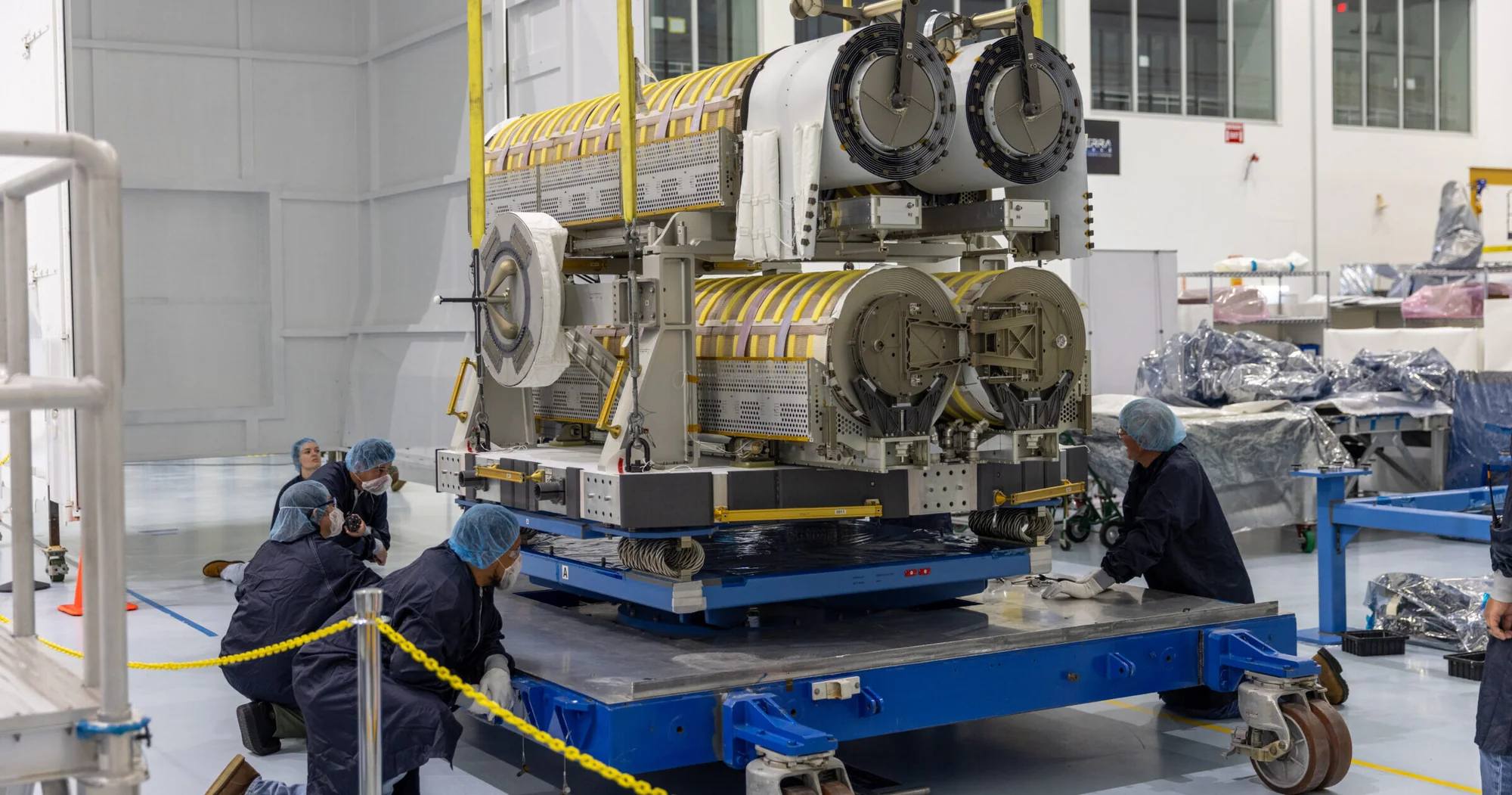
JACKSONVILLE, Fla. (October 12, 2026) – Redwire Corporation (NYSE: RDW), a leader in space infrastructure for the next generation space economy, announced today that the fourth and final pair of its Roll-Out Solar Array (ROSA) wings for the International Space Station will be launching to the station onboard NASA’s SpaceX 35th cargo resupply services mission (SpaceX CRS-35). Since 2021, a total of six Redwire-built ROSA wings have been deployed on the space station, modernizing its power supply to support critical astronautic and research operations.

Each ROSA wing provides 20+ kW of power for over 10 years once deployed, and all eight ROSA wings combined will provide more than 160 kW. Since installation on the station, the six currently deployed wings have contributed toward extended operation of the orbiting lab to 2030.

“We are very proud at Redwire to power the present and future of the International Space, Station which continues to serve as the pinnacle of global human spaceflight,” said Mike Gold, President of Redwire Space. “The ROSA program demonstrates the extraordinary benefits of public-private partnerships to create new technologies that not only enable flagship NASA missions, but have transitioned to support a wide variety of commercial programs. We’re grateful to our customer, Boeing, for their support of Redwire and the development of the innovative ROSA technology, which can now be used for future commercial space stations as well as providing power on the surface of the Moon, Mars, and beyond.”

Leveraging its initial experience on the space station, Redwire has continued to advance ROSA technology to provide robust and reliable power to numerous spaceflight platforms and ambitious missions including NASA’s Double Asteroid Redirection Test and supporting commercial geotelecommunications satellites. Moreover, Redwire has built the most powerful ROSA wings in its history to help power the historic SR-1 Freedom Mission to Mars. In addition to ROSA, Redwire has also developed the Extensible Low-Profile Solar Array (ELSA) for a variety of satellite missions. With more than 65 solar array wings delivered or in development, Redwire will power the future of civil, commercial, and national security missions in space.

About Redwire

Redwire Corporation (NYSE: RDW) is an integrated space and defense tech company focused on advanced technologies. We are building the future of aerospace infrastructure, autonomous systems, and multi-domain operations leveraging digital engineering and AI automation. Redwire’s approximately 1,400 employees located throughout North America and Europe are committed to delivering innovative space and airborne platforms transforming the future of multi-domain operations. For more information, please visit RDW.com.

Media Contact:  

Tere Riley

[email protected]

OR

Investors: 

[email protected]

Class (B2B/B2C)
B2B
Ingest Status
Rewritten
Dedupe hash
1898a255d7be035820af36af1f59d5c2
Press Eligible
Yes
Press Eligible Reason
Manuelle Prüfung nötig. Risiko: MEDIUM. Flags: ['numbers']. Stichprobe: False
Source Name
Redwire Corporation
Image URL
https://rdw.com/wp-content/uploads/2026/10/cropped-KSC-20260811-PH-RCR01_0191orig.jpg
Source Node
Content Hash (SHA-256, erste 32 hex)
912ab4f343440dab62f18fd6b90cd01e
Garmin International, Inc. News
Image File
Original HTML

The ultimate smartwatch

Our most advanced golf smartwatch

Premium cycling computer with hands-free voice control

Powerful smart trainer with multidirectional motion

The ultimate smartwatch

Ultraperformance GPS smartwatch

Simplify your drive with new ultrawide displays

See real-time digital flag signals in the cockpit

Racing radar for high-performance drivers and track enthusiasts

Advanced marine head units

Our clearest sonar ever

Integrated flight displays for experimental and certified piston aircraft

Ultimate aviator smartwatch with satellite and LTE connectivity

Class (B2B/B2C)
Ignore
Ingest Status
Rejected
Dedupe hash
006e35e02ed92117f4645dfacdaa8b0e
Press Eligible
No
Press Eligible Reason
Text too short (78 words. Min: 150)
Source Name
Garmin International, Inc.
Image URL
https://res.garmin.com/en/products/BUNDLE-CAT2-X2RLCLUB/v/cf-lg.jpg
Content Hash (SHA-256, erste 32 hex)
255d2b33a1ed7c088fa4f69c9f84807b