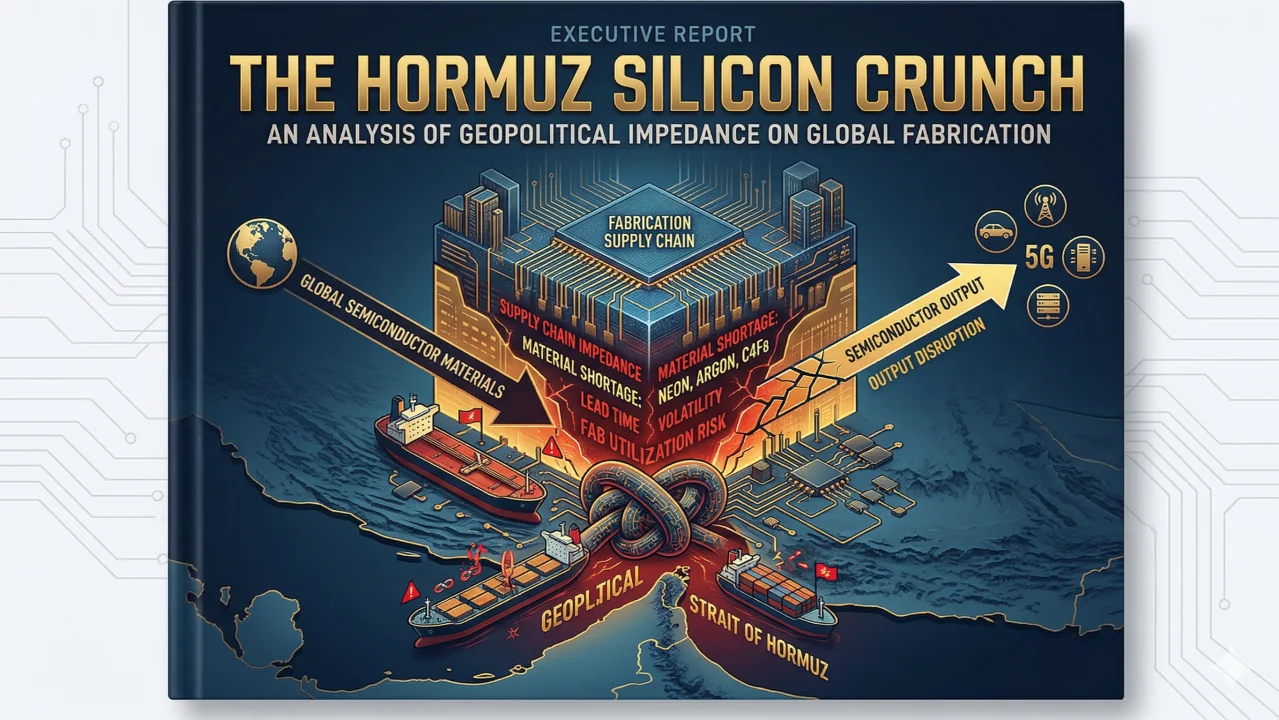
The Hormuz Crisis Isn’t Just an Oil Story, It’s a Semiconductor Materials Crisis Most People Aren’t Tracking Yet
The materials nobody is talking about
Helium — The silent backbone of chip fabrication
This isn’t about party balloons. Inside a semiconductor fab, helium performs three functions that no other gas can replicate:
• It cools wafers during ion implantation, where temperatures would otherwise distort the silicon substrate.
• It serves as a carrier gas in chemical vapour deposition (CVD), transporting reactive gases across wafers with a precision that nitrogen and argon cannot match.
• It detects microscopic leaks in vacuum systems through helium mass spectrometry. Undetected leaks destroy chip yield silently.
The supply picture: Qatar produced roughly one-third of the world’s helium, extracted as a byproduct of LNG processing at the Ras Laffan Industrial City. That facility took direct hits from Iranian strikes. QatarEnergy declared force majeure. Repairs are estimated at three to five years.
Spot helium prices have doubled. Roughly 200 specialised cryogenic containers are stranded near the Strait. These containers keep helium liquid for only 35 to 48 days before it warms and escapes. The clock is ticking — and for Asian fabs, the last scheduled shipments are arriving now. After that, the pipeline is empty.
Bromine — The photoresist ingredient you’ve never heard of
Bromine is used in photoresist chemistry for circuit pattern formation on wafers. It is not optional. When your photoresist chemistry chain breaks, your lithography line doesn’t slow down. It stops.
The supply picture: Israel and Jordan together supply roughly two-thirds of global bromine production. Israel is a direct party to the current conflict. South Korea sources 90% of its bromine imports from Israel. This is a single point of failure that did not appear on most supply chain risk assessments until five weeks ago.
Sulphur and Sulphuric Acid — The upstream bottleneck
The Strait is a major chokepoint for Gulf sulphur exports. Sulphuric acid derived from sulphur is essential for leaching and refining critical metals used in semiconductor manufacturing and battery production. Prices were climbing before February. The Hormuz closure adds a structural supply risk on top of what was already a pricing problem.
Aluminium — Packaging, frames, and the 18-month qualification trap
The Middle East accounts for roughly 9% of global aluminium smelting capacity. Aluminium goes into lead frames, IC packaging, server chassis, and heat exchangers. European and Japanese manufacturers are panic-buying and drawing down inventories.
Here is the part that semiconductor professionals will recognise immediately: automotive manufacturers report that qualifying new aluminium suppliers takes up to 18 months. The same qualification timeline applies to semiconductor packaging materials. You cannot simply switch suppliers overnight when material specifications are measured in parts per billion.
LNG — The power behind the fabs
Not a direct fab material, but LNG powers the energy grids that power the fabs. Twenty percent of global LNG trade moves through Hormuz. Taiwan and South Korea — where most of the world’s advanced chips are manufactured — are heavily exposed. An unreliable grid means unreliable fabs.
Monoethylene Glycol (MEG) — The packaging chain disruptor
A key input for polyester fibres and packaging materials. Around 6.5 million tonnes were shipped from the Gulf in 2025 alone. China is the largest consumer. Shortages are already rippling into the packaging materials used across the electronics supply chain.
Who supplies what — and where the concentration risk sits
The uncomfortable truth: the semiconductor supply chain was optimised for cost efficiency, not geopolitical resilience.
Helium: Qatar (~30% of global supply, now offline), United States (largest producer, but cannot cover the gap), Algeria (modest output), Russia (sanctioned; Amur Gas Processing Plant still running below capacity after repeated explosions and technical failures). Two of four major sources are either offline or restricted.
Bromine: Israel (dominant supplier to Asian semiconductor manufacturers). South Korea’s 90% import dependence on Israeli bromine is a textbook single-point-of-failure.
Helium distribution: Linde, Air Liquide, and Iwatani are the major intermediaries. All three are now being forced to rework their logistics, contract structures, and equipment deployment. Even if Hormuz reopens tomorrow, unwinding those emergency arrangements could take months.
Overall GCC dependency: For specialty chemicals, petrochemical feedstocks, and process gases, the Gulf Cooperation Council countries collectively represent a supply concentration that makes “diversified supply chain” sound like a marketing slogan rather than an operational reality.
Who gets hurt
South Korea imported 64.7% of its helium from Qatar in 2025. Samsung and SK Hynix are directly exposed. SK Hynix has stated they have diversified and secured inventory, but industry analysts estimate that buffer is measured in weeks, not months. South Korea’s Ministry of Trade has launched an investigation into supply and demand for 14 semiconductor materials with high Middle Eastern dependence.
Taiwan relies on Qatari helium for its foundry operations. TSMC says no near-term impact, but their CoWoS advanced packaging capacity was already sold out through mid-2026 before this crisis began. Any upstream helium constraint adds pressure to an already oversubscribed pipeline.
Any fab running EUV lithography is helium-dependent. Helium cools the extreme heat generated by EUV machines. There is currently no viable substitute at the required purity and scale. As chip geometries shrink and EUV adoption grows, per-wafer helium consumption is actually increasing.
HDD manufacturers using helium-sealed drives are also exposed. Western Digital has already sold out through 2026 with prices up 46% since September 2025. A helium shortage on top of that existing demand crunch compounds at both the production and pricing level.
What are the alternatives — and how realistic are they
Let me be straightforward about what “diversification” actually looks like in practice versus in a strategy deck.
Alternative helium sources
The United States is the world’s largest helium exporter, but it cannot compensate for a 30% global supply loss. The Federal Helium Reserve was wound down starting in 2023. New exploration projects exist — Pulsar Helium in Minnesota, Helium One in Tanzania, projects in Saskatchewan and South Africa — but these are early-stage. Production-scale output is years away, not months.
Russia’s Amur Gas Processing Plant was designed to supply up to 25% of global demand. As of 2026, it is still running well below capacity. Western sanctions further limit its commercial viability.
Algeria produces helium, but its output is modest relative to the gap that needs filling.
Substitute gases
Recommended by LinkedIn
Hydrogen and neon are being explored for select applications. But helium’s unique combination of inertness, thermal conductivity, and atomic size makes it irreplaceable for EUV cooling and helium mass spectrometry leak detection.
And the neon supply chain has its own vulnerability. Before Russia’s invasion of Ukraine, roughly half of the world’s semiconductor-grade neon came from two Ukrainian companies in Odessa and Mariupol. The industry already learned this lesson once. Replacing one geopolitically concentrated input with another is not diversification.
Helium recycling
Closed-loop helium recovery systems exist, and some fabs are implementing them. But the technology is not yet efficient enough to close the supply gap at the scale that modern high-volume manufacturing demands. Capital investment, installation, and qualification timelines apply.
Alternative shipping routes
Rerouting around the Cape of Good Hope adds approximately 3,500 nautical miles, roughly $1 million in additional fuel costs per voyage, and 10 to 14 days of transit time.
For cryogenic helium with a 35-to-48-day shelf life, those extra days are not just a cost problem. They are a physics problem. You could load a container on the US Gulf Coast and watch it begin evaporating before it reaches Hsinchu.
The real bottleneck nobody outside a fab understands: qualification
Here is where the conversation needs to go deeper than most supply chain analyses are willing to go.
Even if you find an alternative helium supplier tomorrow, you cannot plug it into a running fab tomorrow. Every new material source — every gas, every chemical, every substrate — must go through a formal qualification process before it touches a production wafer. This is where fabs face a painful tradeoff: qualification takes time, but the crisis does not wait.
In semiconductor manufacturing, qualification exists because a seemingly identical material from a different supplier can behave differently at the atomic level. Trace impurities measured in parts per billion can shift etch rates, alter film stress, or introduce defects that only show up weeks later in device reliability testing. The industry learned this the hard way, repeatedly.
So what are the realistic paths to faster qualification during a crisis like this?
1. Accelerated qualification with rigorous inline data
The standard approach relies heavily on end-of-line electrical testing — you run production with the new material and wait to see if finished devices pass. This is slow. It can take weeks or months depending on the product cycle.
The faster path: design a thorough inline data collection plan that validates the material’s behaviour at each critical process step, not just at the end. Monitor film thickness, particle counts, etch uniformity, deposition rates, and defect density in real time.