Unknown Threat Actor Uses AI-Driven ARTEX to Target South Korean Finance
Image File
Original HTML

CrowdStrike Intelligence identified infrastructure associated with a targeted campaign against South Korean financial organizations that resulted in exfiltrated data. The campaign was active from late September to early October 2026. Analysis of threat actor-controlled open directories uncovered Claude Code session histories, ARTEX configuration files, and Claude memory files, providing direct insight into the threat actor's operational methodology and tooling.

The use of agentic AI tooling alongside traditional offensive capabilities highlights the continued evolution CrowdStrike has observed in adversarial tradecraft. In this activity, the threat actor leveraged ARTEX, a recently released open-source agentic penetration testing (pentesting) tool developed in China, alongside large language models (LLMs). CrowdStrike’s intelligence collection capabilities enable close monitoring of such developments in adversarial tradecraft.

While this activity has not been attributed to a named adversary, the threat actor is likely a Chinese speaker and financially motivated. This assessment is made with moderate confidence based on the use of the Chinese-developed tool ARTEX and observed Chinese-language prompts.

Details

According to industry reports,1 beginning in late September 2026, several South Korean financial organizations experienced data breaches. At one affected bank, the threat actor reportedly breached a loan progress inquiry service used by financial brokers. At another bank, the threat actor compromised an employee mobile work–support system. As of this writing, the number of organizations affected remains unconfirmed.

Activity at multiple organizations purportedly involved overlapping IP addresses. Reporting also suggested the attacker used ARTEX based on references to the string ARTEX in HTML files observed on a reportedly threat actor-controlled server.

ARTEX Infrastructure Analysis

The IP address 38.244.50[.]120 was associated with the activity described and hosted an ARTEX instance and open directory containing a Claude Code markdown document at http[:]//38.244.50[.]120:18899/.claude/CLAUDE.md. The markdown document contained a Chinese-language pentesting prompt that specified how the LLM should conduct pentesting activities. A threat actor-controlled Hong Kong–based IP address also appeared in the document. 

Analysis of the Hong Kong-based IP address identified additional open directories that contained Claude Code session histories, ARTEX configuration files, and Claude memory files. These files indicate that from late September 2026 to early October 2026, the threat actor targeted South Korean financial organizations with extensive activity leveraging ARTEX and LLMs. Targeted organizations overlap with those identified in industry reporting.

The Claude Code sessions reveal a two-server architecture: The Hong Kong-based IP address serves as the primary attacker-controlled infrastructure, and the IP address 38.244.50[.]120 hosts the ARTEX instance likely responsible for the described Korean attacks. The ARTEX instance used DeepSeek v4.1-flash as the primary LLM backend, and the threat actor supplemented this LLM with GLM-5.3 (Zhipu AI) and Grok 4.6 for additional Claude Code sessions. The threat actor likely accessed DeepSeek via the likely LLM API proxy/reseller xcai[.]pro.

Analysis of Claude Code sessions showed the threat actor also used the following proxy IP addresses during the ARTEX-related activity:

- 101.53.80[.]20

- 205.214.59[.]31

- 124.155.252[.]63

- 154.201.79[.]246

- 23.248.249[.]90

- 23.158.220[.]98

- 103.248.148[.]84

- 203.160.133[.]172

- 209.209.85[.]38

In addition to conducting ARTEX-related operations, the threat actor asked Claude where threat actors typically sell Korean data breach information and asked Claude for assistance in finding Korean Telegram data sales groups.

Possible Threat Actor Details

In one Claude Code session, the user asked Claude to create a security researcher résumé that specifically included bullet points conveying the results of the ARTEX-related activity. The prompt included the following personal details:

- Name: YY

- Phone: 17820191556

- Telegram: @YY520CN

- Age: 26 (though the attacker initially provided the date of birth 2007-09-22)

- Education: South China University of Technology

- Location: Maoming, Guangdong, China

Claude Code sessions conducting vulnerability research on a Telegram-based NFT gift marketplace also used the Telegram username YY520CN. An unknown threat actor also employed this username to target a possible Chinese payment platform. While the personal details included in the prompt likely belong to the threat actor who conducted the ARTEX-related activity, currently available information cannot definitively associate these details with the threat actor.

Assessment

The use of agentic AI tooling alongside traditional offensive capabilities highlights the continued evolution observed by CrowdStrike in adversarial tradecraft. This activity demonstrates how AI tooling can enable a financially motivated threat actor to conduct multiple intrusions within a short time span. CrowdStrike Intelligence assesses that adversaries will likely continue to experiment with implementing AI tooling in their operations to enhance their operational tempo and capabilities.

IOCs

This table details the IOCs related to the information provided in this report.

MITRE ATT&CK

This table details the tactics and techniques described in this report.

1 https[:]//www.khan[.]co[.]kr/en/article/202610042320007

Class (B2B/B2C)
B2B
Ingest Status
Rewritten
Dedupe hash
385b45a2a54d897a42622dc25ce5442f
Press Eligible
Yes
Press Eligible Reason
Cybersecurity threat intelligence report on AI-assisted attacks targeting financial organizations.
Source Name
CrowdStrike Newsroom
Image URL
https://assets.crowdstrike.com/is/image/crowdstrikeinc/WebShareDefaultImage
Source Node
Content Hash (SHA-256, erste 32 hex)
8a8e1a955b7eb0bd526ba333ee6b71a9
CrowdStrike and Anthropic Give Critical Infrastructure Defenders the AI Advantage
Image File
Original HTML

Critical infrastructure is where cyber risk becomes real-world risk. The environments powering energy, water, manufacturing, and transportation are among the most complex to defend as they often combine decades-old operational technology (OT) with modern IT. Downtime is not an option, and patching isn’t always possible.

Now, AI is raising the stakes. Adversaries are using AI to move faster and operate at greater scale, compressing the time defenders have to respond to attacks. Critical infrastructure facing machine-speed threats requires machine-speed defense.

That’s why CrowdStrike is joining Anthropic’s Critical Infrastructure Defense Program.

The program brings together cybersecurity and critical infrastructure leaders with Anthropic’s technical guidance and frontier research to strengthen and defend critical infrastructure. It creates a forum to share defensive practices, inform research, and put frontier AI expertise behind the organizations already protecting these environments.

CrowdStrike brings a uniquely powerful foundation to this program: the scale and power of the CrowdStrike Falcon® platform, rich security data across IT and OT, industry-leading threat intelligence, and deep cyber expertise. Together, these provide unmatched context into how adversaries operate and how defenders stop them. Combined with Anthropic’s frontier AI expertise, we can put a greater advantage in the hands of critical infrastructure defenders.

Protecting the Systems Powering the World

CrowdStrike has spent years extending the Falcon platform beyond the endpoint to protect the operational environments that keep businesses and critical infrastructure running.

CrowdStrike Falcon® for XIoT, delivered from the Falcon platform, gives organizations visibility and protection across IT, OT, and connected assets. Defenders can discover unmanaged and legacy assets, understand vulnerabilities and exposure without disruptive scanning, detect threats crossing between IT and OT, and respond with the context of the broader enterprise.

The Falcon platform brings endpoint, identity, cloud, threat intelligence, and OT security together to give defenders the visibility and context they need to stop threats wherever they operate. This gives CrowdStrike a powerful foundation for the AI era: deep security context across the environments that defenders are responsible for protecting.

Bringing the Best of AI to the Defender

Organizations aren’t betting their future on a single model, cloud, or application. They want the best technology for their business and the freedom to choose it. The same approach must apply to cybersecurity.

That’s why CrowdStrike is building an open AI ecosystem around the Falcon platform. Our work with Anthropic is one example. Claude is available within CrowdStrike® Charlotte AI™, where it brings Anthropic’s frontier AI capabilities together with CrowdStrike’s deep security context and expertise.

The Critical Infrastructure Defense Program extends that relationship into one of cybersecurity’s highest-stakes environments. Through this program, CrowdStrike will have access to Anthropic’s technical guidance, frontier cybersecurity research, and a community of leaders who are focused on critical infrastructure and creating new opportunities to share what works and accelerate defensive innovation.

AI is moving too quickly for security innovation to happen in silos. No single company will secure the AI era alone. Winning requires bringing the best of AI and cybersecurity together, and putting that advantage in the hands of defenders.

Learn more about Anthropic’s Critical Infrastructure Defense Program.

Class (B2B/B2C)
B2B
Ingest Status
Rewritten
Dedupe hash
1db6b77ea2bca31805a9d0861a011c95
Press Eligible
Yes
Press Eligible Reason
Cybersecurity partnership and AI defense program for critical infrastructure organizations.
Source Name
CrowdStrike Newsroom
Image URL
https://assets.crowdstrike.com/is/image/crowdstrikeinc/WebShareDefaultImage
Source Node
Content Hash (SHA-256, erste 32 hex)
390e174b7bfc4d18781ee57c3ef4e493
Solving the Continuous Authorization Conundrum
Image File
Original HTML

Zero Trust continues to present an often-overlooked challenge: keeping access decisions accurate as the real-world conditions behind them change.

Over the past decade, AI, cloud transformation, mobile access, and remote work have challenged existing security paradigms at a fundamental level. Organizations have realized they must move from a “walled garden” security model, in which all computers inside a firewall or accessing via VPN are assumed to be trusted, to a Zero Trust model in which every access is independently evaluated.

In the Zero Trust model, security is predicated on an accurate evaluation of what should be permitted within every access request. Initially, it was considered sufficient for enterprise services to evaluate the validity of a session cookie, or access token, associated with each web and API request.

However, this approach has left a few gaps:

- What if an organization wants to instantaneously revoke all access granted to a person or agent due to an urgent event (such as an employee getting terminated, or rogue agent activity)?

- What happens if the factors that went into the decision to issue the access token or cookie in the first place change dynamically while the token or cookie hasn’t expired?

- What happens if the scope of access represented by the token or cookie changes after the token was issued?

To take care of this, organizations often consider two strategies:

- Keep the token short-lived

- Re-validate the token at every request

Neither strategy is ideal. If a token is used, say, a thousand times on average (an extremely conservative estimate for a 24-hour token), then the “re-validate at every access” strategy places a 1000x burden on the issuing system (typically the identity provider, or IdP). This approach is usually considered technically unviable.

The “short-lived token,” on the other hand, places only a roughly 24x burden (assuming one goes to a token that lives for an hour instead of 24 hours), depending on how short-lived the token is. But the short-lived token severely degrades user experience, even if all the user must do is redirect to the IdP and back when the token expires.

Then how can one react based on changes that affect access properties while the access token is still valid?

The Continuous Authorization Conundrum

Let’s take a look at how a system determines whether a token is valid or not. It needs to evaluate multiple factors, such as:

- Is the user or agent account represented by the token valid?

- Is the access still from a device that has no security incidents associated with it?

- Is the accessing device still compliant with device management policies?

- Have the user’s or agent’s tasks changed such that they no longer need the same scope of access offered by the token?

- Has the user gone on leave? Have they gone off duty? Has the agent been terminated?

If we do not want to call the IdP for every access, then we need to evaluate this information at the service the user is accessing, at the time of access, and within milliseconds, so the user doesn’t find a degraded experience.

The problem is, all of this data is located in different places. The user’s account information is in a directory at the identity provider or on-premises. The device security incidents are known to the extended detection and response (XDR) system. The device compliance data is with the MDM. The task information is in a task tracking system such as ServiceNow or Jira. The leave information is in the HR system. The on-duty schedule is in a scheduling system such as PagerDuty.

This brings us to the continuous authorization conundrum:

Solving the Conundrum

While evaluating all needed information in real time at the time of access would seem like a virtually impossible task, a well-established pattern can make it possible. The resulting architecture is arguably more robust and secure than before. In practice, this evaluation happens at a policy enforcement point, which can be externalized from the application, rather than the application code itself.

The solution principles are to:

- Asynchronously and reliably deliver any changes in data required to make access decisions to the system that requires them.

- Evaluate every access request based on the data that is locally available.

A challenge in implementing this architecture is that every system that holds such data could belong to a different provider, and updating each party’s data asynchronously at every other party that requires it will be extremely challenging.

Standards to the Rescue

This is where open standards come into play. The OpenID Foundation has, over a span of 6+ years, developed the Shared Signals Framework (SSF). SSF provides a reliable, asynchronous mechanism to deliver discrete packets of information called Security Event Tokens (SETs). SETs are a standard developed by the IETF. The reliable delivery is important here because SSF transmitters and receivers both know which events have been correctly transmitted to which receiver. SETs are JWTs signed by SSF transmitters and are verified by SSF receivers. Because signals are delivered asynchronously, propagation is near real time rather than instantaneous.

Based on SSF, the Continuous Access Evaluation Profile (CAEP) has defined events that communicate changes required to modulate access in real time. These include:

- Session revoked

- Device compliance change

- Credential change

- Risk level change

There are other profiles based on SSF, such as Risk Incident Sharing and Coordination (RISC), used for communicating account security events, and SCIM Events (used for communicating account changes).

Systems implementing SSF exchange these events so the required data is available to any trusted party that needs it to make near real time access decisions. This is an essential component of implementing a true Zero Trust architecture.

Adoption

SSF and CAEP are being widely adopted across the industry. Popular technology providers such as Apple, CrowdStrike, Google, IBM, Jamf, Okta, SailPoint, Zscaler, and others have all implemented these standards in their products.

Recently, CrowdStrike and Zscaler demonstrated Zero Trust access based on SSF and CAEP, where access to cloud services through Zscaler is determined in near real time by CAEP events based on device incidents detected by CrowdStrike. Read the blog post (which also includes a video demo) here.

The same shared-signals foundation applies as AI agents take on privileged tasks: their access must also react to changing conditions in real time.

Ask your security and identity vendors, SaaS providers, cloud providers, and MSPs about SSF and CAEP support, and how they participate in the signals ecosystem.

Class (B2B/B2C)
B2B
Ingest Status
Rewritten
Dedupe hash
e253d39f43020199025dbfe2dafa08fa
Press Eligible
Yes
Press Eligible Reason
Explains enterprise Zero Trust authorization standards and adoption across security and identity platforms.
Source Name
CrowdStrike Newsroom
Image URL
https://assets.crowdstrike.com/is/image/crowdstrikeinc/WebShareDefaultImage
Source Node
Content Hash (SHA-256, erste 32 hex)
629b1a76999a8f39c5113cb1a02cb966
Fuxing Island showcases Shanghai's innovation drive at IBLAC side event
Image File
Original HTML

Fuxing Island showcases Shanghai's innovation drive at IBLAC side event

SHANGHAI, Oct. 11, 2026 /PRNewswire/ -- A news report from english.shanghai.gov.cn

The side event of the 38th International Business Leaders' Advisory Council for the Mayor of Shanghai (IBLAC) meeting, themed "Innovation Meets in Yangpu, A New Chapter Begins for Fuxing Island", was held on Shanghai's Fuxing Island on Oct 10.

About 100 guests from around the world attended, touring development projects on the island and learning about the innovative achievements of Chinese companies in fields including artificial intelligence, manufacturing, culture, and entertainment.

Jurgen Tinggren, chairman of Bekaert, highlighted new digital capabilities, developments in robotics, and the craftsmanship of new brands.

"I think Shanghai is nearly an exemplary city," Tinggren said. He also praised the willingness of its people to learn about developments elsewhere and find ways to connect.

Several foreign business leaders and executives said they were deeply impressed by Fuxing Island's development. Among them was Stefan Borgas, chief executive officer of RHI Magnesita, who first visited the island in 1991 and was struck by how much it had changed.

Borgas described Shanghai as "one of the best places to innovate," citing the curiosity of its people, substantial funding, infrastructure, and cooperation among companies.

Arnd Franz, chief executive officer of MAHLE GmbH, said affordable technology would have a transformative impact on economic growth worldwide and that working with China and in China would be important for global innovation and growth.

Franz said he was interested in the automotive sector, particularly growth opportunities for companies capable of scaling up manufacturing.

The guests also looked ahead to the meeting on Oct 11, expressing expectations for in-depth discussions on service-sector innovation and the development of international companies in Shanghai.

IBLAC was founded in 1989, when 12 members from eight countries attended its inaugural meeting, providing suggestions for Shanghai's development. It has since served as an advisory body of global business leaders for the city's development. One of its early contributions came in 1991 with the development of the Yangshan Deep-Water Port.

IBLAC has now expanded to 42 members, along with 11 honorary members.

Click the link below to read the original article:

https://english.shanghai.gov.cn/en-IBLACShanghai2026/20261011/a398006652f14644b5eac6e8ac928e53.html

SOURCE english.shanghai.gov.cn

Share this article

Class (B2B/B2C)
B2B
Ingest Status
Need Review
Dedupe hash
prn_302905407
Press Eligible
Yes
Press Eligible Reason
QA FAIL (need review): TARGET asserts the Oct. 11 IBLAC meeting will focus on service-sector innovation, but SOURCE only states guests expressed expectations for in-depth discussions on that topic; the meeting's agenda/focus is not explicitly stated.
Source Name
Unknown Company
Original Summary

<p>SHANGHAI, Oct. 11, 2026 /PRNewswire/ -- A news report from english.shanghai.gov.cn The side event of the 38th International Business Leaders' Advisory Council for the Mayor of Shanghai (IBLAC) meeting, themed "Innovation Meets in Yangpu, A New Chapter Begins for Fuxing Island", was held...</p>

Image URL
https://mmx.prnewswire.com/media/MS2011003/20261011224619EDT_image_1.jpg?id=OA3012137&p=facebook
Generated Article_json
{"target_audience": "b2b", "is_medical": false, "ai_generated_title": "Global CEOs Tour Shanghai's Fuxing Island at IBLAC Side Event", "body_html": "<p><strong>Shanghai -- [CURRENT_DATE] --</strong> About 100 guests from around the world toured Fuxing Island on Oct. 10 at a side event of the 38th International Business Leaders' Advisory Council for the Mayor of Shanghai (IBLAC) meeting, viewing development projects and Chinese company innovations in artificial intelligence, manufacturing, culture and entertainment.</p><h5>Executives from Bekaert, RHI Magnesita and MAHLE praise Shanghai's innovation base</h5><p>Jurgen Tinggren, chairman of Bekaert, pointed to new digital capabilities, developments in robotics and the craftsmanship of new brands. He also credited the willingness of Shanghai's people to learn about developments elsewhere and find ways to connect.</p><p>Stefan Borgas, chief executive officer of RHI Magnesita, first visited the island in 1991 and said he was struck by how much it had changed. He called Shanghai one of the best places to innovate, citing the curiosity of its people, substantial funding, infrastructure and cooperation among companies.</p><h5>MAHLE chief Arnd Franz targets automotive scale-up opportunities in China</h5><p>Arnd Franz, chief executive officer of MAHLE GmbH, said affordable technology would have a transformative impact on economic growth worldwide. Working with China and in China, he said, would be important for global innovation and growth.</p><p>Franz said he was interested in the automotive sector, particularly growth opportunities for companies able to scale up manufacturing.</p><h5>IBLAC's main meeting on Oct. 11 to focus on service-sector innovation</h5><p>Guests expressed expectations for in-depth discussions at the Oct. 11 meeting on service-sector innovation and the development of international companies in Shanghai.</p><p>IBLAC was founded in 1989, when 12 members from eight countries attended its inaugural meeting. One of its early contributions came in 1991 with the development of the Yangshan Deep-Water Port. The council has since expanded to 42 members, along with 11 honorary members.</p>", "meta_description": "About 100 global guests toured Shanghai's Fuxing Island at an IBLAC side event, with Bekaert, RHI Magnesita and MAHLE chiefs backing China-based innovation.", "seo_keywords": "IBLAC, Shanghai, Fuxing Island, Yangpu, Bekaert, RHI Magnesita, MAHLE, innovation, automotive manufacturing, foreign investment", "companies": ["Bekaert", "RHI Magnesita", "MAHLE GmbH"], "industries": ["General Industry"], "markets_regions": ["China"], "news_type": ["event_coverage"], "products": [], "themes": ["innovation", "foreign_investment", "manufacturing"], "events": ["38th IBLAC Meeting"], "cta_text": "Read the original Shanghai government report on the IBLAC side event at Fuxing Island", "learn_more": "https://english.shanghai.gov.cn/en-IBLACShanghai2026/20261011/a398006652f14644b5eac6e8ac928e53.html", "fact_check": {"accuracy_score": 100, "legal_risk": "low", "corrections_made": [], "recommendation": "publish"}}
Content Hash (SHA-256, erste 32 hex)
3d7d0442330b126ec90d55e202eaa3b7
SPS 2026: Phoenix Contact to showcase smart automation solutions for the industry of the future
Image File
Original HTML

SPS 2026: Phoenix Contact to showcase smart automation solutions for the industry of the future

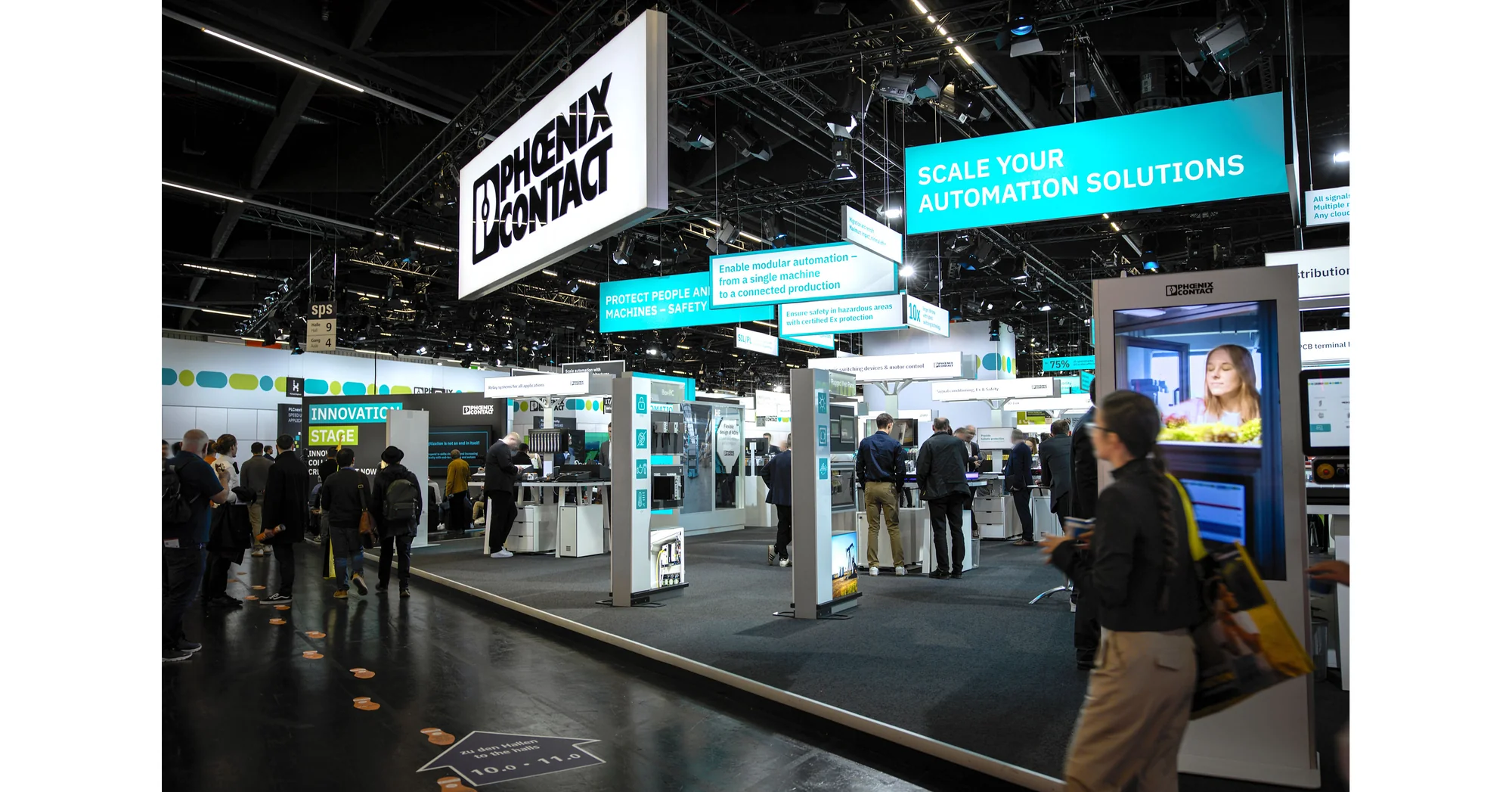
BLOMBERG, Germany, Oct. 12, 2026 /PRNewswire/ -- Phoenix Contact will be showcasing the latest technologies for a digital and future-viable industry at SPS 2026, which will take place from November 24 to November 26, 2026, in Nuremberg, Germany. The focus in Hall 9, Booth 310, will be on developments in the areas of industrial AI, PLCnext Technology, cybersecurity, and field and control cabinet automation.

The central element of the trade show booth will be a conveyor belt application. Its role is to transport water bottles on workpiece carriers so that the bottles can be filled immediately with water. The conveyor belt is automated using Phoenix Contact's entire product portfolio for control cabinet and field installations. For the field level in particular, there are numerous new products, including power supplies, device protection, and motor starters with IO-Link interfaces.

The technology section of the trade show booth will focus on the open PLCnext Technology automation platform. Virtual PLCnext Control is the ideal software-based solution for any operators wanting to decouple automation functions from the hardware. It can run on existing industrial PCs, edge devices, and server infrastructure. Security routers provide comprehensive protection for machines and systems in accordance with the CRA and the Machinery Regulation. In addition, all products will be made available in a CRA-ready format by the deadline. Industrial AI is integrated throughout the entire value chain – from planning and commissioning using the PLCnext Engineer engineering tool, through operation with the MLnext software package, and maintenance with diagnostic capabilities via the MCP interface.

Furthermore, Phoenix Contact is the ideal partner for control cabinet building, taking a holistic approach to the entire process and providing comprehensive support. From engineering through to final assembly, our experts provide support throughout the entire process. These solutions connect engineering, procurement, assembly, marking, wire preparation, and wiring to form a single, end-to-end process. This results in streamlined processes, optimized interfaces, and greater efficiency throughout the value chain.

Alongside the technologies on display, Phoenix Contact will be providing guided tours of its booth at SPS 2026. Participants will gain in-depth insights into selected technologies, practical applications, and future concepts. An informative stage program will highlight a range of subjects including AI, virtualization, cybersecurity (featuring a live hacking demonstration), Power Reliability, and Push-X technology. And, naturally, the experts at Phoenix Contact are looking forward to one-on-one discussions regarding the current challenges and opportunities facing the industry of tomorrow.

SOURCE Phoenix Contact

Share this article

Class (B2B/B2C)
B2B
Ingest Status
Rewritten
Dedupe hash
prn_302899747
Press Eligible
Yes
Press Eligible Reason
Corporate announcement showcasing industrial automation products and technologies for industry professionals.
Source Name
SPS 2026
Original Summary

<p>BLOMBERG, Germany, Oct. 12, 2026 /PRNewswire/ -- Phoenix Contact will be showcasing the latest technologies for a digital and future-viable industry at SPS 2026, which will take place from November 24 to November 26, 2026, in Nuremberg, Germany. The focus in Hall 9, Booth 310, will be on...</p>

Image URL
https://mmx.prnewswire.com/media/MS2003231/5896.jpg?id=OA2989659&p=facebook
Content Hash (SHA-256, erste 32 hex)
c25925e91ccf55442c53c3812e68e4a5
Hon Hai Technology Group (Foxconn)'s Kathy Yang Honored In Most Powerful Women Asia 2026 By Fortune
Image File
Original HTML

Hon Hai Technology Group (Foxconn)'s Kathy Yang Honored In Most Powerful Women Asia 2026 By Fortune

Technology sector leadership showcases Asia's formidable strength

TAIPEI, Oct. 12, 2026 /PRNewswire/ -- Reflecting responsibilities that sit at the intersection of the physical industrial world and the AI world for the largest electronics manufacturer and AI server provider on the planet, Kathy Yang of Hon Hai Technology Group (Foxconn) (TWSE:2317) has been recognized in Most Powerful Women Asia 2026 by Fortune, for a second year.

As General Manager of Global Campus Operations and Head of AI Software Business and AI Infrastructure for Foxconn, Yang joins 16 honorees from technology, the most represented sector in this year's prestigious list, ahead of banking with 14. Their presence reflects the increasingly central role technology plays in Asia's economy, as businesses spanning digital platforms, advanced manufacturing and other technology-driven industries grow in scale and influence.

"What stands out in this year's ranking is how the landscape of business power in Asia is evolving," said Charmian Choo, Asia list Senior Manager. "We see established leaders continuing to shape some of the region's largest companies, alongside a new generation rising through the ranks. The prominence of technology is particularly striking, reflecting the sector's growing influence on Asia's economy and the women increasingly at the forefront of that transformation."

"Women in leadership play an important role in the AI industrial revolution. The real challenge is not deploying technology, but redesigning work, investing in reskilling, and helping our global talent of women and men evolve with it," said Foxconn's Yang, whose remit includes Foxconn's more than 240 sites across 24 countries. "Five years from now, the best factories will not simply be the most automated, but those where humans, AI and robots make one another better."

Earlier this year, Yang was recognized among Fortune's Most Powerful Women in Business 2026. Her work combines Foxconn's global manufacturing scale, engineering capabilities and operational know-how with software, data, computing infrastructure and AI.

Yang previously served as Foxconn's Rotating CEO, the first woman to hold the role, during which she focused on strengthening enterprise-wide execution, cross-business alignment, and governance discipline across one of the world's largest and most complex industrial organizations. She is concurrently a Board Director of Foxconn Industrial Internet (FII) and Chairwoman and CEO of JUSDA, both key units of Foxconn.

About Fortune MPW Asia here.

About Foxconn here.

SOURCE Hon Hai Technology Group (Foxconn)

Share this article

Class (B2B/B2C)
B2B
Ingest Status
Rewritten
Dedupe hash
prn_302905402
Press Eligible
Yes
Press Eligible Reason
Corporate leadership recognition highlighting Foxconn’s technology and AI business.
Source Name
Unknown Company
Original Summary

<p>Technology sector leadership showcases Asia's formidable strength TAIPEI, Oct. 12, 2026 /PRNewswire/ -- Reflecting responsibilities that sit at the intersection of the physical industrial world and the AI world for the largest electronics manufacturer and AI server provider on the planet,...</p>

Image URL
https://mmx.prnewswire.com/media/MS1644921/Foxconn-Logo.jpg?id=OA3012207&p=facebook
Content Hash (SHA-256, erste 32 hex)
0c96373ec4ed3db2945e8e642623e441
TGS Enters Strategic AI Collaboration with Galdor Exploration
Image File
Original HTML

OSLO, Norway (12 October 2026) – TGS, a leading global provider of energy data and intelligence, today announced that it has entered into a framework agreement for a strategic collaboration with newly formed exploration company, Galdor Exploration AS to unlock high-value exploration opportunities on the Norwegian Continental Shelf (NCS) and the broader North Sea region through the application of advanced, integrated data solutions and artificial intelligence (“AI”).

Galdor Exploration is pursuing a modern, data-driven exploration strategy that combines advanced AI-enabled workflows with the multidisciplinary expertise of a highly experienced exploration team with an extensive track record on the Norwegian Continental Shelf and internationally. The company was formally established on 19 July 2026, coinciding symbolically with the 60th anniversary of the spudding of Norway’s first exploration well.

The strategic collaboration will give Galdor Exploration access to TGS’ industry-leading integrated data and technology solutions across the energy data value chain. TGS will also work with Galdor Exploration to implement advanced AI exploration workflows and solutions, including its proprietary Seismic Foundation Model.

“This collaboration reflects our commitment to supporting the next generation of exploration companies with the highest-quality data and cutting-edge exploration technology,” said Kristian Johansen, CEO of TGS. “By working in a different, more collaborative way with our customers, applying the full scope of our integrated solutions, we aim to accelerate value creation and deliver win-win results.”

“Galdor’s strategy is built on a conviction that the future of exploration lies in a modern exploration organization, where we combine deep exploration experience with premium subsurface data and next-generation AI-enabled workflows,” said Ørjan Gjerde, CEO and Founder of Galdor Exploration. “Our collaboration with TGS gives us access to data, technology and expertise of exceptional breadth and quality and allows us to apply advanced machine learning exploration techniques at scale. This will support Galdor’s goal to identify and mature exploration opportunities that, by using conventional approaches, may have been overlooked, underestimated or left behind.”

About TGS

TGS provides advanced data and intelligence to companies active in the energy sector. With leading-edge technology and solutions spanning the entire energy value chain, TGS offers a comprehensive range of insights to help clients make better decisions. Our broad range of products and advanced data technologies, coupled with a global, extensive and diverse energy data library, make TGS a trusted partner in supporting the exploration and production of energy resources worldwide. For further information, please visit www.tgs.com (https://www.tgs.com/).

For media inquiries, contact:

Bård Stenberg

IR & Business Intelligence

investor@tgs.com

Class (B2B/B2C)
B2B
Ingest Status
Rewritten
Dedupe hash
7d68215ad4ed6298cec61df7c177ef69
Press Eligible
Yes
Press Eligible Reason
Strategic AI and data collaboration between energy-sector companies.
Source Name
TGS ASA
Original Summary

<p style="color: #242424; background-color: #ffffff;"><strong>OSLO, Norway</strong> (12 October 2026) – TGS, a leading global provider of energy data and intelligence, today announced that it has entered into a framework agreement for a strategic collaboration with newly formed exploration company, Galdor Exploration AS to unlock high-value exploration opportunities on the Norwegian Continental Shelf (NCS) and the broader North Sea region through the application of advanced, integrated data solutions and artificial intelligence (“AI”). <br /><br />Galdor Exploration is pursuing a modern, data-driven exploration strategy that combines advanced AI-enabled workflows with the multidisciplinary expertise of a highly experienced exploration team with an extensive track record on the Norwegian Continental Shelf and internationally. The company was formally established on 19 July 2026, coinciding symbolically with the 60th anniversary of the spudding of Norway’s first exploration well. <br /><

Image URL
https://www.tgs.com/hubfs/2478981/raw_assets/public/2023-tgs-main/images/tgs-logo-2024-blue.png
Source Node
Content Hash (SHA-256, erste 32 hex)
6af2e768406151f20e95ef06d2d801c9
3iQ Receives In-Principal Approval from Abu Dhabi's IFC
Image File
Original HTML

TORONTO, Oct. 12, 2026 /PRNewswire/ -- 3iQ Corp. ("3iQ"), a global pioneer in digital asset investment solutions, is pleased to announce that its United Arab Emirates (UAE) based sister company 3iQ Middle East Ltd has secured In-Principal Approval (IPA) for a Category 4 license from the Financial Services Authority (FSRA) of ADGM, the international financial centre of Abu Dhabi, the capital of UAE. It follows the announcement of their strategic partnership with Further, the UAE-based digital asset investment manager (see announcement link here), which enables institutional investors access to digital assets via 3iQ's Managed Account Platform (QMAP) a platform that attracted $100 million sovereign-linked seed capital.

The successful granting of this IPA is part of 3iQ's aim to be regulated and present in all the major digital asset hubs globally, so that its award-winning investment management offering is accessible to accredited investors around the world. This includes the first ever Bitcoin and Ethereum ETFs listed on a major stock exchange.

3iQ's presence in the Middle East is led by Rachel Pether, Head of Middle East. Rachel joined 3iQ in 2023 and has become a prominent figure in the region. Prior to joining 3iQ, Rachel spent almost a decade at Abu Dhabi based sovereign investor Mubadala in their Capital Markets & Treasury team and was previously a senior Advisor for SkyBridge Capital.

Pascal St-Jean, CEO of 3iQ and Coincheck Group, said:

"3iQ has been a huge believer in the UAE as a key digital asset hub with an advanced regulatory regime that protects investors. As a first mover in the provision of innovative digital asset investment solutions, and along with our partnership with Further Asset Management, 3iQ looks forward to cementing a presence in the region, starting with the Abu Dhabi Global Market."

Rachel Pether, Head of Middle East at 3iQ, said:

"This is an exciting development for 3iQ and has materialised following constructive collaboration with the ADGM's proactive regulator. Ever since 2023 when we established a footprint in the UAE, 3iQ has taken steps towards becoming the leader in the region with our proven track record of attracting sovereign wealth and institutional capital to digital assets."

Arvind Ramamurthy, Chief Market Development Officer at ADGM, said:

"We congratulate 3iQ on receiving its IPA from the FSRA, an important step in its journey to establishing a regulated presence in ADGM. This milestone reflects the increasing interest from international firms in ADGM's dynamic digital asset ecosystem, underpinned by a progressive regulatory framework and a growing community of global and regional market participants. We look forward to supporting 3iQ as it progresses through the licensing process and seeks to contribute to Abu Dhabi's growing digital asset ecosystem."

About 3iQ Digital Asset Management

Founded in 2012, 3iQ is one of the world's leading alternative digital asset managers, pioneering institutional-grade investments. 3iQ launched the world's first Digital Assets Managed Account Platform (QMAP), a hedge fund investment solution, offering innovative risk-managed investment solutions to gain exposure to digital assets. 3iQ was also the first to launch a Bitcoin and Ethereum ETP listed on a major global stock exchange, integrate staking into its Ethereum and Solana ETPs boosting investor returns, and offer other regulated ETPs. 3iQ is a subsidiary of Coincheck Group N.V. (NASDAQ: CNCK), a NASDAQ-listed holding company based in the Netherlands. Since 2012, 3iQ has been at the forefront of innovation in digital asset investment management. To learn more about 3iQ, visit 3iq.io

W: https://www.3iq.io/

L: https://www.linkedin.com/company/3iq-corp/

X: https://x.com/3iq_corp

Disclaimer

This release is for informational purposes only and does not constitute investment advice or a recommendation, solicitation, or offer to buy or sell any securities, strategies, products, or services described herein. Investment in digital assets is subject to a high degree of risk, including the potential loss of the entire amount invested. 3iQ, nor any of their affiliates, directors, officers, or employees accept any liability for any loss or damage arising directly or indirectly from the use of or reliance on this release or the information contained herein. Readers should conduct their own research and consult with their own professional advisors before making any investment decisions. This release may contain forward-looking statements that involve risks and uncertainties; actual results may differ materially from those anticipated.

SOURCE 3iQ

Share this article

Class (B2B/B2C)
B2B
Ingest Status
Rewritten
Dedupe hash
prn_302903767
Press Eligible
Yes
Press Eligible Reason
Digital asset investment firm announces regulatory approval to expand its institutional business in Abu Dhabi.
Source Name
Unknown Company
Original Summary

<p>TORONTO, Oct. 12, 2026 /PRNewswire/ -- 3iQ Corp. ("3iQ"), a global pioneer in digital asset investment solutions, is pleased to announce that its United Arab Emirates (UAE) based sister company 3iQ Middle East Ltd has secured In-Principal Approval (IPA) for a Category 4 license from the...</p>

Image URL
https://cdn.prod.website-files.com/67166f7faf886e483962354e/6722d680aa50560b1e9993fb_Capture%20d%E2%80%99e%CC%81cran%2C%20le%202024-10-30%20a%CC%80%2020.59.27.avif
Content Hash (SHA-256, erste 32 hex)
c960beed2c2b2961a421e5460412d20c
New Data Reveals Where U.S. Investors Are Using AI the Most
Image File
Original HTML

New Data Reveals Where U.S. Investors Are Using AI the Most

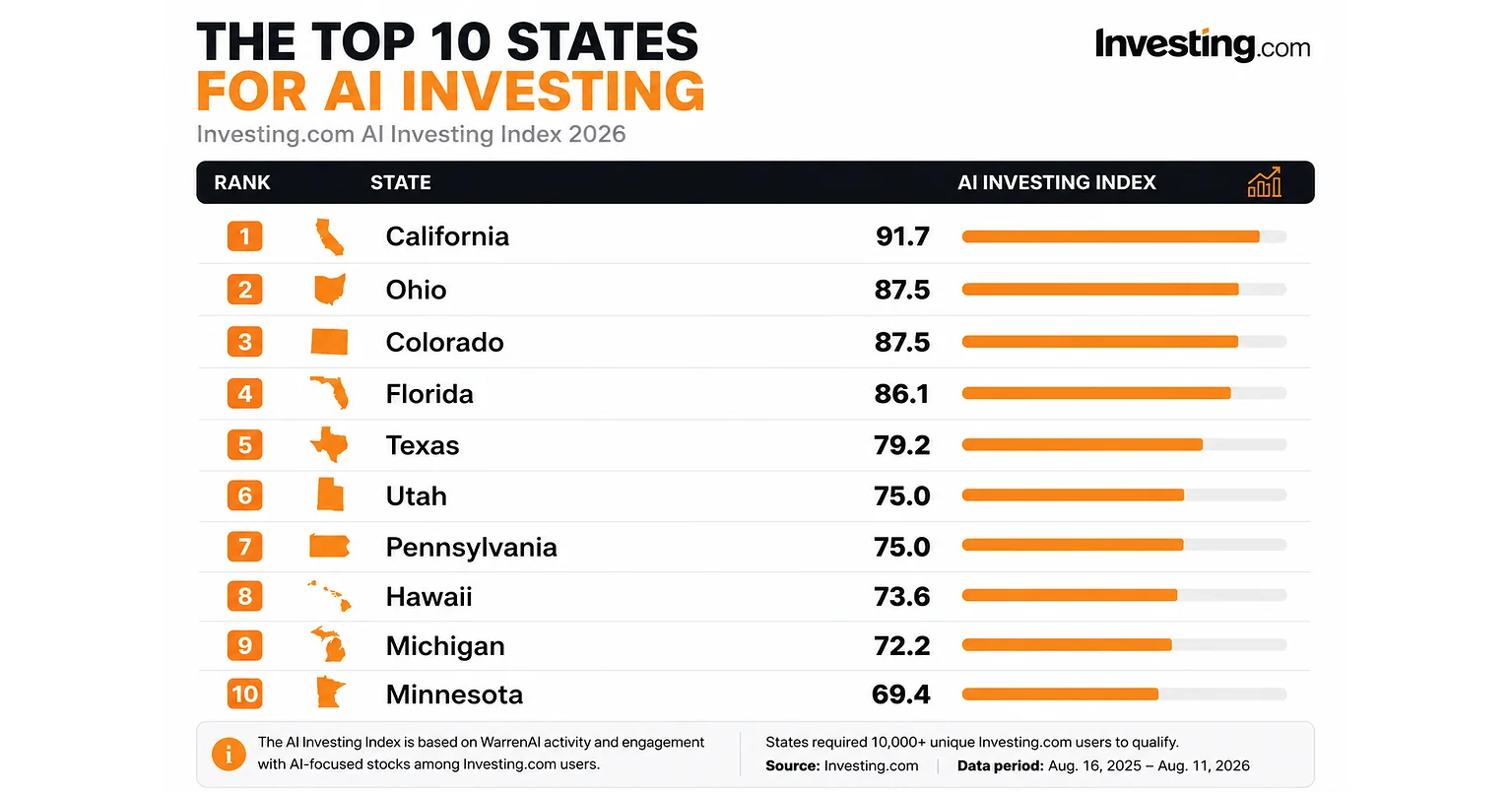
California ranks first, followed by Ohio, Colorado, Florida and Texas in Investing.com analysis of 12 months of investor activity

NEW YORK, Oct. 12, 2026 /PRNewswire/ -- California leads the nation in a new analysis of where investors are using AI to inform investment decisions, but some of the strongest activity is taking place far beyond Silicon Valley and Wall Street. Ohio and Colorado tie for second in the nationwide ranking, with Florida and Texas rounding out the top five. New York, meanwhile, fails to crack the top 10.

The new Investing.com AI Investing Index analyzed 12 months of user activity across the U.S., looking at both the use of AI for investment research and investor engagement with AI-focused stocks, adjusted for audience size in each state.

Key findings:

- California ranks #1 overall, putting the home of Silicon Valley at the top of the AI investing map.

- Ohio and Colorado tie for #2, ahead of Florida and Texas.

- New York ranks just #13, despite being home to Wall Street and the center of the U.S. financial industry.

- Florida shows the highest use of AI for investment research among states included in the study.

- Pennsylvania leads the country in engagement with AI-focused stocks.

California leads, but Wall Street doesn't

California may be the obvious home of America's AI boom, and its investors are embracing the technology too. The state takes the top spot in the new ranking, but what happens immediately behind it is perhaps more revealing.

Ohio and Colorado tie for second, followed by Florida and Texas. Other states in the top 10 include Utah, Hawaii, Michigan and Minnesota, creating an AI investing map that looks markedly different from the traditional centers of American finance.

New York, home to Wall Street, ranks just 13th. New Jersey comes in even further down the list at #27.

"What this data shows is people doing more research, not less. AI has opened up information that was previously out of reach for retail investors, and that's leveling the playing field with the professional side of the market," said Thomas Monteiro, Senior Analyst at Investing.com. "The outcome is the most significant shift we're tracking right now: a measurably more sophisticated retail investor, and as the rankings show, that's happening everywhere."

AI is changing how Americans research investments

The rankings come as AI moves rapidly into the everyday investing habits of Americans.

A separate March 2026 survey found that 62% of U.S. retail investors had already used AI to help inform an investment decision, while more than half said they expected their use of the technology to increase.

Investors are also turning to AI for far more than simply asking whether to buy or sell a stock. The activity analyzed shows investors using AI to explore everything from stock statistics and technical analysis to company news, economic events, dividends and financial statements.

Florida stands out particularly strongly for AI-assisted investment research, recording the highest level of activity among states included in the analysis. Pennsylvania, meanwhile, shows the strongest engagement with AI-focused stocks.

"Proximity to Wall Street used to count for a great deal in research terms," Monteiro explained. "This data suggests it now counts for less than it did. The states at the top of the AI index tend not to be the ones with the financial infrastructure. What we may be watching is a catch-up, with investors who were a step behind on access closing that gap, and in a few states closing it altogether."

The U.S. ranking is part of a broader analysis of AI-related investing activity around the world. The United States ranks #19 among 66 qualifying countries, while Italy, Poland, Israel, Chile and Argentina make up the global top five.

View the full U.S. ranking and analysis:

The U.S. States Embracing AI Investing the Most in 2026

Explore the complete underlying dataset:

Full AI Investing Index data

SOURCE Investing.com

Share this article

Class (B2B/B2C)
B2C
Ingest Status
Rewritten
Dedupe hash
prn_302905359
Press Eligible
Yes
Press Eligible Reason
Analysis of U.S. retail investors’ use of AI for investment research and stock engagement.
Source Name
Unknown Company
Original Summary

<p>California ranks first, followed by Ohio, Colorado, Florida and Texas in Investing.com analysis of 12 months of investor activity NEW YORK, Oct. 12, 2026 /PRNewswire/ -- California leads the nation in a new analysis of where investors are using AI to inform investment decisions, but some...</p>

Image URL
https://mmx.prnewswire.com/media/MS2005065/20261008051314EDT_image_1.jpg?id=OA2994577&p=facebook
Content Hash (SHA-256, erste 32 hex)
414f8d449d296edde2b0595d5a84a845
SWI Group announces €800 million institutional capital increase at a €6.1 billion final valuation to accelerate the expansion of its transatlantic AI infrastructure and compute platform
Image File
Original HTML

SWI Group announces €800 million institutional capital increase at a €6.1 billion final valuation to accelerate the expansion of its transatlantic AI infrastructure and compute platform

SINGAPORE and AMSTERDAM, Oct. 12, 2026 /PRNewswire/ -- Euronext Amsterdam-listed SWI Group ("SWI"; SWICH) today announces an €800 million capital increase with institutional investors.

The capital increase is realized through the issuance of new ordinary shares by SWICH in several series, increasing the total share capital to 558,399,385 ordinary shares. This increases the total equity raised since March 2026 to over €1 billion.

The transaction marks a major milestone in SWI Group's transformation, providing substantial additional equity capital to accelerate the consolidation and expansion of its transatlantic digital infrastructure and AI compute platform across Europe and the United States.

As part of the transformation announced by the Group, the proceeds will support the development and scaling of the Group's data center and AI compute capacity, including power infrastructure, compute deployments and the execution of its development pipeline on both sides of the Atlantic.

The capital increase materially strengthens SWI Group's balance sheet and provides the Group with additional financial capacity to execute its growth strategy at scale, including further investment into AI and increasing its stake in existing investments. It also broadens its institutional shareholder base while enhancing market liquidity and increasing the Company's free float to approximately 20% of the share capital.

"This transaction is about keeping up to speed with the compute and data center markets. We have a clear strategy, a substantial pipeline and a strong position across Europe and the United States. We are very pleased to welcome new investors who share our long-term ambition for the Group," said Max-Hervé George, Founder and Chief Executive Officer of SWI Group.

As part of the transaction, certain investors are granted options in relation to their shares conditional on ECM milestones.

This press release contains information which is or may constitute inside information within the meaning contemplated by the Market Abuse Regulation (EU) 596/2014.

About SWI Group

SWI Capital Holding Ltd. (www.swi.com), listed on Euronext Amsterdam under the ticker SWICH (ISIN: SGXPZ11CH7U7), is the holding company of the SWI Group. SWI Group operates as a global digital investment platform with long-term holdings across digital infrastructure as a core. The Group delivers best-in-class investment solutions, driving growth, resilience, and long-term value across markets.

Share this article

Class (B2B/B2C)
B2B
Ingest Status
Rewritten
Dedupe hash
prn_302905294
Press Eligible
Yes
Press Eligible Reason
Institutional capital raise to expand the company’s AI and data-center infrastructure platform.
Source Name
Unknown Company
Original Summary

<p>SINGAPORE and AMSTERDAM, Oct. 12, 2026 /PRNewswire/ -- Euronext Amsterdam-listed SWI Group ("SWI"; SWICH) today announces an €800 million capital increase with institutional investors. The capital increase is realized through the issuance of new ordinary shares by SWICH in several series,...</p>

Image URL
https://mmx.prnewswire.com/media/MS1836679/SWI-Group-Logo.jpg?id=OA3012010&p=facebook
Content Hash (SHA-256, erste 32 hex)
b31742d15db894f23974613d580526b0