Reedsburg woman arrested on drug-related charges
Image File
Original HTML

Reedsburg woman arrested on drug-related charges

MADISON, Wis. (WMTV) - A person from Reedsburg has been arrested on a number of drug-related charges, Sauk County Sheriff’s Office announced Wednesday.

A search warrant was executed by the Sauk County Drug Task Force on Tuesday on Reinhardt Court in Reedsburg related to an ongoing drug distribution investigation.

During the search, SCSO officials confiscated cocaine, drug paraphernalia, THC products, cash and vehicles.

As a result of the warrant, Mariah Alt, 33, was arrested and taken to Sauk County Jail.

Alt faces multiple charges, including possession with intent to deliver cocaine > 40 grams, maintaining a drug trafficking place, possession of drug paraphernalia and possession of THC.

Sauk County Sheriff’s Office officials said the investigation is ongoing and additional charges are expected.

Anyone with information regarding this case is asked to contact Sauk County Crime Stoppers at 1-888-847-7285 or reach out to their local law enforcement agency.

The Sauk County Drug Task Force consists of officers from the Sauk County Sheriff’s Office, Reedsburg Police Department, Sauk Prairie Police Department, Baraboo Police Department, Wisconsin Dells Police Department, Lake Delton Police Department, Spring Green Police Department and the Wisconsin State Patrol.

Click here to download the WMTV15 News app or our WMTV15 First Alert weather app.

Copyright 2026 WMTV. All rights reserved.

Ingest Status
Rejected
Dedupe hash
b908c8f5b2b82ee6624e6aa56b2aa8de
Press Eligible Reason
JSON nicht lesbar - manuelle Pruefung noetig: Inhalt konnte nicht als JSON geparst werden
Source Name
The Button Law Firm
Image URL
https://gray-wmtv-prod.gtv-cdn.com/resizer/v2/LVZB3GZZCNBCLM54MK2BZAAEEE.jpg?auth=5d8b1b090b8673a3b52146dac2a61da490511cb32f10b1665f77094adc10d56c&width=1200&height=600&smart=true
Source Node
Content Hash (SHA-256, erste 32 hex)
c52747ed8b967727d4ee27965b00e776
Vinyl Chloride Monomer (VCM) Information Sheet
Original HTML

Vinyl Chloride Monomer (VCM) Information Sheet

By

Evan Tracey

|

April 2023

What is vinyl chloride monomer?

- Vinyl chloride monomer (VCM) is a colorless, flammable gas at room temperature that is created through a chemical reaction where ethylene and chlorine are transformed into vinyl chloride monomer[1].

- VCM is mostly used to make polyvinyl chloride (PVC), which is made into products that are part of our everyday lives, including PVC pipes that deliver clean drinking water, vinyl windows and siding for energy-efficient homes, and IV blood bags that preserve our Nation’s blood supply.

Release Impacts:

VCM is a reactive compound, but it is stable under recommended storage and handling conditions. It is not bioaccumulative, and exposure to sunlight helps it dissipate quickly.[2]

In its gas form[3]:

- VCM released into the air collects in low-lying areas where it dissipates rapidly and evaporates in approximately one to two days.

- VCM released into water partitions rapidly to air, dissipates quickly and has little impact on aquatic life.

- VCM released in the soil evaporates rapidly near the surface.

Known Health Issues

- VCM is considered a known human carcinogen in specific cases where industrial workers have had repeated, long-term exposure to elevated levels of VCM in a confined space.

- Low-level, short-term exposure to VCM is less toxic than commonly used substances like iodine, quartz, and nicotine.[4]

- Since the early 1970s, improvements in manufacturing facilities, engineering controls, and workplace practices have substantially reduced workplace exposures in the United States and most other industrialized countries that manufacture vinyl chloride and produce or fabricate PVC products[5].

PVC Product Safety

VCM is an intermediary chemical in the production of PVC. It is chemically transformed in the polymerization process and its presence in almost all cases is non-detectable in finished PVC products.[6]

- PVC is an inert material and is not carcinogenic.

- PVC products adhere to government safety regulations and standards for safe use. For example: PVC pipe for clean and drinking water delivery adheres to NSF/ANSI/61 standard; PVC medical applications adhere to U.S. Pharmacopeia Guidelines; and PVC in food contact is permitted by the U.S. Food and Drug Administration

Vinyl Industry Safety & Environmental Performance

- The U.S. PVC industry is one of the most regulated industries in the United States.

- OSHA recordable incidents in the vinyl industry have declined 88% since 1993[7].

- VI PVC resin producers’ OSHA incident rate is one-third of the overall chemical industry incident rate, and one-fifth of the general manufacturing industry[8].

- For more than 3 decades the U.S. vinyl resin industry has decreased ambient emissions to air and water according to EPA Toxic Release Inventory (TRI) reports for vinyl chloride by 88% on a unit basis since 1987.

VCM Manufacturing Safety Protocols & Procedures

Manufacturers of PVC and VCM adhere to some of the most stringent safety and environmental regulations in the chemical industry. All safety protocols, procedures, and training programs are conducted in accordance with U.S. Environmental Protection Agency (EPA), and the U.S. Department of Labor Occupational Safety and Health Administration (OSHA).

- Every facility monitors the air and water for releases. VCM releases of 1 pound or more are reported to state and or federal regulatory agencies.

- Facilities work closely with local rapid response teams to ensure there are good communications, safety, and emergency response plans.

- Every manufacturing facility is gated and has 24-hour security.

VCM Transportation Safety Protocols & Procedures

- The majority of VCM is produced onsite or near PVC resin manufacturing facilities and is mostly conveyed via pipeline. Relatively little is transported long distances via rail.

- The railroads have very strict safety processes and protocols for transporting VCM, and railroads are regulated by the DOT’s Pipeline and Hazardous Materials Safety Administration (PHMSA) and Federal Railroad Administration (FRA).

[1] Source: CDC Agency for Toxic Substances & Diseases Registry (ATSDR) Vinyl Chloride Toxicological Profile

[2] Source: CDC ATSDR Vinyl Chloride Toxicological Profile

[3] Source: CDC ATSDR Vinyl Chloride Toxicological Profile

[4] Source: Permissible Exposure Limits – OSHA Annotated Table Z-1 |Occupational Safety and Health Administration

[5] Source: CDC ATSDR Vinyl Chloride Toxicological Profile

[6]Source:  https://www.uni-bell.org/Blogs/Technical-Blog/Post/2434/Leaching-of-Vinyl-Chloride-Monomer-VCM-Not-An-Issue-for-AWWA-PVC-Water-Pipe

[7]Source: U.S. EPA Toxic Inventory Release Data Emissions to Air and Water

[8] Source: Incidence rates of nonfatal occupational injuries and illnesses by industry and case types, 2020 (bls.gov)

Class (B2B/B2C)
B2B
Ingest Status
Error
Dedupe hash
613a9e298c38aa13a22416b003c26d58
Press Eligible
No
Press Eligible Reason
Drupal Push 422
Source Name
Vinyl Institute
Source Node
Content Hash (SHA-256, erste 32 hex)
420e0c032e590c11f449380d6a60fa8c
10 Best Wavetec Alternatives in 2026
Image File
Original HTML

See How WaitWell Works

Take a quick, self-guided tour

WaitWell recognized in Canada’s 2026 Top Growing Companies ranking. Read more

We evaluated 10 Wavetec alternatives across cloud-first deployment and time to live, pricing transparency, North American implementation and support coverage, compliance evidence for US regulated buyers, named native integrations, unified walk-in and appointment management, AI and forecasting depth, and independent review evidence.

Our findings show that WaitWell is the closest cloud-first match for North American organizations that have shortlisted or inherited Wavetec and want the same operational depth without hardware capex, quote-only pricing or a support relationship spanning eight time zones, delivered as unified walk-in queuing, appointment scheduling, staff scheduling, payments, and Waillo AI in one platform with published per-location pricing and SOC 2 Type II, HIPAA, and WCAG 2.1 AA documentation.

For buyers whose needs are different in shape, several Wavetec alternatives are worth evaluating: Qmatic is the closest like-for-like where ticket dispensers and signage stay in the deployment, Engageware is purpose-built for bank and credit union branch counters, Qtrac gives US public agencies a GSA purchasing vehicle, and Qminder publishes its pricing openly for walk-in environments that run on service analytics.

This guide is built for branch network leads, operations managers, IT directors, and procurement teams in banking, telecom retail, healthcare, government, and higher education across the US and Canada who are testing whether a hardware-anchored, distributor-delivered queue system still fits.

Wavetec is a serious company and this guide will not pretend otherwise.

Founded in 1986 and headquartered in Dubai Silicon Oasis, Wavetec operates offices across Barcelona, Karachi, Lima, Mexico City, Nairobi, New York, Riyadh, and Santiago, reports more than 20,000 customer experience installations across 70 or more countries, and holds ISO 9001:2015 and ISO/IEC 27001 certification along with GDPR compliance. It was the first company to launch WhatsApp queuing, it serves more than 150 enterprise clients including stock exchanges and major banking networks, and its May 2026 AI forecasting and simulation module is a genuine piece of engineering rather than a press release.

The organizations that start looking elsewhere are rarely questioning that capability. They are questioning the delivery model around it: hardware and on-site installation as the default, quotes that bundle dispensers and annual maintenance with no published price, a support and implementation center of gravity eight hours ahead of Eastern time, an integration story built on API capability rather than named connectors, and a compliance file that stops short of what a US health system or county office is required to collect.

The points below reflect what we hear in North American shortlist evaluations. They are about fit for a specific market and procurement context, not about whether the platform performs.

Wavetec’s core is a hardware-plus-software estate: Donatello ticket dispensers and printers, digital signage players and video walls, floor-standing self-service kiosks and counter displays, delivered largely through distributors and on-site engineering.

A cloud tier exists, but it is presented as a deployment choice rather than a self-serve product. Reviewers with limited internal IT resources report extended timelines and additional coordination to get installed.

For an organization that wants a queue live at a new site within days, and that does not want a hardware refresh cycle sitting on the balance sheet, that model is a structural mismatch rather than a pricing disagreement. Cloud-first alternatives treat kiosks as optional peripherals rather than as the spine of the deployment.

Wavetec publishes no pricing on its own site, and the major software directories carry no figure either. Every path ends in a sales conversation.

Because quotes combine hardware, software licensing, installation, and ongoing maintenance into one number, buyers cannot model cost per location before they engage. At least one reviewer reports paying more than a comparable competitor for equivalent functionality.

For a mid-market buyer running a structured evaluation, or a public agency that has to put a figure in a budget request this quarter, that is a practical blocker. It is the single most common reason we see Wavetec drop off a shortlist before capability is ever discussed.

Wavetec does have a New York office, and this point is often overstated by competitors, so it is worth being precise.

The company is led from Dubai Silicon Oasis with major operations in Karachi, and its installation base concentrates in the Middle East, Africa, South Asia, and Latin America. North American presence exists but is thin relative to that footprint, and named US and Canadian references are comparatively few.

Support quality itself reviews well. The risk buyers are pricing is coverage rather than competence: escalation paths during North American business hours, implementation resources in the same time zone, and reference customers operating under the same regulatory framework.

For a branch network opening at 8am Eastern, the question is not whether support is good. It is who answers.

Wavetec documents REST APIs, SDKs, webhooks, OAuth2, and SAML single sign-on, and describes general compatibility with CRM, POS, and ERP systems. That is a legitimate technical foundation.

What is absent is a named connector catalog. There is no specific published connector for Microsoft 365, Outlook, Google Workspace, Salesforce, Teams, Zoom or any EHR, and no named core banking vendor behind the integration positioning. Reviewers flag gaps with call center platforms specifically.

For a service team standardized on Microsoft 365, or a clinic running an EHR, “we have an API” describes a development project with a budget and a timeline. Buyers are increasingly screening for pre-built, production-ready connectors instead, and pricing the difference.

Wavetec publishes ISO 9001:2015 and ISO/IEC 27001 certification and GDPR compliance. For many markets that is a strong position.

For US regulated procurement it is incomplete. A SOC 2 Type II report, HIPAA compliance with a signed BAA, WCAG 2.1 AA or Section 508 conformance with a VPAT, and a US or Canadian data residency commitment are all absent from public documentation as of August 2026.

One nuance matters here. Wavetec product materials describe security standards “aligned with SOC 2 / ISO 27001 frameworks.” Alignment with a framework is not the same artifact as a SOC 2 Type II attestation report from an independent auditor, and a security reviewer will make that distinction immediately. If you are evaluating Wavetec, ask specifically whether a SOC 2 Type II report exists and can be shared under NDA.

For a health system, a county office or a public university, these omissions are disqualifying on paper before capability enters the conversation.

This is the point where Wavetec deserves the most credit and still loses the deal for a certain buyer.

The AI forecasting and simulation module released in May 2026 produces 14-day-ahead traffic forecasts in 30-minute intervals, counter staffing recommendations, capacity breach alerts and what-if simulation. Very few competitors ship anything comparable, and it is a legitimate reason to shortlist Wavetec.

The practical constraints are that it requires at least 90 days of historical queue data to function and a four to eight week deployment for existing clients, which means a new buyer gets nothing from it in the first quarter of ownership.

More structurally, Wavetec has no native staff scheduling and no integrated payment collection. So the platform can tell you that Tuesday at 11am needs two more counter staff, but rostering those staff happens in another system, and collecting a service fee at the counter happens in a third.

Buyers who want forecast, schedule and payment to close the loop inside one platform are searching for exactly that.

Before going deeper into the alternatives, it is worth being explicit about where Wavetec remains the right answer. The honest version of this guide is not that every organization should leave.

If your deployment is genuinely global, and particularly if it spans the Middle East, Africa, South Asia or Latin America, Wavetec’s regional presence, distributor network and installed base are advantages that no North American cloud vendor on this list can match. In those markets Wavetec is frequently the strongest option available, and a US-centric comparison misses the point.

If WhatsApp is a primary service channel for your customers, Wavetec launched WhatsApp queuing first and has the deepest production experience with it. In markets where WhatsApp is the default messaging platform, that is a functional requirement rather than a feature preference.

If your operating model depends on physical infrastructure, with ticket dispensers, video walls, self-service kiosks, cash deposit machines and financial market displays as part of one integrated estate, Wavetec designs and manufactures across that whole stack. Very few vendors do, and splitting it across a software vendor and a hardware vendor introduces its own integration risk.

If demand forecasting is your primary requirement, you already have years of historical queue data, and you can absorb a four to eight week deployment, the AI forecasting and simulation module is ahead of most of this category and worth evaluating on its own terms.

For everyone else, and particularly for North American buyers with regulated procurement requirements, the alternatives below are worth evaluating directly.

Class (B2B/B2C)
B2B
Ingest Status
Error
Dedupe hash
acd77a879d018268eb09e780d07f1715
Press Eligible
No
Press Eligible Reason
Drupal Push 422
Source Name
WaitWell
Image URL
https://waitwellsoftware.com/wp-content/uploads/2026/09/Person-at-counter-with-queue-screen.png
Source Node
Content Hash (SHA-256, erste 32 hex)
689e23547018cebf18c4f64724785ae8
10 Best Q-nomy Alternatives in 2026
Image File
Original HTML

See How WaitWell Works

Take a quick, self-guided tour

WaitWell recognized in Canada’s 2026 Top Growing Companies ranking. Read more

We evaluated 10 Q-nomy alternatives across cloud-native architecture, pricing transparency, unified walk-in and appointment management, compliance evidence held by the platform vendor, native integration depth, multi-location configurability, conversational AI, and implementation model.

Our findings show that WaitWell is the closest cloud-first match for organizations that have outgrown Q-Flow’s on-premise or dedicated-cloud deployment model, its quote-only per-license pricing, and its partner-led configuration process, and that want unified walk-in queuing, appointment scheduling, staff scheduling, payments, and Waillo AI in one queuing and appointment management platform with per-location pricing and SOC 2 Type II plus HIPAA compliance held under its own name.

For buyers whose needs are different in shape, several Q-nomy alternatives are worth evaluating: Qmatic is the other enterprise incumbent for organizations keeping physical ticketing and signage in the deployment, Engageware is purpose-built for banking and credit union branch operations with skill-based routing into advisory appointments, Qtrac offers US public agencies an established GSA procurement path, and Qminder publishes its pricing openly for mid-size environments that want structured walk-in service analytics.

This guide is built for operations managers, service leads, IT directors, and procurement teams in healthcare, government, higher education, and banking who are re-evaluating Q-Flow in 2026 and need a credible, side-by-side comparison before committing to another multi-year contract.

Q-nomy has been building Q-Flow since 2002, and the platform earns its reputation in genuinely difficult environments. It orchestrates complete customer journeys rather than single service lines, covering scheduling, intake, routing, queue management, back-office process management, SLA assurance, and follow-up under one rules layer. Large government agencies, health systems, banks, and telecoms run it at scale.

For organizations whose operational profile has shifted toward cloud-first SaaS, published pricing, self-service configuration, and vendor-held compliance evidence, several aspects of the Q-nomy model become reasons to evaluate alternatives.

The points below reflect what we hear consistently in shortlist evaluations and are not commentary on Q-Flow’s product quality, which remains strong for the use cases it was designed around.

Q-nomy describes Q-Flow as supporting on-premise, dedicated cloud, and managed deployment models, so organizations can align the platform with their technical and regulatory needs. For buyers with hard data residency mandates or an established Microsoft estate, that flexibility is exactly why they chose it.

It is also a long-term commitment. Someone owns the infrastructure, the patching cadence, and the version upgrades for the life of the contract. Q-Flow ships numbered platform releases, most recently version 6.3, delivered directly or through the company’s global network of business partners and resellers, which means upgrades arrive as projects rather than as background events.

IT directors benchmarking against multi-tenant SaaS platforms that update continuously and require no infrastructure ownership tend to price that difference across five years rather than one. That calculation is usually what starts the search.

Q-nomy does not publish pricing, offer a free tier, or run a public trial. Every deployment is quoted individually.

The clearest public view of the commercial model comes from Q-Flow’s own AWS Marketplace listing, which describes four separately counted license types billed per unit: a Standard User License and a Premium User License covering the staff who operate the platform, plus a Kiosk License and a Digital Signage License covering physical endpoints. Quantities are set independently and add together on a single invoice.

For a DMV network, county office, or clinic group planning to add 20 or 40 front-line staff, that structure turns headcount growth into a contract renegotiation. Organizations that prefer per-location SaaS pricing with unlimited staff (the WaitWell model) find the predictability easier to plan against, and procurement teams find published pricing significantly faster to evaluate.

Q-Flow is sold and implemented both directly and through a global partner and reseller network, and Q-nomy’s own release materials describe an environment built for customization developers alongside standard deployments.

That model produces excellent outcomes on large, well-funded programs with dedicated integration budgets. It is a poor fit when an operations manager needs to add a service type, change a routing rule, or adjust a notification template inside a business week.

Teams that have hit this wall are usually screening for one specific capability: whether their own administrators can make configuration changes the same day, without opening a statement of work or waiting on a release cycle.

This distinction changes who you are actually evaluating, so it is worth understanding precisely.

Several of Q-Flow’s most visible public sector deployments run through ACF Technologies, Q-nomy’s implementation partner. The South Carolina DMV deployment, frequently cited in Q-Flow’s government marketing, was delivered by ACF using Q-Flow, and ACF markets Q-Flow as its own enterprise platform.

That matters at the security review. Procurement teams in healthcare, government, and financial services ask for the platform vendor’s own SOC 2 Type II report, its signed BAA, its ISO certificate, and its documented data residency commitment. When those artifacts belong to the implementation partner rather than the software vendor, the distinction is not academic, and it is frequently the point where a regulated buyer’s evaluation stalls.

Q-nomy’s public security messaging speaks to GDPR support and protecting health information. As of August 2026 we did not locate a publicly reachable Q-nomy trust center, SOC 2 Type II report, or published HIPAA BAA. Ask for these directly and confirm whose name appears on them.

Q-Flow orchestrates the customer journey. It does not schedule the staff delivering that journey, and it does not collect payment at the point of service.

Both capabilities remain separate systems to procure, integrate, and reconcile. For a service operation trying to match counter staffing to forecast demand, that means the platform measuring demand and the platform assigning staff to meet it are two different products with two different data models.

Organizations that want the whole service operation in one place, rather than the line alone, are searching accordingly.

Q-nomy was acquired by Israeli private equity firm Fortissimo Capital in early May 2026, with terms undisclosed. Private equity ownership is not inherently negative for a product, and Fortissimo is an established firm with a long technology track record, but a change of control is a live procurement consideration for anyone signing a three-year or five-year agreement.

Separately, Q-nomy announced AgentFlow in July 2026, a Q-Flow module connecting conversational AI interactions to appointments, routing, and live service, powered either by Q-nomy’s own AI or an external platform such as Salesforce Agentforce. Initial capabilities cover AI-assisted appointment booking and customer routing, with additional capabilities described as arriving over time.

That is a credible direction. It is also a module announced recently rather than a capability with years of production history. Buyers evaluating AI in 2026 should separate shipped functionality from launch announcements and ask for a general availability date and a live reference customer.

Before going deeper into the alternatives, it is worth being explicit about where Q-Flow remains the right answer. The honest version of this guide is not that every organization should leave Q-nomy for a cloud-native alternative. Q-Flow is well-suited to specific deployment profiles that we will name directly.

If your organization has a mature Q-Flow deployment with deep partner relationships, internal staff trained on the platform, and a heavily customized configuration built over years, the migration cost to an alternative may exceed the benefit even when the alternative looks better on paper. Multi-year incumbency and custom development create real switching costs that a feature comparison does not capture.

If your security posture or regulatory environment genuinely requires on-premise or dedicated private-cloud deployment, Q-Flow’s deployment flexibility is a real differentiator that most cloud-native alternatives cannot match at all. This is less common in 2026 than it was five years ago, but it remains absolute where it applies.

If your requirement extends well past the service counter into BPM-style back-office task orchestration, SLA assurance across internal processes, and developer-extended journey logic, Q-Flow is built for that scope in a way that queue-first platforms are not. Organizations that need a customizable journey engine sitting inside an existing Microsoft footprint, and that have budget for the professional services engagement to maintain it, will find Q-nomy’s model appropriate rather than limiting.

If you operate at global enterprise scale across regions where Q-nomy’s partner network has established presence and your alternatives lack equivalent regional coverage, the distribution model can be the deciding factor regardless of platform-level comparisons.

For everyone else, the alternatives below are worth evaluating directly.

Class (B2B/B2C)
B2B
Ingest Status
Error
Dedupe hash
7630b7b63806f6881565664d997271a2
Press Eligible
No
Press Eligible Reason
Drupal Push 422
Source Name
WaitWell
Image URL
https://waitwellsoftware.com/wp-content/uploads/2026/09/Woman-on-phone-booking-appointment-1280x720.png
Source Node
Content Hash (SHA-256, erste 32 hex)
09a9669147cd4b283acfedc31e5b8b04
What’s new at WaitWell – September 2026
Image File
Original HTML

What’s new at WaitWell – September 2026

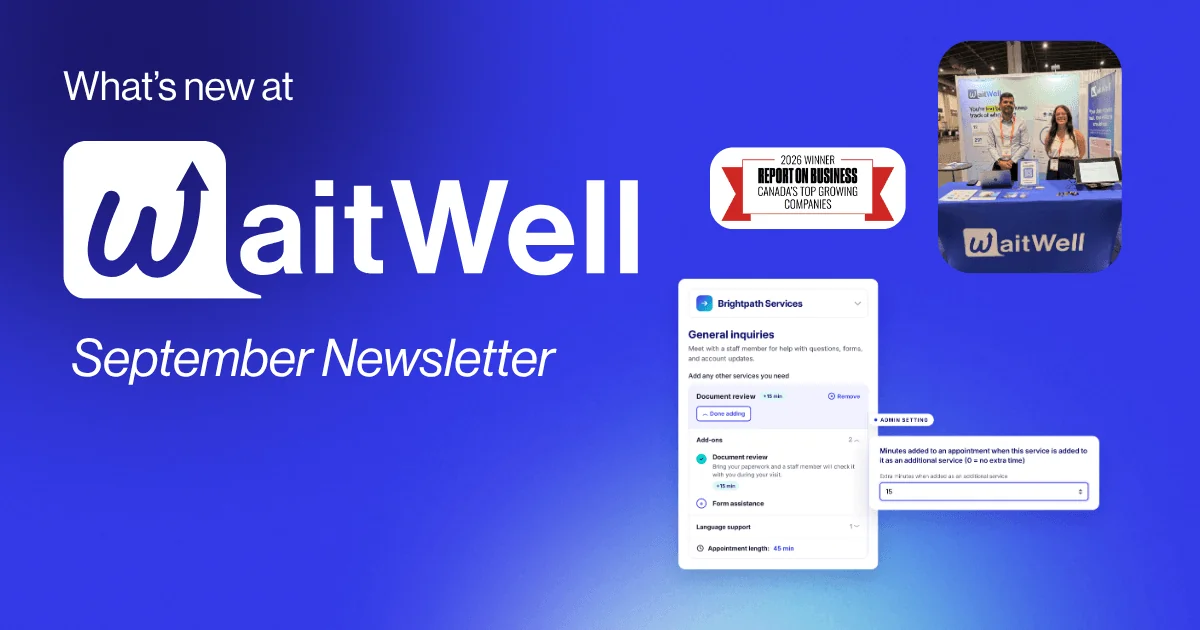
September brings more control to your front line, with add-on services that fit every appointment, queue status your way, and new staff permissions. Plus, WaitWell ranked No. 57 on The Globe and Mail’s 2026 list of Canada’s Top Growing Companies.

Your monthly roundup of what’s new at WaitWell. This issue covers September’s product updates, our spot on The Globe and Mail’s list of Canada’s Top Growing Companies, where our team has been on the road, and the free live sessions you can join in October.

👋 Hi WaitWell Community,

This month is about control. You decide exactly when each queue closes and reopens, who sees whose appointments, and how long an appointment runs when a customer adds extra services.

Add-on services lead the way. They can now add time to an appointment, so customers only see slots with enough room for everything they booked.

We also have news to celebrate. The Globe and Mail ranked WaitWell No. 57 on its 2026 list of Canada’s Top Growing Companies, after 500% growth over three years.

Everything here is covered briefly, so reach out to your Client Success Manager to go deeper.

Product updates

This month gives your team more control and your customers less guesswork. Here are the highlights.

Appointments that fit every add-on

When a customer adds an extra service, their appointment now grows to make room for it. No more rushed visits or overlapping bookings.

- Set how many extra minutes each add-on takes

- Customers pick add-ons from a simple list, grouped by category

- They only see times with room for the whole visit

- Works online, at the kiosk, and when staff book

Queue status, your way

Each queue now has its own status, so you choose when it closes and when it comes back.

- Close it until someone reopens it

- Close it over lunch, and it reopens for the afternoon

- Close it until the next business day

- Change every queue at once, or one at a time

Queue settings also got a cleaner layout. Each queue opens in its own window, with everything organized on three tabs.

Show staff only what they need

New permissions help each person focus on their own customers. Everyone keeps full access today, so nothing changes until you adjust them.

- Staff can see only their own appointments

- Choose who can pick their own desk

- Choose who can rename or set up desks

A lobby display that explains itself

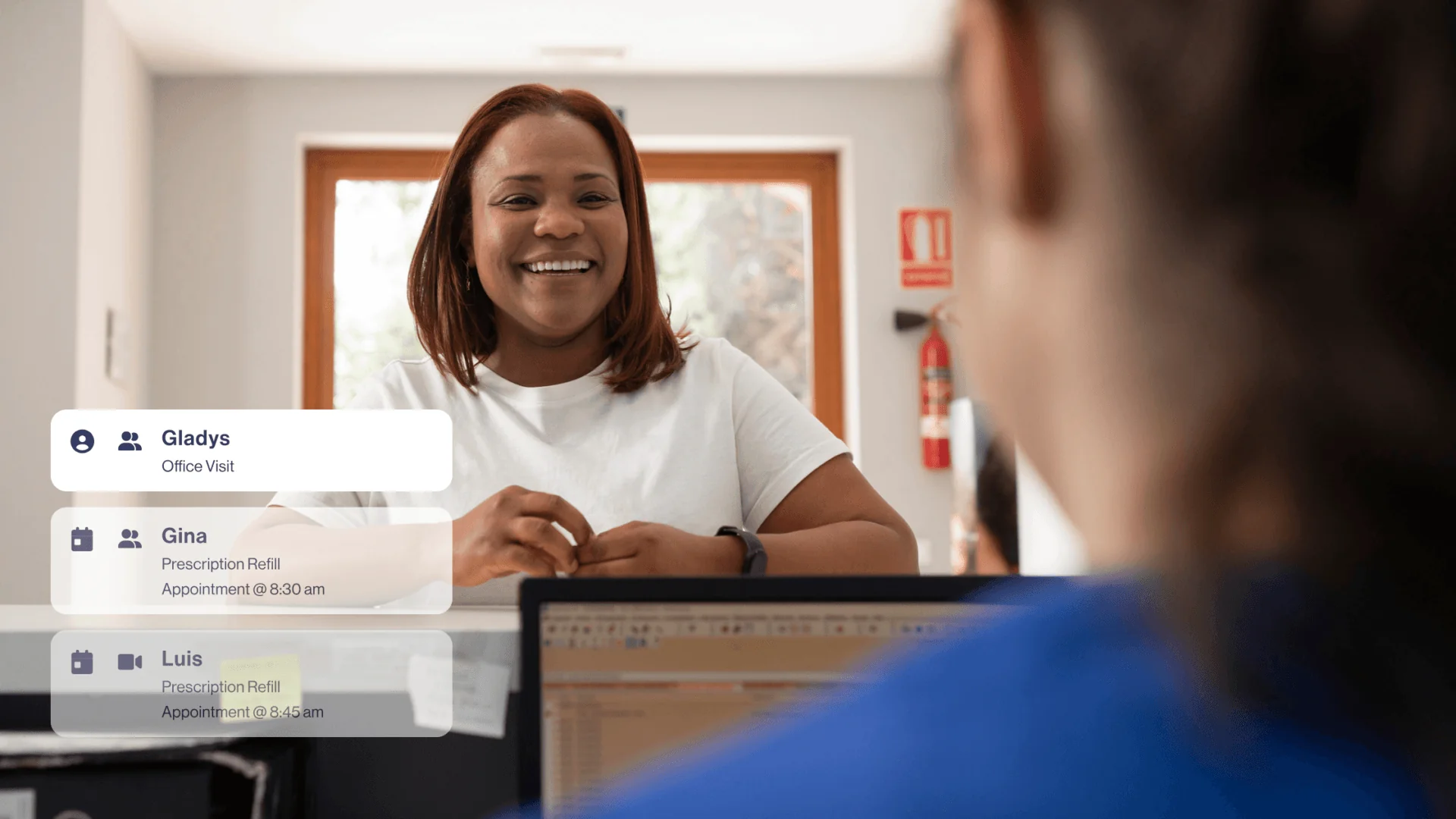
Appointments can now show in their own column, right next to the walk-in line. When someone who arrived later gets called first, everyone can see they had an appointment.

Also new this month

Scheduling

- Start or end someone’s shift right from the schedule

- Staff clock in on their own when they take a desk

Customers and reports

- See how well each staff member’s time gets booked

- Pick and reorder the columns on the Customers page

- Filter customers by details like language, tags, or date of birth

Everyday use

- Update queue hours for many locations at once with a spreadsheet

- Get a warning when a time looks like an AM/PM mix-up

- Put note and message shortcuts in the order you use them

- Click links right inside staff notes

There is a lot in this release, and it is easier to show than to describe. Contact your Client Success Manager for a walkthrough.

No. 57 on Canada’s Top Growing Companies

The Globe and Mail named WaitWell to its 2026 Report on Business ranking of Canada’s Top Growing Companies. We ranked No. 57 out of 375 companies, after growing 500% over three years.

We grew by taking on the middle work, like check-ins, forms, and redirecting people from the wrong line, so staff can focus on the part only a person can do.

“We did not grow by automating people out of service. We grew because we made service better for the staff at the counter, the person in front of them and the admin who has to make resource allocation decisions,” said Steve Vander Meulen, WaitWell’s CEO and co-founder.

The numbers:

- No. 57 of 375 on Canada’s Top Growing Companies

- 500% growth over three years

- Nearly 45 million people served

- More than 12.8 million hours of waiting saved

Much of that growth came from teams like yours expanding WaitWell to more services and locations. Thank you for trusting us with your front line.

Read the full story

On the road

Two stops this month, in two very different corners of the work our customers do.

IVECCS in Savannah, Georgia brought together emergency and critical care vets, technicians, and practice managers from September 14 to 17.

Emergency clinics never know who will come through the door next. A pet in crisis needs to be seen right away, and a worried owner in the waiting room wants to know what is happening. Check-in, the waiting room, and clear updates are part of the care.

That is where WaitWell fits. Fast check-in, text updates so owners are not left guessing, and booking and reminders that keep follow-up visits on track. We had great conversations on the exhibit hall floor about how clinics handle all three.

Thank you to every vet team that stopped by to share how their clinic runs.

This week we are in Providence, Rhode Island for AAMVA’s Annual International Conference, from September 29 to October 1. Leaders from motor vehicle agencies come together to work through the biggest issues they face.

For DMVs, many of those issues show up in the lobby: long lines, busy walk-in hours, and customers who arrive without the right documents. We are there to share how appointments, queueing, and forms sent before the visit help offices serve more people with the staff they have. Come find us if you will be there.

Join a live session, or watch one on demand

Every week we run free live sessions to help you get more out of WaitWell. Some walk through features step by step. Others dig into bigger topics like cutting wait times, reducing no-shows, and running a smoother service operation. Bring your questions, because our team is there live to answer them.

Can’t make a time that works? Our on-demand library is open whenever you are. Watch a past session start to finish, or skip to the part you need.

See upcoming sessions and watch on demand

Until next time, The WaitWell team 💙

Class (B2B/B2C)
B2B
Ingest Status
Error
Dedupe hash
f82abbfdb56d9c146102f2c494b36319
Press Eligible
No
Press Eligible Reason
Drupal Push 422
Source Name
WaitWell
Image URL
https://waitwellsoftware.com/wp-content/uploads/2026/09/September-newsletter.png
Source Node
Content Hash (SHA-256, erste 32 hex)
6c33b77e6418cbc6b15eeebf63394db9
Attend an online event with WaitWell
Original HTML

Attend an online event with WaitWell

Join us for live and on-demand sessions to discover how others are improving the experience in busy service locations and learn about WaitWell.

WaitWell recognized in Canada’s 2026 Top Growing Companies ranking. Read more

See how service organizations like yours are reducing wait times, improving operations, and creating better experiences for staff and customers.

Class (B2B/B2C)
Ignore
Ingest Status
Rejected
Dedupe hash
332b4cc48d241c4b0208bf476d3e0aa6
Press Eligible
No
Press Eligible Reason
Text too short (62 words. Min: 150)
Source Name
WaitWell
Source Node
Content Hash (SHA-256, erste 32 hex)
b214be8d4d779d5421455c0c8f1f8d86
Senior Planet Programs
Image File
Original HTML

Senior Planet Programs

Senior Planet is the flagship program of OATS from AARP.

Senior Planet programming affords older adults the opportunity to engage with a dynamic mix of offerings to achieve measurable change in one or more areas of their lives: financial security, social engagement, creative expression, health and wellness, and civic participation.

In addition to structured, multi-week courses, Senior Planet programming also includes a robust series of lectures, workshops, guest speakers, and special events, high-quality online content, and participant-driven affinity groups.

In-Person Experiences

Senior Planet centers are designed as technology-themed community spaces for older adults.

There are four Senior Planet centers across the United States, located in New York City, NY; Plattsburgh (North Country), NY; Denver, CO; and Miami, FL. A notion reflected in the design of all Senior Planet centers is that something world-changing could potentially be going on at any moment, and that anyone who walks through the door could be a part of it.

We also have an on-the-ground, partnership-based presence in Montgomery County, MD; San Antonio, TX; and Santa Clara County, CA.

Older adults across the country can also find Senior Planet classes offered at any of our 400+ licensed partner sites. These locations are a part of the Senior Planet licensing program, which works with local organizations to deliver Senior Planet programs.

Virtual Programming

A digital community for older adults that combines the experience of a trusted nonprofit with a commitment to informative and compelling content.

SeniorPlanet.org offers a wide range of free virtual classes each week, taught live on Zoom by Senior Planet expert trainers. Classes include morning stretch and meditation sessions, programs on online banking and telemedicine, discussion groups that foster engaging conversation and lasting friendships, demos of new and emerging technology, and much more.

Visitors can also find a variety of educational materials that complement classes, allowing for a blended learning experience with multimedia content, self-paced learning, and a flexible approach to when and where the learning takes place. Resources include video tutorials that correspond to the content in our course books, a Glossary of Tech Terms, quizzes, and even crossword puzzles.

The website also stands apart for its provocative and entertaining articles and interviews that challenge traditional portrayals of seniors. Some of the most popular article topics include nationally-recognized sex columnist Joan Price, Senior Planet’s Ask the Techspert series, and monthly interviews with older celebrities.

Five Impact Areas

Where impact meets accessibility.

Senior Planet programs are built around five impact areas: financial security, social engagement, creative expression, health and wellness, and civic participation. All five areas represent opportunities in the lives of older adults where a significant impact can be achieved through the use of technology.

- Financial Security – Senior Planet financial security programs aim to empower older adults of all income levels to leverage digital financial tools to shop, bank, save money, and take control of their finances.

- Social Engagement – To combat isolation among older adults, Senior Planet offers social engagement programs designed to help older adults leverage digital tools to connect with friends and family and stay active in their communities.

- Creative Expression – Digital channels are an essential part of the creative process: from exploring ideas to sharing the final product. Creative expression programs introduce unique ways to express creativity digitally, incorporating new platforms and fun ideas into the process.

- Health and Wellness – Senior Planet health and wellness programs familiarize older adults with digital tools to help them take better control of their health while introducing stretching, cardio, and resistance exercises. Exposure to these activities builds knowledge and confidence, empowering older participants to begin an exercise regimen of their own.

- Civic Participation – Civic participation programs address the disconnect between older adult activism and modern tools for advocacy. Lectures and workshops help older adults stay engaged in civic life, combat ageism, and raise their voices through digital advocacy.

Class (B2B/B2C)
B2C
Ingest Status
Rewritten
Dedupe hash
d1b388a710bf15f53d455ec51e5ccff9
Press Eligible
Yes
Press Eligible Reason
Overview of technology education programs and services for older adults.
Source Name
Older Adults Technology Services (OATS) from AARP
Image URL
https://oats.org/wp-content/uploads/2024/02/DSA05179-scaled.jpg
Content Hash (SHA-256, erste 32 hex)
18664ffa4b486300fa121e77074af22a
Indicators That Matter
Original HTML

Indicators That Matter

If money is the currency of the modern economy, accountability is the currency of social change. Accountable nonprofit organizations measure impact by collecting data through surveys, program observation, external evaluations, and collaborative research.

By tracking extensive metrics and collaborating with leading academic researchers to refine the organization’s research and assessment tools, OATS has set new standards for a data-driven organization.

Since its inaugural program in Bedford-Stuyvesant, Brooklyn in 2004, OATS has been measuring participant outcomes with post-course surveys, and has tracked over 20,000 responses. We use this extensive evidence-based data to analyze program impact, curriculum relevance, and the quality of trainers and program environments. We’ve raised the bar when it comes to collecting actionable program data and creating reliable systems for management, program design, and external reporting. Adhering to the highest standards of accountability, OATS will demonstrate the strong return on investment (social and financial) that results from support for quality programs that change the way we age.

Here are some highlights from the development of the OATS knowledge base:

2010

A 2010 “Social Impact Analysis” of the OATS programs conducted by the New York Academy of Medicine, which tracked OATS participants from enrollment through course completion and six months afterwards to assess technology use and social engagement.

A 2013 collaboration with Cornell University Sociology Professor Erin Cornwell and the AARP Foundation to create the nation’s first comprehensive survey instrument to measure the effect of technology training on social engagement of senior citizens.

2013

A 2014 phone survey of 1,200 older Americans, sponsored by OATS and New York Law School and conducted by Research America, Inc., which tracked technology use and the impact of training on social outcomes.

2014

A 2014 collaboration with the Columbia University Institute on Aging to develop a suite of field-ready surveys to track OATS participant outcomes on health, civic engagement, financial security, and lifelong learning, subsequently used to assess outcomes for over 5,000 participants.

2014

A 2016 door-to-door survey of 215 senior-headed households in the Queensbridge Public Housing development in New York City that assessed technology use, training priorities, and community-level goals for change, sponsored by the Citi Community Foundation and the Mayor’s Fund to Advance New York City.

2016

A 2019 tracking study of 459 OATS participants in San Antonio, Texas, measuring the social engagement impact of participation in OATS programs, in collaboration with the Renssalaerville Institute, sponsored by the Humana Foundation.

2019

Today

OATS tracks more than 200 different program outcome variables across five impact areas, along with dozens of data points on demographics, program and site information, and trainer performance. All data are entered into Qualtrics for analysis and cross-referenced with information on programs, participants, sites, and staff maintained in a Salesforce database. In addition to quarterly all-staff reviews of metrics and outcomes, our leaders regularly publish research findings in peer-reviewed journals, academic publications, and public convenings.

Meaningful research requires an extraordinary commitment to continual data collection, analysis, and refinement of methods. As a learning organization with a near-fanatical commitment to program accountability, OATS continues to set new standards for excellence and impact, strengthening the case for expanded investment and engagement by public, private, and philanthropic entities.

Class (B2B/B2C)
B2B
Ingest Status
Need Review
Dedupe hash
89ec2454e64abfe5d844c3ad2b8e23ef
Press Eligible
Yes
Press Eligible Reason
QA FAIL (need review): Proper noun mismatch: the target changes 'Renssalaerville Institute' from the source to 'Rensselaerville Institute'. All other facts and figures match the source.
Source Name
Older Adults Technology Services (OATS) from AARP
Generated Article_json
{"target_audience": "b2b", "is_medical": false, "ai_generated_title": "OATS tracks 200+ outcome variables after 20,000 survey responses", "body_html": "<p><strong>New York -- [CURRENT_DATE] --</strong> OATS has collected more than 20,000 post-course survey responses since its 2004 debut in Bedford-Stuyvesant, Brooklyn, and now tracks over 200 program outcome variables across five impact areas to document the results of its senior technology training.</p><h5>OATS ran six outside studies between 2010 and 2019</h5><p>The New York Academy of Medicine's 2010 Social Impact Analysis followed participants from enrollment through course completion and six months afterward, measuring technology use and social engagement. In 2013, OATS worked with Cornell sociology professor Erin Cornwell and the AARP Foundation on what it describes as the first comprehensive survey instrument measuring how technology training affects seniors' social engagement.</p><p>A 2014 phone survey of 1,200 older Americans, sponsored by OATS and New York Law School and run by Research America, Inc., tracked technology use and social outcomes of training.</p><h5>Columbia partnership produced surveys covering more than 5,000 participants</h5><p>In 2014, OATS worked with the Columbia University Institute on Aging to build field-ready surveys on health, civic engagement, financial security and lifelong learning. They have since been used to assess outcomes for over 5,000 participants.</p><p>A 2016 door-to-door survey of 215 senior-headed households in New York City's Queensbridge Public Housing development, sponsored by the Citi Community Foundation and the Mayor's Fund to Advance New York City, assessed technology use, training priorities and community-level goals. A 2019 study of 459 participants in San Antonio, Texas, run with the Rensselaerville Institute and sponsored by the Humana Foundation, measured social engagement impact.</p><h5>Qualtrics and Salesforce anchor the current data infrastructure</h5><p>OATS enters all data into Qualtrics for analysis and cross-references it with program, participant, site and staff records in a Salesforce database. It also records dozens of data points on demographics, program and site information, and trainer performance. Staff review metrics and outcomes quarterly, and leaders publish findings in peer-reviewed journals, academic publications and public convenings.</p><p>OATS says the data will demonstrate social and financial return on investment, and it is using the record to argue for expanded investment from public, private and philanthropic entities.</p>", "meta_description": "OATS has logged 20,000+ survey responses since 2004 and tracks 200+ outcome variables across five impact areas using Qualtrics and Salesforce data systems.", "seo_keywords": "OATS, nonprofit impact measurement, senior technology training, Qualtrics, Salesforce, social impact analysis, older adults, program accountability, philanthropic investment", "companies": ["OATS", "Qualtrics", "Salesforce"], "industries": ["Education, Research & Public Sector"], "markets_regions": ["United States"], "news_type": ["general_news"], "products": [], "themes": ["impact_measurement", "digital_inclusion"], "events": [], "cta_text": "Learn more about OATS research and impact measurement for senior technology training programs", "learn_more": "", "fact_check": {"accuracy_score": 97, "legal_risk": "low", "corrections_made": ["Corrected the source spelling 'Renssalaerville' to 'Rensselaerville'", "Attributed the 'first comprehensive survey instrument' claim to OATS rather than stating it as independent fact", "Did not expand the OATS acronym because the source does not spell it out"], "recommendation": "publish"}}
Content Hash (SHA-256, erste 32 hex)
514ac46f85367bd9f661369b6c1f9f3c
A Change is in Order
Original HTML

A Change is in Order

At OATS and Senior Planet, our mission is to harness technology to change the way we age. It drives our strategy and is the basis for all our programs, so it’s essential to understand what we mean by changing the way we age, and how we translate this into operational terms. But first, let’s explore what we believe is not going right.

There are a lot of things wrong with how we deal with aging in America today. We underinvest in geriatricians and overinvest in nursing homes. We drive people out of the workforce when they still have the desire and capability to contribute. We have created an age-segregated society where older and younger people rarely socialize, collaborate, or create together. We are facing unprecedented growth in the proportion of our population that is old, yet we have failed to update or modernize our public policies or social practices to prepare for these changes or to care for the people who will, in increasing numbers, need our help.

After working with seniors and technology for fifteen years, we have developed some distinct ideas about what’s wrong with how we do “aging” today. Ours is not a universal point of view, and there are many worthy organizations helping seniors today who bring very different approaches to diagnosing this problem. But as with all meaningful work, ours begins with a particular vantage point. One that is rooted in grassroots activism, an optimism about social change, and a faith in the potential of older people. It’s a vantage point born from tens of thousands of hours of working side-by-side with seniors determined to learn, to grow, and to change themselves and the world around them. Here’s how we see the problem:

Older adults are invisible.

Aging is viewed through a lens of negativity.

Society has disempowered older adults.

Our culture is permeated by ageism, a pervasive and corrosive bias that often manifests in simply ignoring the presence and importance of older people. In a society that places little value on being old (aside from a nostalgic and somewhat condescending respect for “wisdom”), seniors have been scrubbed from our physical and social spaces. Many social settings—in commerce, fashion, nightlife, popular music—are informally age-segregated and older adults are rarely or never visible. Unsurprisingly, seniors report feeling unwelcome and, when they do venture to contribute their voices, unheard. Even in social work and medicine, programs offering geriatric specializations and placements have been notably under-subscribed; today we face an increasing mismatch between the growing population of older adults and a shrinking workforce of people interested in working with them.

We live in an era of increasing life-spans, improving health and mobility for people over 60, and expanding possibilities for what older adults can create and produce. Yet, Americans continue to associate aging with decline, sickness, impairment, and dependency, and our cultural framework for aging remains mired in outdated stereotypes of seniors—caught in the image of the old lady eating cat food, or the slumped nursing home patient in a gown. To be sure, cognitive and physical decline often accompany aging, especially in the more advanced years, but aging is not about frailty or impairment. For many older adults, their older years are their best ones and they are seizing their most valuable time on earth to fulfill themselves.

Unfortunately, we live in a culture where we treat the phrase “senior moment” as a harbinger of loss and inadequacy.

This is what we mean when we say at OATS that we want to change the way we age.

Class (B2B/B2C)
B2B
Ingest Status
Rewritten
Dedupe hash
554f7da1db2cdb5f7640a0d6b7571b1b
Press Eligible
Yes
Press Eligible Reason
Organizational thought leadership on technology, aging, and social programs for older adults.
Source Name
Older Adults Technology Services (OATS) from AARP
Content Hash (SHA-256, erste 32 hex)
9e33e60d68c26ec9071abd9b2ce43cf0
The Care and Feeding of Partnerships
Image File
Original HTML

The Care and Feeding of Partnerships

In 2008, OATS came close to financial catastrophe. An unexpected shortfall in the New York City budget led to the elimination of a program that provided almost half of our annual budget.

We were facing staff layoffs, site closings, cancelled programs—and then we got a call from the executive director at one of our nonprofit partners, a site where OATS had been teaching classes for several years.

We accepted, sheepishly, and their support meant that several OATS trainers were able to keep their jobs and we managed to keep our programs going until more sustainable funding was secured. It’s partnerships like these—vital long-term relationships that both deliver great outcomes and make sure we look out for each other—that inspire us at OATS.

Every program we have delivered since our first day of operation has been a partnership. We have taught at over 200 locations all over America, worked with libraries, schools, senior centers, advocacy campaigns, government agencies, corporations, and foundations, and have prided ourselves on building long-term connections wherever we go. Partnerships are so important to OATS that we secured funding from the Consumer Technology Association Foundation to build a dedicated “Partner Portal” to make sure organizations all over the world can access OATS up-to-date curriculum, technical support, digital content, and organizational resources in real-time and usable formats.

We believe in the power of collaboration and the importance of sustaining lasting relationships. Here are a few principles that guide our collaborations.

Value every partner organization for their unique expertise—content, culture, history, policy, programs, geography, networks, knowledge—the list is endless.

Learn what drives partner organization success—and reinforce it wherever possible.

Get to know the people. Relationships are essential in the nonprofit sector for building trust.

Don’t skimp on resources. Strong partnerships take effort, and staff, and money. Make sure to build strong financial and program models to feed successful collaborations.

At OATS we pride ourselves on being great partners. We work every day to deliver value and quality through collaborative relationships with organizations that range from a two-person operation run out of a housing project in West Harlem to international corporations with revenues over a billion dollars.

Class (B2B/B2C)
B2B
Ingest Status
Error
Dedupe hash
71cf2d2ac5f3ae4251788927c1c6607c
Press Eligible
No
Press Eligible Reason
Drupal Push 422
Source Name
Older Adults Technology Services (OATS) from AARP
Image URL
https://oats.org/wp-content/uploads/2020/04/oats_chat-1024x993.jpg
Content Hash (SHA-256, erste 32 hex)
8f87c4c3195cec64472d866a01783d12