Waystar to Report Third Quarter 2026 Financial Results on November 2, 2026
Image File
Original HTML

LEHI, Utah and LOUISVILLE, Ky., Oct. 14, 2026 /PRNewswire/ -- Waystar Holding Corp. (Nasdaq: WAY), a provider of leading healthcare payment software, today announced it will report financial results for the third quarter ended September 30, 2026, after market close on Monday, November 2, 2026. The company will discuss its financial results on a conference call at 4:30 p.m. Eastern Time that same day.

A live audio webcast of the conference call will be available on Waystar's investor relations website at https://investors.waystar.com/news-events/events. The webcast will be archived on the site for those unable to listen in real time.

About Waystar

Waystar's mission-critical software is purpose-built to simplify healthcare payments so providers can prioritize patient care and optimize their financial performance. Waystar serves over 30,000 clients, representing over 1 million distinct providers, including 16 of 20 institutions on the U.S. News Best Hospitals list. Waystar's enterprise-grade platform annually processes over 7.5 billion healthcare payment transactions, including over $2.4 trillion in annual gross claims and spanning approximately 60% of U.S. patients and one in three U.S. hospital discharges. Waystar strives to transform healthcare payments so providers can focus on what matters most: their patients and communities. Discover the way forward at waystar.com.

Media Contact

Kristin Lee

[email protected]

Investor Contact

Edward Parker

[email protected]

SOURCE Waystar

Share this article

Ingest Status
Rejected
Dedupe hash
prn_302908884
Source Name
Unknown Company
Original Summary

<p>LEHI, Utah and LOUISVILLE, Ky., Oct. 14, 2026 /PRNewswire/ -- Waystar Holding Corp. (Nasdaq: WAY), a provider of leading healthcare payment software, today announced it will report financial results for the third quarter ended September 30, 2026, after market close on Monday, November 2,...</p>

Image URL
https://mmx.prnewswire.com/media/MS672710/Waystar-Logo.jpg?id=OA3019258&p=facebook
Content Hash (SHA-256, erste 32 hex)
23a437cbc63f59fb82b21b22a1ccc635
The RealReal Announces Timing of Its Third Quarter 2026 Earnings Conference Call
Image File
Original HTML

SAN FRANCISCO, Oct. 14, 2026 /PRNewswire/ -- The RealReal (Nasdaq: REAL)—the world's largest online marketplace for authenticated, resale luxury goods—today announced that it will release its financial results for the third quarter, ended September 30, 2026, after the market closes on October 29, 2026.

The RealReal will host a conference call at 2:00 p.m. Pacific Time (5:00 p.m. Eastern Time) to review its financial results.

A live webcast of the conference call will be available online at investor.therealreal.com. The archived webcast will be available shortly after the call at the same location.

To access the live webcast, please register at this link: https://the-realreal-earnings-call-q3-2026.open-exchange.net/

About The RealReal Inc.

The RealReal is the world's largest online marketplace for authenticated resale luxury goods, trusted by a community of 45 million members. Its full-service consignment model across fashion, fine jewelry and watches, art and home, makes it easy for customers to buy and sell luxury wherever they are. The Company combines rigorous, expert-led authentication with AI and proprietary technology to optimize operations and pricing while streamlining the customer experience. Backed by 15 years of proprietary data and more than 50 million items sold, The RealReal has become the preferred destination for modern luxury resale, redefining the luxury lifecycle.

SOURCE The RealReal

Share this article

Class (B2B/B2C)
B2B
Ingest Status
Rewritten
Dedupe hash
prn_302909122
Press Eligible
Yes
Press Eligible Reason
Company announcement of its quarterly financial results and earnings call.
Source Name
Unknown Company
Original Summary

<p>SAN FRANCISCO, Oct. 14, 2026 /PRNewswire/ -- The RealReal (Nasdaq: REAL)—the world's largest online marketplace for authenticated, resale luxury goods—today announced that it will release its financial results for the third quarter, ended September 30, 2026, after the market closes on...</p>

Image URL
https://mmx.prnewswire.com/media/MS1884555/The-RealReal-logo-Black.jpg?id=OA3014022&p=facebook
Content Hash (SHA-256, erste 32 hex)
c9bb89df2bdcb0c9b69e11dca5a3af73
Colossal Accelerates the Full Dodo De-extinction Pipeline
Image File
Original HTML

New AI platform GenoMorph identifies candidate regulatory DNA linked to the dodo's distinctive craniofacial anatomy, while technologies adapted from earlier species programs advance Nicobar pigeon germ-cell development, chicken stem-cell chimeras and embryo gene editing.

DALLAS, Oct. 14, 2026 /PRNewswire/ -- Colossal Biosciences, the world's first de-extinction company, today announced new scientific milestones that will accelerate dodo de-extinction efforts. Building on last year's advances in pigeon primordial germ cells, gene-edited chicken surrogates and comparative avian genomes, today Colossal unveiled GenoMorph, its AI platform developed to identify potential gene-editing targets from limited genomic data. Applied to the dodo program, the platform identified an estimated 2,300 candidate regulatory elements associated with avian beak size and shape. Colossal also announced advances across its avian de-extinction pipeline, including substantially improving the dodo genome assembly through the use of technology from its dire wolf project, an expanded Nicobar pigeon colony, newly derived Nicobar primordial germ cells, chicken embryonic-stem-cell chimeras and a breakthrough lipid-nanoparticle system for gene editing delivery in avian embryos. Together, these capabilities provide the genomic, cellular and reproductive foundation required to translate predicted dodo traits into experimentally validated edits.

Colossal Develops GenoMorph, a New Internal AI Platform  

Colossal has developed GenoMorph, an AI-powered platform that identifies potential gene-editing targets for de-extinction projects with limited genomic data. The platform combines comparative genomics, developmental biology and high-resolution 3D morphology to predict which regulatory elements may be active during development and identifies those most strongly associated with differences in physical form.

Unlike protein-coding genes, which provide instructions for building an animal, regulatory DNA controls when, where and how strongly those instructions are activated. These genetic "switches" help shape traits such as the size and structure of a bird's skull and beak.

"De-extinction is as much a data problem as a biology problem," said Ben Lamm, CEO and Co-Founder of Colossal. "Because so few dodo genomes survive, we cannot rely on the population-level comparisons available for many living species. Our GenoMorph platform provides another path: it learns how regulatory DNA shapes living birds, then identifies the genetic switches that may have contributed to the dodo's distinctive anatomy. This is more than a solution for the dodo. It provides a repeatable approach for extinct species whose genomic records are similarly limited."

To build GenoMorph, Colossal's avian team created an avian regulatory atlas using hundreds of samples from chickens, quail, ducks and pigeons. The samples covered six stages of embryonic development and three regions of the developing face. The team then combined these data with genomes and CT-derived skull measurements from more than 70 bird species, including the Nicobar pigeon, the dodo's closest living relative, mapped using 541 anatomical landmarks.

The analysis identified 653 candidate regulatory elements associated with beak size and 1,698 associated with beak thickness and breadth. These findings do not yet establish that the elements cause those traits; instead, they provide prioritized targets for experimental testing. Elements confirmed to influence craniofacial development may then be considered for precision genome editing in the Nicobar pigeon, providing a data-driven path toward reconstructing key aspects of the dodo's distinctive anatomy.

"The dodo's defining anatomy emerged from networks of regulatory instructions that are difficult to interpret from ancient DNA alone," said Beth Shapiro, PhD, Colossal's Chief Science Officer. "The answer turned out to be comparative: use the breadth of living bird diversity, combined with AI, to identify candidate loci for the next phase of testing. By learning how skulls and beaks develop across living birds, GenoMorph allows us to prioritize the regulatory changes most likely to have shaped the dodo and move them into functional validation. It establishes a repeatable framework for connecting ancient genomes to extinct traits."

"You cannot train AI to answer a precise developmental question using just generic data," said Anna Keyte, Avian Species Director at Colossal. "We needed to capture how regulatory activity changes across species, developmental stages and different regions of the face. Building that dataset required more than a year of focused experimental work, and it is what allows GenoMorph to generate biologically meaningful predictions."

Candidate elements are now entering functional-validation studies. Those confirmed to influence craniofacial development may be prioritized for precision editing in the Nicobar pigeon genome. Preliminary findings have been presented at the Craniofacial Gordon Research Conference and the Society for Molecular Biology and Evolution annual conference and the 2026 Society for Molecular Biology and Evolution annual meeting.

While this work advances the dodo de-extinction program, its scientific implications extend well beyond a single species. The ability to predict developmentally active regulatory DNA from genome sequence alone, and to validate that against quantitative morphological data across a broad comparative sample, provides a scalable framework for studying the genetic basis of complex anatomical traits in any bird lineage. This includes endangered species for which large population genomic datasets are unlikely ever to exist, where identifying functionally relevant regulatory variants has previously been intractable.

Dire Wolf Technology Is Helping Build a More Complete Dodo Genome

The dodo genome assembly that Colossal's team is using is of extremely high quality for ancient DNA, thanks to the excellent preservation of the dodo specimen from which the genomic data was extracted. However, the fragmented nature of ancient DNA means that, despite this excellent preservation, gaps in the genome sequence remain that can impact analysis. Through the dire wolf program, the company developed a computational genome-assembly method that, applied to improve the dodo genome assembly, demonstrates how technologies created for one de-extinction project can be refined and applied across Colossal's broader species portfolio.

Ancient DNA is fragmented into short strands of surviving DNA, damaged due to degradation, and the genome sequence is often substantially different from that of its closest living relative. Conventional assembly methods map ancient DNA fragments against a living reference genome—in this case, the Nicobar pigeon—and may discard fragments that are too divergent to align. This can leave gaps in the assembly and bias the reconstructed genome toward the living species.

Colossal's published iterative assembly method addresses this limitation by using newly mapped dodo DNA to progressively update the reference genome. The updated reference is then used to map the ancient DNA again, allowing previously unmatched fragments to "walk" into gaps with each successive round. After repeating this process until the number of newly recovered dodo sequences reached a plateau, the result is a substantially more complete assembly than would have been possible through a conventional single-pass approach. Our dodo genome has, for example, 95% of bases covered at least 5-fold (meaning that at least five unique ancient DNA molecules map to more than 95% of letters in the genome), and an average coverage of 65-fold.

"We are in the final stages of our analysis of the dodo genome, with much more to come after the genome paper goes through peer review. In the meantime, it's been rewarding to see that an approach developed for the dire wolf is now producing value across another species program. That repeatability is central to Colossal's model: every scientific breakthrough becomes part of a scalable technology platform that can accelerate the programs that follow," said Beth Shapiro.

Colossal Expands Its Nicobar Pigeon Colony and Avian Research Platform

Colossal has expanded its Texas colony of Nicobar pigeons—the dodo's closest living relative—to 36 birds following successful breeding among established pairs. The growing colony provides an increasingly robust foundation for studying Nicobar pigeon development, reproduction, and genetics while supporting the company's dodo de-extinction program.

Eggs collected during the latest breeding season were used to derive Nicobar pigeon primordial germ cells, or PGCs. These are the cells that eventually develop into sperm and eggs. Establishing these cells is essential to our path of creating heritable genome edits and producing future generations of birds carrying selected dodo traits.

Colossal is also working to develop a telomere-to-telomere Nicobar pigeon genome, improving on the existing chromosome-level assembly. This will provide a stronger foundation for identifying potential edits and for improving the genome of the Rodrigues solitaire, an extinct relative of the dodo. Colossal plans to add newly available solitaire sequence data and remap it against the improved Nicobar reference to increase its coverage and completeness.

Chicken embryonic-stem-cell chimeras

Colossal scientists have also developed a new platform using avian embryonic stem cells to generate chimeric chickens, and have successfully hatched the first chimeras produced through the platform. Embryonic stem cells offer a route to introduce engineered cells into a developing embryo and observe how those cells contribute to the phenotype of the bird. Hatching viable chimeric chickens confirms that the cultured cells retain the developmental potential needed to integrate into a host embryo and contribute to its various tissues.

Class (B2B/B2C)
B2B
Ingest Status
Rewritten
Dedupe hash
prn_302908617
Press Eligible
Yes
Press Eligible Reason
Biotech company announces AI and genomic research milestones for its de-extinction program.
Source Name
Unknown Company
Original Summary

<p>New AI platform GenoMorph identifies candidate regulatory DNA linked to the dodo's distinctive craniofacial anatomy, while technologies adapted from earlier species programs advance Nicobar pigeon germ-cell development, chicken stem-cell chimeras and embryo gene editing. DALLAS, Oct. 14,...</p>

Image URL
https://mmx.prnewswire.com/media/MS2012775/GenoMorph_Team-Meeting.jpg?id=OA3017323&p=facebook
Content Hash (SHA-256, erste 32 hex)
45d1745910004ac1e78c7ffd34ec5549
TrueLoyal Puts Loyalty Program Data Inside Any AI Assistant, So Teams Can Get Answers Without Waiting on a Report
Original HTML

TrueLoyal Puts Loyalty Program Data Inside Any AI Assistant, So Teams Can Get Answers Without Waiting on a Report

The TrueLoyal MCP, now in beta, lets loyalty teams ask questions about their members and purchases in plain language and build their own dashboards.

SAN ANTONIO, Oct. 14, 2026 /PRNewswire/ -- TrueLoyal, the loyalty and advocacy platform behind Rewards and Fan Club™, today announced that loyalty teams can now get answers about their program the moment they have the question. With the new TrueLoyal MCP, now in beta, a team can ask the AI assistant of their choice how many members signed up last week, which members haven't purchased in a while or what their points liability looks like, and get the answer back from their own program data. MCP stands for Model Context Protocol, the open standard that lets AI assistants connect to the business software a company already runs on.

Today most loyalty teams get answers about their program through dashboards and reporting requests. A question like which members are slipping away, or how many members a brand can actually email, usually means a ticket, a data pull and a wait. And by the time the answer comes back, the moment to act on it has often passed.

And most loyalty teams are small. The person who owns the program is often also running email, promotions and reporting, without an analyst to call on. At the same time, AI assistants are quickly becoming where work gets done, so loyalty data needs to live somewhere those tools can read it. The TrueLoyal MCP brings the program into the tools teams already use, and gives a lean team the kind of answers that used to take an analyst.

In the beta, teams can search and analyze member and transaction data through MCP. So the person who owns the program can ask questions like these and get an answer back in the same conversation.

- How many members signed up last week?

- Which member referred the most new members?

- Group my members by how recently they purchased, how often they purchase and how much they have spent, and tell me what each group has in common.

- How many of my members can I actually email, broken down by subscription status and opt-outs?

- How did my last campaign perform?

- What is my current points liability?

Teams can also ask the MCP to build a custom dashboard around the numbers they care about most, and then add to it, remove from it or change it whenever they want without filing a request.

That includes the numbers finance asks about. A loyalty team can pull points liability, campaign results and member trends on their own, so the case for the program is easier to make in the language the CFO uses.

"Static dashboards answer the questions someone thought to ask last quarter. That is not how loyalty teams work. With MCP there is no new UI to learn. You open the AI assistant you already use, ask what your members are doing, and get the answer from your TrueLoyal program sitting right next to the rest of your data. Minutes, not a ticket and a week. And this is step one. Next, that same assistant stops reporting on your program and starts running it," said Jacek Materna, CEO of TrueLoyal.

"You've always had more questions about your members than time or tools to answer them. Not everyone has an analyst down the hall. Now you don't need one. TrueLoyal works inside the AI tools you already use, so you can ask a question and get an answer from your own data in seconds. Learn faster, act sooner and prove the program's value. Whatever you can describe, you can see," said Caleb Fox, VP of Product at TrueLoyal.

Because this is member data, access is opt-in. MCP is off by default, and a brand has to enroll before it can be used. Each user can only reach the data their TrueLoyal account already has permission to see.

Every answer is pulled from the brand's own program data in TrueLoyal, so the team knows exactly where the numbers come from. And because the beta starts with read access only, the team stays in control of the program while they get comfortable working this way.

Availability

The TrueLoyal MCP beta is now live for select Rewards customers.

Eligible brands can activate it via their TrueLoyal admin banner and connect their AI assistant. To request access, contact your TrueLoyal account rep. General availability is scheduled for later this year.

Read our full breakdown at trueloyal.com/blog/ai-loyalty-program-management-mcp.

About TrueLoyal

TrueLoyal is a loyalty and advocacy platform that helps brands turn the customer experience into repeat purchases and long-term growth. Brands use Rewards to run their loyalty program and Fan Club™ to bring community and user-generated content together, all connected to the commerce systems they already use. TrueLoyal also offers services that range from Program Strategy to fully managed loyalty operations. Learn more at trueloyal.com.

SOURCE TrueLoyal

Share this article

Class (B2B/B2C)
B2B
Ingest Status
Rewritten
Dedupe hash
prn_302909128
Press Eligible
Yes
Press Eligible Reason
Announces a business AI integration for loyalty teams and program data analysis.
Source Name
Unknown Company
Original Summary

<p>The TrueLoyal MCP, now in beta, lets loyalty teams ask questions about their members and purchases in plain language and build their own dashboards. SAN ANTONIO, Oct. 14, 2026 /PRNewswire/ -- TrueLoyal, the loyalty and advocacy platform behind Rewards and Fan Club™, today announced that...</p>

Content Hash (SHA-256, erste 32 hex)
590badd41a464b8c98cbe8d324cef7ae
Enghouse Transportation and Cal-ITP Expand Integrated Transit Payments Across Ventura County
Image File
Original HTML

Enghouse Transportation and Cal-ITP Expand Integrated Transit Payments Across Ventura County

MARKHAM, ON, Oct. 14, 2026 /PRNewswire/ -- Enghouse Transportation & Public Safety, a leader in transportation and public safety solutions, today highlighted the continued success of its collaboration with the California Integrated Travel Project (Cal-ITP) in expanding integrated, rider-friendly fare payment across Ventura County.

The regional launch brings together seven transit operators within a coordinated open-loop payment program. Riders can use the contactless credit or debit card already in their wallet across participating services, with the correct fare calculated automatically at each tap.

Building on the first Enghouse open-loop payment deployment with the Ventura County Transportation Commission (VCTC), the expanded program delivers a seamless array of services across agency boundaries. Regional fare capping allows customers to transfer between participating operators and receive applicable fare benefits as though the network were a single transit system. Cal-ITP also supports reduced fares for eligible riders across all participating operators.

"This regional launch is a major milestone for Cal-ITP and public transit in California, and it was made possible through collaboration between vendors, transit operators, and the State. We hope to see more regional projects roll out in the future that will expand access to public transportation for all Californians," said Gillian Gillett, Chief of Data & Digital Services and California Integrated Mobility Program Manager at California Department of Transportation.

The cooperation reflects a shared commitment by Enghouse, Cal-ITP, VCTC and local transit agencies to reduce barriers to public transportation. Enghouse contributes scalable fare collection technology and real-time payment processing, while Cal-ITP provides the statewide framework and implementation support needed to make contactless payments and benefit eligibility easier to adopt. Together, the partners are creating a practical model for connected, simple and passenger-focused regional mobility.

"We are proud to have partnered with Cal–ITP to support VCTC in deploying its open–loop fare payment solution and enabling reduced fares for eligible riders across all seven operators. This milestone reinforces our commitment to expanding modern, accessible payment options across the region and setting the foundation for broader adoption ahead," said Daniel Sjöström, Managing Director at Enghouse Transportation and Public Safety.

Looking ahead, Enghouse and Cal-ITP will continue supporting transit agencies as they modernize fare collection, improve interoperability and make public transportation simpler and more accessible for every rider.

About Enghouse Transportation & Public Safety

Enghouse Transportation & Public Safety is a division of Enghouse Systems Limited. It helps transit agencies modernize ticketing and Automated Fare Collection through secure, cost-effective hardware and software solutions designed to improve operational efficiency and the passenger experience. For more information, visit www.enghousetransportation.com.

Contact Information: Balvinder Sandhu, Director of Marketing, Enghouse Networks & Transportation, + 44 (0)1628 641 789, [email protected]

Share this article

Class (B2B/B2C)
B2B
Ingest Status
Rewritten
Dedupe hash
prn_302909124
Press Eligible
Yes
Press Eligible Reason
Company announcement about deploying integrated transit payment technology across regional transit operators.
Source Name
Unknown Company
Original Summary

<p>MARKHAM, ON, Oct. 14, 2026 /PRNewswire/ -- Enghouse Transportation & Public Safety, a leader in transportation and public safety solutions, today highlighted the continued success of its collaboration with the California Integrated Travel Project (Cal-ITP) in expanding integrated,...</p>

Image URL
https://mmx.prnewswire.com/media/MS2013707/Enghouse-Systems-Limited-Enghouse-Transportation-and-Cal-ITP-Exp.jpg?id=OA3020119&p=facebook
Content Hash (SHA-256, erste 32 hex)
81faffe614057307d010e4bcae36af9b
Threat Intelligence Market to Reach USD 24,108.25 Million by 2032 Amid AI-Driven Cyberthreats and Faster Incident Response - Credence Research
Image File
Original HTML

NOIDA, India, Oct. 14, 2026 /PRNewswire/ -- The "Threat Intelligence Market – Growth, Share, Opportunities & Competitive Analysis, 2024–2032" report has been added to the Credence Research Inc. offering.

The global Threat Intelligence Market was valued at USD 5,789.50 million in 2024 and is projected to reach USD 24,108.25 million by 2032, registering a CAGR of 19.52% during the assessment period. Rising attacker sophistication, expanding cloud and identity attack surfaces and growing security-operations automation are driving demand for threat intelligence that connects adversary context with practical detection and response. Enterprises increasingly want intelligence feeds, investigation platforms and managed expertise that help analysts prioritize material threats rather than add to alert volume.

Key Takeaways

- The global market is projected to rise from USD 5,789.5 million in 2024 to USD 24,108.25 million by 2032, reflecting a 19.52% CAGR over eight years.

- North America holds an estimated 42% share, while Asia Pacific represents about 25% in the report's regional assessment.

- Solutions and services address distinct buyer needs, from threat-intelligence platforms and feeds to managed analysis and implementation support.

- Strategic, tactical and operational intelligence support executive risk planning, security-control decisions and incident-level investigation.

- Cloud delivery and integration with security information and event management, extended detection and response and security orchestration tools are central to platform differentiation.

- Data quality, false positives, analyst capacity and the difficulty of contextualizing indicators remain important adoption barriers.

Scope & Segmentation – Threat Intelligence Market

The report provides an in-depth analysis of the Threat Intelligence Market, including market drivers, demand patterns, technology or product trends, competitive positioning and revenue forecasts through 2032. The study assesses commercial and operating factors affecting procurement, adoption and investment decisions.

The Threat Intelligence Market is segmented across the following dimensions:

- By Component, the report covers Solutions and Services.

- By Intelligence type, the report covers Strategic, Tactical and Operational.

- By Deployment, the report covers Cloud and On-premise.

- By Enterprise size, the report covers Small and medium enterprises and Large enterprises.

- By End user, the report covers Banking, financial services and insurance, IT and telecom, Manufacturing, Healthcare, Energy and utilities, Retail and Other industries.

- By Geography, the report covers North America, Europe, Asia Pacific, Latin America and Middle East and Africa.

Access crucial information at unmatched prices!

Request a sample of the report and evaluate the market opportunity: View the Credence Research report

Why This Report Matters

- It distinguishes intelligence gathering from operationalizing intelligence, a critical difference for security buyers assessing software, data feeds and managed services.

- It helps vendors and investors evaluate demand across strategic risk analysis, threat hunting, cloud security and automated response.

- It identifies integration and data-quality requirements that can determine whether threat intelligence improves security outcomes or merely increases alert traffic.

Market Overview

Threat intelligence has moved beyond static lists of malicious domains and IP addresses. Buyers increasingly seek evidence on attacker objectives, tactics, infrastructure and exploitation patterns that can be correlated with their own telemetry. The market spans commercial intelligence platforms, enriched feeds, threat research, incident support and integration services. Revenue growth depends on customers' willingness to pay for timely, relevant intelligence that improves security decisions.

Cloud-first environments, third-party software dependencies and AI-enabled attacker workflows have raised the value of context. Security teams need to know which exposures attackers are exploiting, whether a campaign affects their sector and which defenses should take priority. Vendors are responding with tighter integration between threat intelligence, detection engineering, vulnerability management and automated security operations.

Market Insights

- North America is the largest regional market in the report, supported by enterprise security budgets and a dense ecosystem of cybersecurity vendors.

- Asia Pacific offers expansion opportunities where cloud adoption, critical-infrastructure modernization and cyber risk awareness are rising.

- Buyers increasingly evaluate intelligence by investigative usefulness, integration depth, source provenance and response speed.

- AI can improve correlation and triage, but human validation remains important for attribution, confidence scoring and high-consequence decisions.

Key Attributes

Segmentation

By Component

Solutions • Services

By Intelligence type

Strategic • Tactical • Operational

By Deployment

Cloud • On-premise

By Enterprise size

Small and medium enterprises • Large enterprises

By End user

Banking, financial services and insurance • IT and telecom • Manufacturing • Healthcare • Energy and utilities • Retail • Other industries

By Geography

North America • Europe • Asia Pacific • Latin America • Middle East and Africa

Market Drivers

Attack velocity raises the value of contextual intelligence

Security teams face compressed investigation windows when adversaries exploit newly disclosed weaknesses or abuse trusted software and identities. Intelligence that links technical indicators with known attacker behavior can help prioritize the vulnerabilities and incidents most likely to matter. Buyers therefore favor products that enrich alerts with threat actor context and connect that evidence to response playbooks.

Security operations converge around shared data

Organizations are consolidating telemetry from endpoints, networks, cloud services and identity systems. Threat intelligence becomes more valuable when it is delivered into these workflows rather than consumed through a separate portal. This shift supports demand for APIs, machine-readable indicators, automation and managed expertise that translate research into defensive action.

Market Trends and Opportunities

Agentic security workflows create opportunities for intelligence providers that can explain confidence levels, preserve analyst review and automate routine enrichment. Differentiation will depend on the relevance of underlying data and the ability to reduce investigative effort without hiding uncertainty.

Industry-specific intelligence remains an important opportunity. Financial institutions, healthcare networks, manufacturers and utilities face different attacker objectives and operational constraints, making targeted reporting and tailored integration more useful than undifferentiated feeds.

Regional Analysis

North America

The report estimates North America at approximately 42% of global demand. Large enterprises, federal and regulated buyers and established security providers support spending on threat hunting, managed intelligence and advanced security operations. Procurement increasingly emphasizes measurable detection improvement and integration with existing controls.

Europe

European demand reflects cyber resilience requirements, privacy governance and operational risk management across financial services, industrial firms and public institutions. Buyers place weight on threat-sharing processes, vendor transparency and integration with existing security operations.

Asia Pacific

Asia Pacific accounts for about 25% in the report's regional assessment. Expanding digital infrastructure, cloud migration and rising cyber awareness support adoption, though enterprise maturity and local data requirements differ significantly across countries.

Latin America and Middle East and Africa

These markets offer selective growth in banking, telecom, government and critical infrastructure. Budget constraints, skills shortages and varied regulatory regimes can favor managed intelligence and scalable cloud delivery.

Market Challenges

High-volume feeds can overwhelm analysts when indicators lack provenance, confidence scoring or relevance to a buyer's environment. False positives waste response capacity, while missed context can conceal genuine threats. Vendors must demonstrate data hygiene, transparent enrichment and a clear path from intelligence to action.

Integration complexity remains a commercial obstacle. Security teams operate mixed vendor stacks and often need custom mapping, workflow tuning and training. Buyers should assess total implementation effort, licensing terms and measurable response improvements rather than relying only on indicator counts.

Future Outlook

Intelligence platforms will move further toward continuous prioritization of attacker behavior, exploited exposures and industry-specific campaigns. Cloud-native delivery and automated enrichment should expand reach, while analysts remain responsible for validation and decisions that carry material business risk.

Providers that combine proprietary research, usable integrations, transparent confidence measures and strong managed services are positioned to capture higher-value enterprise demand.

Competitive Landscape

The competitive environment includes security platform vendors, specialized intelligence providers and managed service organizations. Anomali focuses on intelligence operations and data correlation, while CrowdStrike and other endpoint or cloud security vendors embed adversary research into broader detection workflows. Cisco, Check Point, Fortinet and IBM address buyers seeking intelligence linked to existing security controls and enterprise operations.

Competition increasingly centers on coverage, timeliness, explainability and the operational value of intelligence.

Class (B2B/B2C)
B2B
Ingest Status
Rewritten
Dedupe hash
prn_302909034
Press Eligible
Yes
Press Eligible Reason
Cybersecurity market research on threat intelligence demand, growth, and industry trends.
Source Name
Unknown Company
Original Summary

<p>NOIDA, India, Oct. 14, 2026 /PRNewswire/ -- The "Threat Intelligence Market – Growth, Share, Opportunities & Competitive Analysis, 2024–2032" report has been added to the Credence Research Inc. offering. The global Threat Intelligence Market was valued at USD 5,789.50 million in 2024 and...</p>

Image URL
https://mmx.prnewswire.com/media/MS1622339/Credence-Research-Logo.jpg?id=OA3019803&p=facebook
Content Hash (SHA-256, erste 32 hex)
346aee7122df24a147e2c90411d6a353
In HelloNation, Portable Imaging Expert Ken Andrews Explains the Portable X-Ray Visit Process for Patients and Caregivers
Image File
Original HTML

The Article Walks Through Each Step of the Portable X-Ray Process, From Scheduling to Results, to Help Patients and Caregivers Prepare.

SYRACUSE, N.Y., Oct. 14, 2026 /PRNewswire/ -- What should patients and caregivers expect during a portable x-ray visit? A HelloNation article answers that question by walking through each step of the process, from the initial scheduling request to the delivery of results to the ordering provider.

Scheduling is the first step and is coordinated between the ordering physician or nurse practitioner and the portable imaging service. The HelloNation article explains that the provider places the imaging request, specifies the type of study required, and the imaging service arranges a visit time that fits within the patient's existing care schedule. Caregivers and facility staff are notified of the expected arrival window so they can be present when the technologist arrives.

When the technologist arrives, the visit begins with a brief introduction and confirmation of the patient's identity and the order details. The article notes that the technologist explains what the study involves, how the patient will be positioned, and what to expect during the exam. This orientation is standard practice and is particularly helpful for patients who are anxious about an unfamiliar process or who have questions about what the imaging will involve.

Setup takes only a few minutes. The article describes the technologist bringing all necessary equipment, including the mobile X-ray unit and any positioning aids, and preparing the space around the patient. Patients who are bedridden can generally be imaged in place without moving to a different surface, and the technologist guides any minor adjustments needed for those who are ambulatory.

The imaging portion of the portable x-ray visit takes only seconds per exposure. The article explains that the technologist positions the receptor, adjusts the equipment, and asks the patient to hold still briefly during each image capture. Most patients find the experience considerably less stressful than traveling to an outside appointment.

Portable Imaging Experts incorporate a built-in quality review into every visit. The article notes that after images are captured, the technologist reviews them for diagnostic quality before leaving. If an image does not meet the standard needed for accurate interpretation, it can be retaken on the spot. That built-in check ensures the ordering provider receives complete and usable results.

Images are transmitted digitally after the visit and sent to a radiologist or interpreting physician for review. The article explains that the radiologist prepares a report communicated to the ordering provider, with same-day or next-day reporting common for routine studies. That turnaround allows the ordering provider to incorporate findings into the patient's care plan without significant delay.

Caregivers can meaningfully support the visit by being present when the technologist arrives. The article notes that sharing information about the patient's positioning limitations, surgical history, or other relevant clinical factors allows the technologist to adapt their approach from the outset. A caregiver who knows the patient well is often the most useful source of that context.

No special preparation is required for most portable x-ray visits. The article explains that patients do not need to fast, change into a gown, or complete paperwork at the time of the appointment. If the ordering provider has specific instructions, those are communicated during scheduling. Questions about radiation exposure are common, and the article notes that the dose involved in a standard portable X-ray is consistent with what would be received at a stationary facility.

Ken Andrews of K & A Radiologic Technology Services, Inc. provides portable imaging services to patients and care communities throughout the Syracuse, New York area.

What Patients and Caregivers Can Expect During a Portable X-Ray Visit features insights from Ken Andrews, Portable Imaging Expert of Syracuse, New York, in HelloNation.

About HelloNation

HelloNation is America's Good News Network, a premier media platform built on the idea that good news travels faster when real people tell real stories. Through its community-focused digital publications and innovative "edvertising" approach, HelloNation delivers expert-driven, good-news content that informs, inspires, and spotlights the leaders making a meaningful impact in their communities.

SOURCE HelloNation

Share this article

Class (B2B/B2C)
B2C
Ingest Status
Rewritten
Dedupe hash
prn_302909038
Press Eligible
Yes
Press Eligible Reason
Patient-focused healthcare information about the portable X-ray visit process.
Source Name
Unknown Company
Original Summary

<p>The Article Walks Through Each Step of the Portable X-Ray Process, From Scheduling to Results, to Help Patients and Caregivers Prepare. SYRACUSE, N.Y., Oct. 14, 2026 /PRNewswire/ -- What should patients and caregivers expect during a portable x-ray visit? A HelloNation article answers...</p>

Image URL
https://i.ytimg.com/vi/uZ-UskIYPmU/hqdefault.jpg
Content Hash (SHA-256, erste 32 hex)
474c9b861ec1fd88a262281247715279
VETERAN REAL ESTATE EXECUTIVE JAMIE TELCHIN JOINS THIRD LAKE DEVELOPMENT AS PRESIDENT OF MULTIFAMILY
Image File
Original HTML

TAMPA, Fla., Oct. 14, 2026 /PRNewswire/ -- Third Lake Development announced that Jamie Telchin has joined the firm as President of Multifamily, where he will oversee the continued growth and execution of the Third Lake Development's multifamily platform. Jamie Telchin brings more than 25 years of real estate development experience and has led the development and redevelopment of projects representing approximately $3 billion in total capitalization across multiple asset classes, including multifamily, luxury residential, hospitality, medical and mixed-use developments.

In his role, Jamie Telchin will be responsible for advancing Third Lake Development's multifamily strategy, including sourcing new development opportunities, guiding projects through entitlement and development, and helping expand the firm's presence in high-growth markets throughout the Sun Belt.

"We are excited to welcome Jamie to Third Lake Development," said Luke Thomas, Chief Executive Officer of Third Lake Development. "His depth of experience, leadership and track record of delivering complex projects will be instrumental as we continue to grow our multifamily platform. Jamie's strategic perspective and development expertise make him an exceptional addition to our team."

Prior to joining Third Lake Development, Jamie Telchin held senior leadership positions with several prominent real estate organizations, most recently serving in multifamily development leadership roles focused on expanding multifamily platforms across the Sun Belt.

"I am excited to join Third Lake Development at such an exciting stage of the firm's growth," said Jamie Telchin. "Third Lake Development has built a strong reputation for identifying compelling opportunities and executing high-quality developments. I look forward to working alongside the team to expand the multifamily platform and continue creating communities to meet the ongoing need for multifamily housing across the nation while generating long-term value for our partners."

The addition of Jamie Telchin further strengthens Third Lake Development's leadership team as the firm continues to expand its multifamily, build-to-rent and self-storage platforms across the Sun Belt.

ABOUT THIRD LAKE DEVELOPMENT

Third Lake Development, LLC is a vertically integrated real estate development company specializing in ground-up multifamily, build-to-rent, self-storage and mixed-use projects in high-growth markets. The firm focuses on data-driven site selection, institutional-quality design and disciplined capital execution to deliver long-term value for partners and communities.

www.thirdlakedevelopment.com 

CONTACT

Jennifer Carvalho

[email protected]

SOURCE Third Lake Development

Share this article

Class (B2B/B2C)
B2B
Ingest Status
Rewritten
Dedupe hash
prn_302908987
Press Eligible
Yes
Press Eligible Reason
Real estate development company leadership appointment and expansion news.
Source Name
Unknown Company
Original Summary

<p>TAMPA, Fla., Oct. 14, 2026 /PRNewswire/ -- Third Lake Development announced that Jamie Telchin has joined the firm as President of Multifamily, where he will oversee the continued growth and execution of the Third Lake Development's multifamily platform. Jamie Telchin brings more than 25...</p>

Image URL
https://mmx.prnewswire.com/media/MS2013554/Jamie-Telchin.jpg?id=OA3019577&p=facebook
Content Hash (SHA-256, erste 32 hex)
043adf54d4bfe211698c0318d014fccd
CALIFORNIA SCIENCE CENTER TO OPEN ADVANCE RESERVATIONS ON OCTOBER 21, 2026 FOR THE SAMUEL OSCHIN AIR AND SPACE CENTER, HOME OF SPACE SHUTTLE ENDEAVOUR
Image File
Original HTML

California Science Center Members receive early reservation access beginning October 19

Clickherefor images and footage

Clickherefor archival images and footage

LOS ANGELES, Oct. 14, 2026 /PRNewswire/ -- The California Science Center announced today that advance reservations for the Samuel Oschin Air and Space Center, the permanent home of Space Shuttle Endeavour, will be available beginning Wednesday, October 21, 2026, at 9:30 a.m., ahead of the new Air and Space Center's public opening on Friday, November 13.

California Science Center Members will receive early access to reservations beginning Monday, October 19, at 9:30 a.m.

"Fourteen years after Space Shuttle Endeavour arrived at the California Science Center, following its incredible overland journey across Los Angeles and Inglewood, reservations will soon become available to see it in its permanent home this November," said President and CEO of the California Science Center, Jeffrey Rudolph. "The Samuel Oschin Air and Space Center fulfills a decades-long dream and provides us with our biggest platform yet to stimulate curiosity and inspire science learning in everyone."

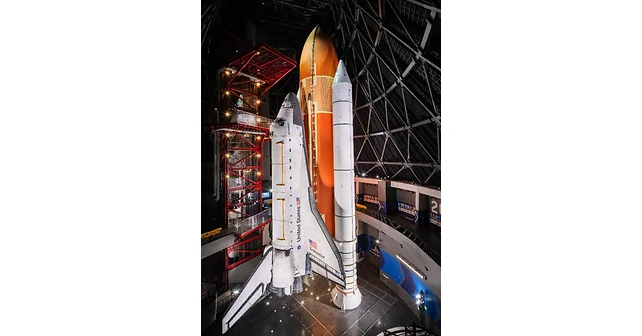
The Samuel Oschin Air and Space Center is a 200,000-square-foot expansion of the California Science Center that will nearly double the museum's exhibit space. The new center features more than 100 artifacts, including rare and historic aerospace objects, along with 100 new hands-on exhibits, featuring interactive experiences focused on science, technology, and engineering. The three multi-level galleries – the Samuel Oschin Shuttle Gallery, the Korean Air Aviation Gallery, and the Kent Kresa Space Gallery – represent the third and final phase of a three-decade master plan to develop one of the world's leading science learning centers. At the heart of the new center, Space Shuttle Endeavour will be displayed vertically in a launch-ready configuration with authentic solid rocket boosters and the last remaining flight-qualified external tank, ET-94. The Samuel Oschin Air and Space Center opens to the public on Friday, November 13, 2026, at 10:00 a.m.

RESERVATION DETAILS

Advance reservations will be available at: https://californiasciencecenter.org/visit/get-reservations-tickets or by calling 213-744-2019. Guests can make up to 19 individual reservations per entry time. Parties of 20 or more individuals require a group reservation by calling 213-744-2019.

While general admission to the California Science Center is free, reservations for the Samuel Oschin Air and Space Center – including Space Shuttle Endeavour – are strongly encouraged due to anticipated high demand. Entry may be limited for visitors without advance reservations. A $4 reservation service fee per person will apply; the fee will be waived for California Science Center Members.

Membership to the California Science Center Foundation supports a world-class educational resource and family destination that is available to everyone, general admission free. All Memberships are family memberships and include program and event admission for up to two adults and four children (aged 17 and under). Several Membership levels are available, with additional benefits and experiences varying by gift level. In appreciation for their support, California Science Center Members will be eligible to make the first reservations beginning October 19 at 9:30 a.m.

More information about California Science Center Membership can be found at californiasciencecenter.org/member.

About the California Science Center

The California Science Center is a dynamic destination where families, adults, and children can explore the wonders of science through hands-on exhibits, live demonstrations, innovative programs, and awe-inspiring large-format movies. The California Science Center and IMAX Theater are located in historic Exposition Park just west of the Harbor (110) Freeway at 700 Exposition Park Drive, Los Angeles. Open daily from 10:00 a.m. to 5:00 p.m. General admission to the Science Center is FREE. The California Science Center is proud to be accredited by the Association of Zoos and Aquariums (AZA) and the American Alliance of Museums (AAM). Visit https://californiasciencecenter.org/ for more information.

About the EndeavourLA Campaign

A project of this scope and scale requires the visionary leadership of the philanthropic community and the support of the broader public. EndeavourLA is the California Science Center Foundation's fundraising campaign that enabled the acquisition and previous temporary display of space shuttle Endeavour supports our work to complete the Samuel Oschin Air and Space Center and sustain ongoing exhibits, programs, and operations. The project's lead donors are the Mr. and Mrs. Samuel Oschin Family Foundation and the State of California, joined by principal donors Korean Air and the Kresa Family Foundation, along with numerous individuals, foundations, and corporate supporters. 

The California Science Center Foundation is actively fundraising to complete this ambitious project, with over $415 million raised toward the $450 million goal. Everyone can help realize this exciting vision for the future Samuel Oschin Air and Space Center, and donations at any level are welcome. To contribute or learn more, go to endeavourla.org.

About Membership to the California Science Center

For more information about opportunities to support the California Science Center Foundation as a Member visit our website at californiasciencecenter.org/member, email [email protected] or call 213-744-7504. Memberships can be purchased online or in person at the Membership Services Window, located at the Box Office, open daily from 10:00 a.m. to 4:30 p.m.

Media Contacts

Kristina Kurasz Cutting | Director of Communications | California Science Center

[email protected] | 213-744-7446

Sophie Jefferies | Communications Manager | California Science Center

[email protected] | 213-744-7491

Maura Klosterman-Vu | Polskin Arts

[email protected] | 310-552-4117

SOURCE California Science Center Foundation

Share this article

Class (B2B/B2C)
B2C
Ingest Status
Rewritten
Dedupe hash
prn_302909032
Press Eligible
Yes
Press Eligible Reason
Public announcement of a science center opening and visitor reservations.
Source Name
Unknown Company
Original Summary

<p>California Science Center Members receive early reservation access beginning October 19 Clickherefor images and footage Clickherefor archival images and footage LOS ANGELES, Oct. 14, 2026 /PRNewswire/ -- The California Science Center announced today that advance reservations for the...</p>

Image URL
https://mmx.prnewswire.com/media/MS2013623/California-Science-Center-announced-today-that-advance-reservations-for-the-Samuel-Oschin.jpg?id=OA3019765&p=facebook
Content Hash (SHA-256, erste 32 hex)
0508f8b307a2924b3551d0a090be607c
Hadrian Expands Partnership with Lockheed Martin to Scale Production of Critical Missile Systems
Image File
Original HTML

First-of-its-kind, seven-year agreement brings Hadrian's automated manufacturing capabilities directly into Lockheed Martin's Grand Prairie facility to scale critical missile production

TORRANCE, Calif., Oct. 14, 2026 /PRNewswire/ -- Hadrian, the advanced manufacturing company building highly automated factories and production capacity for America, today announced a first-of-its-kind, seven-year agreement with Lockheed Martin to bring Hadrian's advanced manufacturing capabilities directly into Lockheed Martin's Missiles and Fire Control (MFC) facility in Grand Prairie, Texas.

Building on the memorandum of understanding announced in December 2025, the agreement will integrate Hadrian's manufacturing capabilities, Opus software platform, and national factory network with Lockheed Martin's program and production expertise. Together, the companies will add scalable manufacturing capacity to support critical missile programs integral to the United States' Arsenal of Freedom, including PAC-3 MSE, THAAD, PrSM, and GMLRS.

Through the partnership, Hadrian and Lockheed Martin will:

- Add advanced manufacturing capacity at Lockheed Martin's Grand Prairie facility to support production across key missile programs.

- Strengthen supply chain resiliency by bringing machining capacity on-site while maintaining access to Hadrian's broader manufacturing network.

- Combine Hadrian's Opus software and automated manufacturing capabilities with Lockheed Martin's existing program and production expertise.

- Begin commissioning in early 2027, with manufacturing cells phased in over the seven-year agreement and each supporting multiple missile programs.

"The warfighter can't wait on peacetime timelines. Hadrian is bringing the automation, software, and workforce training from our own factories directly into Lockheed Martin, so we can produce more, faster. Rebuilding the Arsenal of Freedom at the scale America needs will take partnerships that combine expertise and speed, and this is what that looks like," said Chris Power, CEO of Hadrian.

Hadrian will operate directly inside Lockheed Martin's production ecosystem in Grand Prairie, creating a new model for expanding domestic capacity needed to produce critical defense systems. The partnership will also provide the flexibility to shift production across Hadrian's broader machining network as demand evolves.

"Moving with wartime urgency to deliver the combat-proven capabilities the United States and our allied partners need at unprecedented scales requires innovative solutions and thinking differently," said Tim Cahill, president, Lockheed Martin Missiles and Fire Control. "This partnership brings together the world-class workforce and proven excellence of Lockheed Martin with Hadrian's expertise in commercial technology, ensuring we take the best of both companies to meet the mission."

The partnership is designed not only to meet today's production needs, but to strengthen the American manufacturing base needed to sustain U.S. defense production for the long term.

About Hadrian

Hadrian is rebuilding America's industrial base with highly automated factories that combine process engineering, AI, and robotics. Its mission is to help space and defense manufacturers produce full programs at scale in the U.S. while giving American workers the tools to compete globally.

The company operates four facilities covering just under 3 million square feet: two in Torrance, California, and newly launched sites in Arizona and Alabama, with additional sites in development across the country. More information at https://www.hadrian.co/.

About Lockheed

Lockheed Martin is a global defense technology company driving innovation and advancing scientific discovery. Our all-domain mission solutions and 21st Century Security® vision accelerate the delivery of transformative technologies to ensure those we serve always stay ahead of ready. More information at Lockheedmartin.com.

Media Contact: [email protected]

SOURCE Hadrian

Share this article

Class (B2B/B2C)
B2B
Ingest Status
Rewritten
Dedupe hash
prn_302909081
Press Eligible
Yes
Press Eligible Reason
QA FAIL (need review): Final paragraph is a generic 'About Hadrian' boilerplate describing the company's facilities and locations, with no news context, which violates the PR-boilerplate ending criterion.
Source Name
Unknown Company
Original Summary

<p>First-of-its-kind, seven-year agreement brings Hadrian's automated manufacturing capabilities directly into Lockheed Martin's Grand Prairie facility to scale critical missile production TORRANCE, Calif., Oct. 14, 2026 /PRNewswire/ -- Hadrian, the advanced manufacturing company building...</p>

Image URL
https://mmx.prnewswire.com/media/MS1588320/Hadrian-Updated-Logo.jpg?id=OA3019784&p=facebook
Content Hash (SHA-256, erste 32 hex)
eba15d45dfaf59c36ba7d18430c8e04a