PayCargo News
Image File
Original HTML

Australian freight businesses are feeling this pressure directly. According to CreditorWatch’s April 2026 Business Risk Index, late payments across Australian businesses are now at their highest level since January 2020. The report frames late payments as an early indicator of financial stress, one that shows up before it’s reflected in the formal insolvency data.

What the data actually shows

CreditorWatch’s findings point to a few things happening at once: higher interest rates are pushing up the cost of debt, inflation and energy prices are adding to everyday expenses, and softer consumer demand is making it harder for businesses to pass those costs along. Together, that’s leaving less breathing room in day-to-day cash flow, and freight is one of the industries feeling it most.

The Transport, Postal and Warehousing industry recorded one of the highest rates of invoices sitting more than 60 days overdue, at 7.09%, alongside a 1.24% rolling annual insolvency rate, one of the higher figures across the industries CreditorWatch tracks.

Data Source: CreditorWatch Business Risk Index, rate of 60+ arrears by industry, 12 months to April 2025.

Why freight is exposed to this particular pressure

Transport and logistics businesses tend to run on thinner margins than most industries, and they’re more exposed to input costs, fuel, labor, equipment, that move independently of what they can charge customers.

But it’s worth being precise about where the 60-plus days are actually going. Even in a slower-than-ideal case, settlement itself doesn’t take two months. Payments in Australia typically settle within a business day or two, and when vendors have guaranteed funds behind a payment, that friction is reduced even further. So where do the other 58 or 59 days actually go? The delay isn’t happening at the point of transfer. It’s happening before the payment is ever authorized.

Where the delay is actually coming from

A meaningful share of “late payment” isn’t a customer sitting on cash, it’s an invoice that never made it through internal approval in the first place. In freight specifically, that tends to come down to a few recurring issues:

- Invoices missing required documentation before they can be matched to a shipment

- GST amounts on freight invoices that are missing, incorrectly calculated, or don’t match a valid tax invoice

- Approval workflows that don’t reflect how the team actually operates, so invoices get routed to the wrong person or stall waiting on a sign-off nobody was expecting to give

- Charges that don’t match an existing accrual or contract, going unflagged until someone happens to catch the discrepancy manually

- Disputed charges handled over email and spreadsheets, with no clear record of where a dispute stands or who’s responsible for resolving it

None of these are customer behavior problems. They’re internal workflow problems, and they compound as invoice volume grows.

How forwarders are closing the internal gap

The bottleneck for most freight businesses isn’t moving money, it’s everything that happens before approval: matching an invoice to a shipment, validating the charges, getting it signed off.

A few patterns are showing up in how forwarders are closing that gap:

- Approval flows built for logistics, not generic finance software. Roles, approval routing, and document handling are set up to match how a freight team actually operates, rather than forcing operations to adapt to a finance tool.

- Reconciliation against accruals and contract terms, automatically. Invoices are matched against accrual data and contracted rates the moment they arrive (including GST treatment and valid tax-invoice requirements), instead of someone manually checking a rate sheet against a bill.

- Exceptions flagged and routed automatically. Exceptions are flagged immediately and routed to the right person for review and approval, so the approved cost moves straight into the TMS rather than sitting in a manual queue.

- Disputes handled in one place. Rather than disputes living in scattered email threads, they’re managed end-to-end, with document attachments and status visibility, so nothing sits unresolved because no one remembers whose turn it is to respond.

- Straight-through processing at scale. One global freight forwarder PayCargo works with, operating across 20+ countries and more than 14,000 customers, had a 40-person finance team dedicated entirely to manual invoice reconciliation. After implementing PayCargo’s AP Automation, 80% of invoices now clear for payment automatically, freeing that team from manual reconciliation without adding headcount as volume grew.

For freight teams already managing thin margins and rising input costs, removing the internal delay is one of the few levers fully within their control.

The bigger picture

A six-year high in late payments isn’t going to resolve itself through better customer relationships alone. For Australian freight businesses, it’s a structural signal that cash is moving too slowly through the system, and every day an invoice sits unresolved is a day of working capital they don’t have access to.

Fixing that doesn’t require rebuilding how a business operates. It usually starts with automating the one step that’s been quietly slowing everything else down.

Class (B2B/B2C)
B2B
Ingest Status
Error
Dedupe hash
6f25a5128f7504aaa80a33886f80aab7
Press Eligible
No
Press Eligible Reason
Drupal Push 422
Source Name
PayCargo
Image URL
https://paycargo.com/wp-content/uploads/2026/09/invocie.avif
Source Node
Content Hash (SHA-256, erste 32 hex)
2dc0ef167b0c92f938f9aea0658a7455
Keeping your logistics payments secure
Image File
Original HTML

SECURITY & COMPLIANCE

Keeping your logistics payments secure

At PayCargo, we prioritize security, privacy, and regulatory compliance. As a trusted logistics technology platform, we facilitate secure payment instructions exclusively through licensed financial institutions and payment providers.

How PayCargo ensures payment security & compliance

Whether you’re a payer or vendor, PayCargo is your trusted partner, ensuring secure payments, data privacy, and strong relationships. Our mission is to provide fast, secure, and compliant financial infrastructure, ready for the future of logistics.

Day to day security protocol

Security is fundamental at PayCargo. Our platform is supported by strong internal controls, reliable technology, and secure financial reporting.

Smart, protected data storage

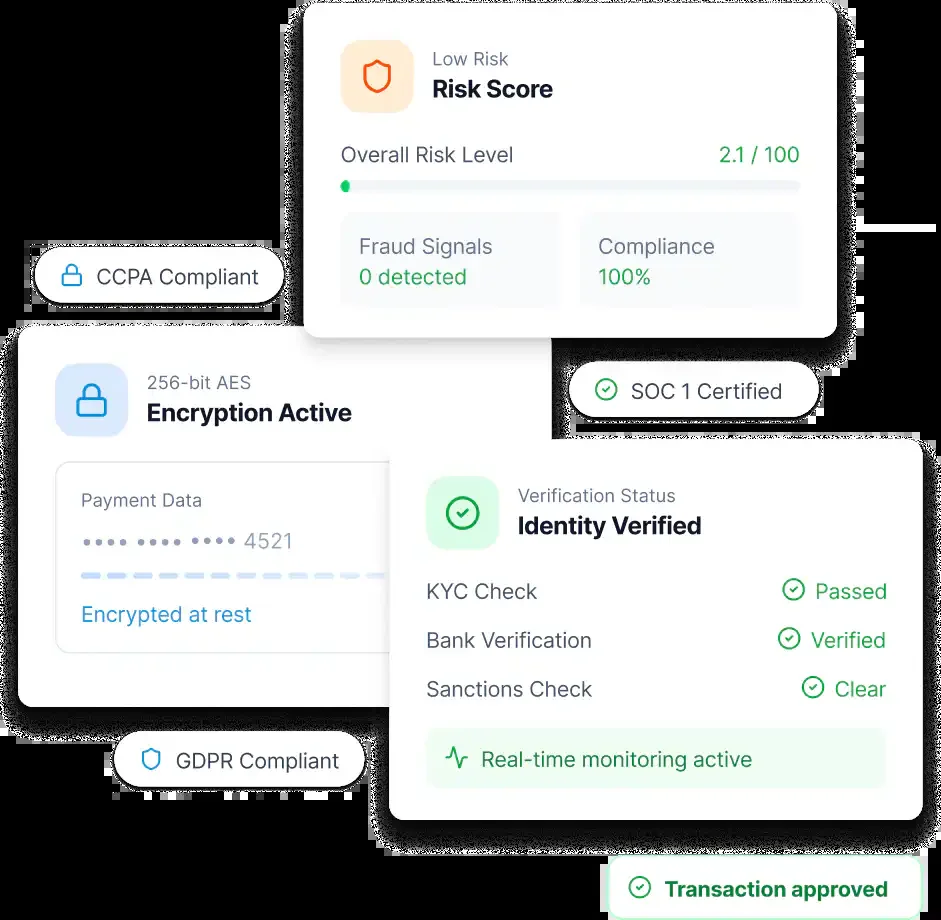
Complying with GDPR and CCPA, PayCargo minimizes sensitive data storage and protects what we keep using AES-256 encryption, verified by independent auditors.

Global compliance & licensing

PayCargo complies with local laws worldwide by partnering only with licensed banks and payment providers. We maintain licenses, perform audits, and use SOC 1–validated technology to ensure regulatory adherence in every jurisdiction.

OUR CERTIFICATIONS

Our commitment to security and compliance

PCI DSS Compliance

PayCargo complies with the Payment Card Industry Data Security Standard (PCI DSS), helping ensure that cardholder data is securely handled and protected.

SOC 1 Type 2 Certified

PayCargo is SOC 1 Type 2 certified, ensuring strong controls over financial reporting, internal processes, and transaction security.

GDPR Compliant

PayCargo implements data privacy practices aligned with the EU General Data Protection Regulation (GDPR) globally, supporting the protection of personal data for our customers and partners.

CCPA Compliant

We comply with the California Consumer Privacy Act (CCPA), empowering California residents with control over their personal data.

Key features of PayCargo’s secure payment platform

We onboard every member using a proprietary, risk-based system refined over a decade. Multiple layers of identity and account verification prevent fraud, identify high-risk entities, and reduce risks from unverified or sanctioned parties. We use trusted tools, including global identity checks, government and commercial databases, and real-time account validation to ensure secure, compliant payer and vendor profiles from the start.

To verify the identity of payers and vendors on our network, we use trusted, industry-leading technologies and commercial databases, including public government sources, to thoroughly verify both identity and bank account information.

PayCargo screens members against OFAC, EU, UN, and other required sanctions lists at onboarding and through ongoing monitoring. We also screen for PEPs and adverse media and follow “Know Your Cargo” guidance to verify counterparties and key documents, helping prevent goods diversion and reduce regulatory and reputational risk.

PayCargo verifies all new vendor bank accounts using third-party bank verification systems to ensure that account and routing numbers match the vendor’s business name. Multi-party calls are also conducted for final verification. PayCargo never holds or transfers funds; we send secure payment instructions between verified banks, keeping all money within the banking system.

Our fraud and risk team, combined with advanced technologies, continuously monitors transaction activity to detect and prevent fraud. Unusual activity is stopped in real time and before it is processed, reducing the risk of chargebacks and protecting you from fraudulent activity and the risk of financial loss.

PayCargo proactively manages vendor risk through ongoing relationship oversight, advanced fraud monitoring, and robust verification protocols. All vendors undergo rigorous due diligence, including multi-layered identity and bank account verification using trusted verification tools and commercial intelligence sources. Any changes to vendor banking details trigger a full re-verification process. Our fraud and risk teams continuously monitor transaction activity to ensure security and compliance.

PayCargo uses a proprietary, risk-based onboarding process with layered identity and account verification to help ensure secure, compliant participants across the network.

Fraud prevention

and risk management

PayCargo integrates seamlessly with systems that power every aspect of your business.

Fraud prevention and risk management

Non-compliant partners increase fraud risk, regulatory fines, and operational disruptions. PayCargo’s strict onboarding and continuous monitoring reduce these risks, protecting your logistics payments at every step.

Partner compliance: minimizing your risk

Our fraud team uses advanced tools and real-time monitoring to detect and stop suspicious transactions. We combine rule-based logic, third-party verification, and AI-powered solutions to stop fraud before it impacts your business.

Customer support for transaction issues

PayCargo follows a multi-step verification process to ensure payment details are accurate and secure:

Transaction cancellations

PayCargo assists in canceling transactions before the cutoff time (varies by region) if an issue is identified.

Refunds

- Automated Refunds: Available for vendors enrolled in this feature, allowing you to request refunds directly through your PayCargo account.

- Manual Refunds: For vendors not enrolled, PayCargo assists in recovering funds by working with the vendor and keeping you informed throughout the process.

Maintaining payment accuracy and security

PayCargo follows a multi-step verification process to ensure payment details are accurate and secure:

1. Fraud prevention and risk management

Customers must submit official documents (like a voided check or bank letter) to verify bank details.

2. Vendor vetting and KYC

Customers must submit official documents (like a voided check or bank letter) to verify bank details.

3. Ongoing audits & compliance

Customers must submit official documents (like a voided check or bank letter) to verify bank details.

How we handle vendor bank account changes

Verification process

Any request to update a Vendor’s bank account information undergoes a rigorous verification process to confirm the legitimacy of the new details.

Security with advanced technologies

We use bank-grade verification systems to validate U.S. bank and routing numbers and ensure account accuracy.

Expanding our global vendor network

150,000+ businesses and 6,500+ vendors trust PayCargo.

Streamline operations and reduce storage fees by 23%.

$45B+ in logistics transactions enabled by PayCargo since 2021.

SECURITY & COMPLIANCE

Questions about security or compliance?

We’re available to answer questions about PayCargo’s security, compliance standards, and risk controls.

Policies

To ensure the security, privacy, and proper functioning of our platform, PayCargo has developed the following policies. These outline the terms, conditions, and guidelines governing the use of our services:

Request access

Please provide the following details to get access to PayCargo Private Reports

Class (B2B/B2C)
B2B
Ingest Status
Error
Dedupe hash
632f3bb5c6374944a1c182baf8c0d514
Press Eligible
No
Press Eligible Reason
Drupal Push 422
Source Name
PayCargo
Image URL
https://paycargo.com/wp-content/uploads/2025/11/security-ui.webp
Source Node
Content Hash (SHA-256, erste 32 hex)
67c57b5ac6f0e11cc1729a221a47cb07
Meet Us at TIACA Air Cargo Forum 2026
Image File
Original HTML

Attending Team Members

Todd Pigeon

Vice President of Sales

PayCargo

Jonathan Giffin

Director of Enterprise Development

PayCargo

Maggie Lelutie

Director of Enterprise Development

PayCargo

Isaac Adams

Director of Enterprise Development

PayCargo

The International Air Cargo Association (TIACA) is the unique international association representing and uniting all parts of the air cargo industry. TIACA Air Cargo Forum is a world-class event that brings together industry leaders, innovators, and stakeholders from across the air cargo and logistics community.

Find answers, access demos, and troubleshoot quickly.

Class (B2B/B2C)
Ignore
Ingest Status
Rejected
Dedupe hash
7612089b430d45c9ac1ba30d157a6674
Press Eligible
No
Press Eligible Reason
Text too short (84 words. Min: 150)
Source Name
PayCargo
Image URL
https://paycargo.com/wp-content/uploads/2026/01/airplane-at-terminal-gate-in-international-airport-2026-01-05-00-52-21-utc-1024x683.webp
Source Node
Content Hash (SHA-256, erste 32 hex)
e3e4aac3a7029bf27cb9209fe5709c56
Hayden Panettiere Died of ‘Toxic Effects’ of Fentanyl and Other Drugs, Coroner Says. What We Know So Far
Image File
Original HTML

Hayden Panettiere’s cause of death has been confirmed by the coroner’s office of the county where she died, five weeks after the actor passed away at age 36.

The actor died from “toxic effects of fentanyl, 4-ANPP, Alprazolam, Methocarbamol, and Quetiapine,” according to a statement from South Carolina’s Greenville County Coroner’s Office, released Sept. 22.

The manner of death was accidental, the statement added.

Panettiere’s death was first announced on Aug. 16, 2026, by her father, Skip Panettiere. She had been pronounced dead earlier that day after emergency personnel in Greenville responded to a report of an unresponsive female, who was later identified as the “Nashville” star.

At the time, no cause or manner of death was shared, but Panettiere’s publicist, Kasey Kitchen, said an investigation was ongoing.

Local authorities added in a statement at the time that there were no “signs of foul play or suspicious circumstances” uncovered in the preliminary investigation and that “an acquaintance of Ms. Panettiere placed the 911 call.”

Panettiere leaves behind a daughter, Kaya, 11, whom she shared with ex-fiancé Wladimir Klitschko. In 2018, Panettiere gave up custody of Kaya. She called not living with her daughter “the most gut-wrenching experience of my life” in her 2026 memoir, “This Is Me: A Reckoning.”

Panettiere was open about her experiences with addiction and postpartum depression leading up to her death.

She wrote in her memoir that a doctor told her while she was in treatment in 2020 that she’d “be dead within five years” if she didn’t stop drinking. And she recalled taking “happy pills” at age 16 to help her with media interviews.

“They were the gateway drug that ushered me toward the good of pharmaceuticals and the downfall of addiction,” Panettiere wrote.

The actor had said that she hoped that her candidness would be able to help others going through similar challenges. And at a May 2026 appearance to promote her memoir, she shared that she’d been able to do just that.

“Someone said to me, ‘Because you’ve talked about your mental health, you gave me the courage to be honest about mine and get myself help, and you saved my life.’ And I was like, ‘This is worth it, I can hopefully leave the world a better world than I found it,’” Panettiere said.

How Did Hayden Panettiere Die?

Panettiere died from “toxic effects” of several drugs, according to local authorities. These include:

- Fentanyl: a strong synthetic opioid used for pain relief and as an anesthetic

- 4-ANPP: a precursor to fentanyl usually found in illicit forms of the drug

- Alprazolam: an anxiety medication available under the brand name Xanax

- Methocarbamol: a prescription muscle relaxant

- Quetiapine: an antipsychotic medication used to treat schizophrenia, bipolar disorder and major depressive disorder

Hayden Panettiere’s Cause of Death Explained

The “toxic effects” of medications lead to death when “a toxic amount of a drug, or combination of drugs overwhelms the body,” according to the National Harm Reduction Coalition.

In particular, opioids like fentanyl can render a person unable to breathe because the drugs affect the receptors that drive the body to inhale and exhale. Without enough oxygen, the heart and brain will stop functioning, leading to coma and then death.

Ingest Status
Rejected
Dedupe hash
735090d48cff8fb8aa396fd34476e254
Press Eligible Reason
JSON nicht lesbar - manuelle Pruefung noetig: Inhalt konnte nicht als JSON geparst werden
Source Name
Truveta
Image URL
https://media-cldnry.s-nbcnews.com/image/upload/t_social_share_1200x630_center,f_auto,q_auto:best/rockcms/2026-08/hayden-panettiere-cause-death-mh-08172026-73b77b.jpg
Source Node
Content Hash (SHA-256, erste 32 hex)
4cb8280bdcd64a0eb1ce90afd600f0eb
Kyle Kennedy Spoke About Being Paralyzed and Disability Rights in Emotional Speech Before Death
Image File
Original HTML

Prior to her death last month, Kyle Kennedy — educator and granddaughter of Robert F. Kennedy — became a fierce advocate for the disability community, bringing major accessibility issues to legislators after a spinal cord injury left her paralyzed.

The activist appeared before the Massachusetts State Legislature as recently as June 2025 to testify on discrimination against those with disabilities while receiving healthcare services. Her testimony came just a year before she passed away.

“Blessed with a formidable intellect, dry wit, and beauty, she will be remembered for her devotion to her children Conor, Josephine, and Declan, and her support for educational reform for disadvantaged children and for people living with disabilities,” Kennedy’s obituary reads.

Kennedy died at her home in Westwood, Massachusetts, on Sept. 21, NBC News confirmed with the town clerk, Dottie Powers. She was 42.

Kennedy — who graduated from Georgetown University in Washington, D.C., before earning master’s degrees from New York’s Pace University and Harvard University — spent her early years heavily involved in education, according to her obituary.

She taught in the New York City public school system as part of nonprofit Teach for America before working with tech companies with the aim of advancing school curricula. She also coached educators who worked with young students, the obituary said. However, the spinal cord injury in 2020 prompted her to get involved in a new realm of advocacy.

Speaking to the Joint Committee on Health Care Financing, Kennedy threw her support behind a Massachusetts House bill that seeks to protect disabled people from being denied or de-prioritized for lifesaving treatment, as well as from other forms of discrimination.

In front of state legislators, Kennedy opened up about her experiences receiving healthcare as someone who was paralyzed from the chest down. During her testimony, she shared that she had once been turned away at a dentist’s office because “they couldn’t find an exam room to fit me.” In another instance, she said she was asked, “Well, how disabled are you?” upon calling ahead to inquire about the accommodations for her wheelchair.

Through tears, Kennedy also brought up a number of incidents in which her catheter and bladder issues were insensitively handled by a number of medical personnel.

“I could go on to tell you about how hard it is for me to get a chest X-ray, or that it’s pretty much impossible for me to have a mammogram. But our time is limited,” Kennedy said during her testimony. “I believe that H.130 will make it so that these stories don’t have to happen, or maybe we’ll have a happier outcome for disabled people like myself, and perhaps more training for the people who need it.”

As of July 20, the bill has been referred to the committee on House Ways and Means and needs to go through several other committees before being passed.

According to her obituary, Kennedy continued to demonstrate resilience amid her advocacy and medical struggles.

“The years that followed brought struggles but Kyle fought to maintain her dry wit and determination through it all, trying to be the best possible mother to her sons and caring for her two beloved, ill-behaved Wheaten terriers,” the obituary said.

Ingest Status
Rejected
Dedupe hash
7c25ce14963401462911f0e7c5feab63
Press Eligible Reason
JSON nicht lesbar - manuelle Pruefung noetig: Inhalt konnte nicht als JSON geparst werden
Source Name
Truveta
Image URL
https://media-cldnry.s-nbcnews.com/image/upload/t_social_share_1200x630_center,f_auto,q_auto:best/rockcms/2026-10/kyle-kennedy-paralysis-testimony-02-mh-10212026-137831.jpg
Source Node
Content Hash (SHA-256, erste 32 hex)
99be2027183377571a6610e4f9418e3e
What happens when you stop taking a weight loss drug? Many people gain the weight back.
Image File
Original HTML

Artemis Bayandor, 40, has been trying to lose weight for the last 20 years.

She didn’t find success until her doctor prescribed Wegovy, a weight loss drug, in August 2021. She lost 15 pounds in about six months.

But it all stopped in February, when Bayandor’s health insurance denied her coverage, forcing her to stop taking the medication. A month later, she had gained the 15 pounds back, followed by 10 more pounds six months later.

“It was kind of a mind f---,” said Bayandor, of Naperville, Illinois.

Bayandor’s experience isn’t uncommon: Widespread shortages of Wegovy, a popular weight loss aid, have forced some people in the U.S. to stop taking it, leading them to gain some — or all — of their weight back. Others have stopped taking it for different reasons, such as cost, unpleasant side effects or unrelated health issues.

Dr. Domenica Rubino, the director of the Washington Center for Weight Management & Research in Arlington, Virginia, said the weight gain in people who stop taking the drug “makes sense.”

Rubino led a 2021 study, published in the Journal of the American Medical Association, that found that people who took Wegovy regained two-thirds of the weight they had lost when they went off the drug.

Obesity is a chronic illness, she said. As with any other chronic illness, most patients will need to take the medication for their entire lives to maintain the benefits, which, in this case, means keeping the weight off.

“They are chronic medications,” she said, “which means you basically take them just like you take blood pressure medicine or diabetes medicine.”

Wegovy, or semaglutide, is part of a class of drugs called GLP-1 agonists. They mimic a hormone that helps reduce food intake and cuts appetite. In clinical trials, Wegovy was shown to reduce body weight by around 15%.

People who stop taking the drug may notice that their appetites return to the levels they experienced before they took it, said Dr. Holly Lofton, the director of the weight management program at NYU Langone Health. In some cases, she said, their appetites may feel even bigger than they were before they lost the weight.

“When you’re at that max weight loss, your body’s hunger hormones are the highest,” she said. “So if you lose 50 pounds and regain 25, your hunger is the highest when you’ve lost the 50. And even when you regain the 25, it doesn’t go back to baseline; your hunger is higher than prior to losing weight.”

Eli Diaz, 35, of Naples, Florida, said her doctor first prescribed Ozempic in February before switching her over to Wegovy a month later. She also made some lifestyle changes, including altering her diet and exercise. (Ozempic and Wegovy are the same drug, semaglutide. It’s sold under the name Ozempic for diabetes and, at a higher dose, as Wegovy for weight loss.)

From February to May, Diaz lost 22 pounds.

In May, an unrelated thyroid issue landed her in the hospital and forced her to stop taking Wegovy.

Over the next six months, she gained all of the weight back.

“It was expected, because I didn’t continue the medication or the diet afterward,” she said.

Lofton noted that with or without Wegovy, a healthy diet and exercise are important for weight maintenance.

Diaz said she’s considering starting again on the drug. “I am willing to start soon again and see if, you know, if they will help me again,” she said.

Restarting the medication sometimes isn’t an easy task, said Dr. Susan Spratt, an endocrinologist and the senior medical director for the Population Health Management Office at Duke Health in North Carolina.

Because Wegovy can come with side effects, such as nausea or vomiting, patients are often first prescribed a lower dose that is gradually increased over several weeks.

“That’s really burdensome,” she said.

Bayandor, the Illinois woman, said she worries about the side effects. She said it took her six months before she reached the highest dose.

“Honestly, I’m afraid,” she said of restarting the medication. “When I was on it, it felt taxing on my body.”

She said she plans to see a weight loss physician next month before she decides whether to get back on the medication, if she can afford it.

“It is such a great and powerful drug,” she said.

Related:

Class (B2B/B2C)
B2C
Ingest Status
Error
Dedupe hash
2775c8528e4c569eb5dd8137835a5be9
Press Eligible
No
Press Eligible Reason
Drupal Push 422
Source Name
Truveta
Image URL
https://media-cldnry.s-nbcnews.com/image/upload/t_social_share_1200x630_center,f_auto,q_auto:best/rockcms/2023-01/230118-weight-loss-stock-mn-0955-7c8470.jpg
Source Node
Content Hash (SHA-256, erste 32 hex)
1b80e19902416fac13b9eef49d8b39ec
Smarter management for demurrage and detention
Image File
Original HTML

Container Payment Portal™

Smarter management for demurrage and detention

The Container Payment Portal™, powered by PayCargo and Gnosis Freight, combines real-time tracking with seamless payments to speed container release and reduce dwell time.

Trusted by:

Real-time visibility. Faster container release.

A joint solution connecting PayCargo payments with Gnosis Freight visibility to eliminate manual steps, reduce delays, and simplify container management.

Instant invoice visibility

Automate invoice handling and cut manual data entry

One-click payments

Pay accurately and instantly using secure, verified payment options

Immediate release

Containers are cleared as soon as payment is made

Fewer disputes

Shared, verified information helps every party stay compliant

How Hapag-Lloyd Streamlined Demurrage Payments with the Container Payment Portal™

Built to meet the standards of global logistics

Oversee containers from payment to release

Unified visibility and payments

View all container charges and holds in one dashboard, combining PayCargo’s secure payments with Gnosis Freight’s real-time data.

Connected carrier network

Link directly with carriers and terminals to send verified payment and release data automatically.

Automated release workflow

Trigger container release as soon as payment is confirmed no manual steps or delays.

Verified audit trail

Every transaction is tracked, time-stamped, and accessible for compliance and dispute resolution.

How PayCargo payments work

See how our secure network connects payers and vendors to move freight faster

One network, all modes

Connect shippers, carriers, and terminals through a unified platform that simplifies communication and cash flow.

Instant, verified settlements

Real-time verified invoice data plus PayCargo settlement flow to accelerate container release.

End-to-end visibility

From invoice to release, every stakeholder can view, track, and confirm payment and release status.

Manage container payments and releases in real time

Payments

Secure, real-time payments to keep shipments moving.

PayCargo Finance

Flexible funding options to manage cash flow.

Class (B2B/B2C)
B2B
Ingest Status
Rewritten
Dedupe hash
9802a63922f70f413f5e24f0f7b18ff5
Press Eligible
Yes
Press Eligible Reason
Describes a logistics payments and container-management solution for shippers, carriers, and terminals.
Source Name
PayCargo
Image URL
https://paycargo.com/wp-content/uploads/2025/12/products-cpp-image-ui.webp
Source Node
Content Hash (SHA-256, erste 32 hex)
00771b4ddf348735b8582b3b4be54cc9
PayCargo News
Image File
Original HTML

Image Source: ABC News

From October 1, 2026, Australian businesses will no longer be able to add an extra fee to a customer’s bill simply because they paid by card, either debit or credit. The ban covers eftpos, Mastercard, and Visa, the three networks the Reserve Bank of Australia (RBA) directly regulates. American Express, UnionPay, and PayPal have all agreed to align on the same date. It applies everywhere a card is used: in-store, online, or through a mobile wallet.

The RBA concluded that surcharging had stopped working as intended: most customers had no way to avoid it at checkout, and many merchants were charging a flat fee with little connection to what the card actually cost to process. The underlying cost doesn’t disappear, businesses just can’t show it as a separate line item anymore. They absorb it or account for it elsewhere in their pricing.

To soften that shift, the RBA is also lowering interchange fees and tightening transparency rules so businesses can see what they’re actually being charged. A further cap on foreign-card interchange fees follows in April 2027.

What a business can actually do about it

The RBA’s guidance points to a few concrete steps: reviewing whether a business is on the right payment plan for its needs, shopping around between providers rather than assuming the current setup is cheapest, and, for anyone who wants to steer customers toward a specific payment method, offering a discount instead. That’s still allowed, even though the reverse no longer is.

Most major payment providers are already reaching out to their business customers with guidance on how the change applies to their specific platforms, and industry bodies have published their own resources for merchants navigating the transition.

Image Source: 4BC Brisbane

What this means for logistics

The RBA has been clear that business-to-business payments aren’t automatically exempt. Unless a specific card network chooses to carve out its own exemption, and that decision sits with the card networks, not the RBA, the same no-surcharge rule applies whether the person paying is a consumer or another business.

That matters for freight specifically because a lot of freight runs through exactly that kind of payment. Supplier invoices, storage and detention charges, and account settlements are frequently paid by card, and frequently between two businesses rather than a business and a consumer. Carriers, forwarders, and airlines that currently pass a card-processing fee on to customers paying by credit card are in the same position as any other business here. They need to stop doing that by October 1.

From there, it’s the same set of choices every merchant in the country is working through: absorb the cost, build it into pricing, or look more closely at where payment costs are actually coming from and whether a different provider or process could bring them down.

Freight businesses also tend to run a specific kind of payment mix that makes this harder than it looks on paper. A single carrier or forwarder might be settling invoices through credit card, direct debit, and wire transfers on any given day, often across several disconnected systems that don’t talk to each other. It’s a pattern we see often: payment, invoicing, and reconciliation handled as three separate steps instead of one connected process, no matter which of those payment methods is involved.

Australian freight businesses are looking at what the surcharge changes mean for the way they manage payments, not just at replacing one fee with another. They’re looking at the whole payment process, from how invoices are paid through to reconciliation and settlement. The surcharge change is bringing that conversation to the forefront.

For a lot of freight businesses, that closer look is landing on the same place: how much of the payment and invoicing process is still manual, and how much time that manual work adds before an invoice is actually settled. Tools like AP automation and document automation have been part of that conversation for a while, the surcharge change is just giving it new urgency.

For the full detail, including the RBA’s complete FAQ on how the ban applies to specific payment types, visit the RBA’s surcharging page.

Ingest Status
Rejected
Dedupe hash
ddd1e1967051bdf608d773f560554335
Source Name
PayCargo
Image URL
https://paycargo.com/wp-content/uploads/2026/10/card-surcharge.avif
Source Node
Content Hash (SHA-256, erste 32 hex)
44637844031f50903e3a5e4c47e03031
Alaska Airlines Becomes First Carrier to Fully Integrate Digital Payment System with PayCargo and IBS Software
Image File
Original HTML

PayCargo, the trusted logistics payment platform, and IBS Software, a leading SaaS solutions provider to the travel and aviation industry, today announced a new integration with Alaska Airlines that makes Alaska the first carrier to bring both inbound and outbound payment processes together through the PayCargo platform via iCargo, IBS Software’s market-leading cargo management platform. This announcement comes a few short weeks after PayCargo and IBS Software announced the deepening of their long-standing partnership to accelerate digital transformation across the global air cargo ecosystem.

The new system sets a benchmark for digital payment automation in air cargo. It connects payment and cargo management workflows from start to finish. This integration helps customers release cargo more quickly and with greater accuracy. It also reduces manual steps and provides a clearer and more reliable payment experience.

“This integration reflects our focus on making air cargo simpler and more reliable for our Alaska Air Cargo customers,” said Ian Morgan, Vice President of Cargo, Alaska Airlines. “Working with PayCargo and IBS Software, we’re creating a process that’s faster, clearer, and more connected.”

PayCargo and IBS Software have worked together for several years to simplify how airlines and freight forwarders manage payments. The new integration builds on that partnership by embedding PayCargo’s secure, real-time payment capability directly into the iCargo system used by Alaska Airlines.

“This milestone with Alaska Air Cargo shows what is possible when payment and cargo systems work as one,” said Eduardo Del Riego, President and CEO of PayCargo. “Customers benefit from faster processing, fewer errors, and smoother financial operations.”

“At IBS Software, our goal is to help airlines improve efficiency through well-connected digital systems,” said Radhesh Memon, VP, Head of Strategy & Product, Cargo at IBS Software. “Working with PayCargo and Alaska Airlines has resulted in a simple and practical solution that ushers in a new era of seamless payments directly through our iCargo platform.”

The collaboration marks a step forward in the modernization of air cargo operations. By combining payment and cargo management systems in one connected process, PayCargo, IBS Software, and Alaska Airlines are helping to make freight transactions faster, more accurate, and easier to manage. The integration reinforces each company’s commitment to advancing efficiency and reliability across the air cargo industry.

About PayCargo

PayCargo is the most trusted logistics payment platform, accelerating the release of cargo across the global supply chain. With over 6,500 active vendors in the PayCargo Network, users can instantly send secure payments for same-day or overnight release to major Air, Land, Rail and Ocean carriers.

What started as a streamlined payment solution has grown into a comprehensive platform supporting the full invoice lifecycle. By expanding beyond payments to offer tools that automate and optimize invoice processing, PayCargo continues to drive innovation across the supply chain, helping industry leaders improve efficiency, reduce manual work, and gain better financial control.

For more information, visit paycargo.com

About Alaska Air Cargo

Alaska Air Cargo serves 100-plus destinations across North America with more than 1,300 daily flights, offering a variety of reliable shipping products, a long history of cold-chain innovations and unmatched customer service throughout our network. We are the only passenger airline in the U.S. with dedicated cargo planes, and our freighter fleet serves 20 communities across the state of Alaska, as well as Seattle and Los Angeles in the lower 48. We also offer belly-cargo service on more than 300 passenger planes serving the continental U.S., Canada, Hawaii and Mexico.

About IBS Software

IBS Software is a leading SaaS solutions provider to the travel industry globally, managing mission-critical operations for customers in the aviation, tour & cruise, hospitality, and energy resources industries. IBS Software’s solutions for the aviation industry cover fleet & crew operations, aircraft maintenance, passenger services, loyalty programs, staff travel, and air cargo management. Across the hospitality sector, IBS Software offers a cloud-native, unified platform for hotels and travel sellers, including central reservation (CRS), property management (PMS), revenue management (RMS), call centre, booking engine, loyalty, and distribution. For the tour & cruise industry, IBS provides a comprehensive, customer-centric, digital platform that covers onshore, online and on-board solutions. Across the energy & resources industry, we provide logistics management solutions that cover logistics planning, operations & accommodation management. The Consulting and Digital Transformation (CDx) business focuses on driving digital transformation initiatives of its customers, leveraging its domain knowledge, digital technologies and engineering excellence. IBS Software operates from 17 offices across the world. Further information can be found at www.ibsplc.com Follow us: Blog | LinkedIn | Facebook | Instagram

Class (B2B/B2C)
B2B
Ingest Status
Need Review
Dedupe hash
263356bcc8066d0c50db1c685cfafb32
Press Eligible
Yes
Press Eligible Reason
QA FAIL (need review): The final paragraph is a generic 'About PayCargo' boilerplate (vendor count, network capabilities, invoice lifecycle) copied from the source and adds no news context to the article.
Source Name
PayCargo
Image URL
https://paycargo.com/wp-content/uploads/2026/02/preparation-before-flight-loading-of-cargo-contai-2026-01-08-01-32-43-utc-1024x683.webp
Source Node
Generated Article_json
{"target_audience": "b2b", "is_medical": false, "ai_generated_title": "Alaska Airlines First to Run Cargo Payments via PayCargo, iCargo", "body_html": "<p><strong>United States -- [CURRENT_DATE] --</strong> Alaska Airlines has become the first carrier to run both inbound and outbound cargo payment processes through the PayCargo platform, connected to IBS Software's iCargo cargo management system, the three companies announced.</p><h5>PayCargo embeds real-time payments directly into iCargo</h5><p>The integration places PayCargo's secure, real-time payment capability inside the iCargo system that Alaska Air Cargo already uses. Payment and cargo management workflows are linked from start to finish, which the companies say lets customers release cargo faster and with greater accuracy while cutting manual steps.</p><p>The announcement follows by a few weeks the deepening of the long-standing PayCargo and IBS Software partnership, which targets digital transformation across the global air cargo ecosystem.</p><h5>Alaska Air Cargo targets a faster, more connected process</h5><p>Ian Morgan, Vice President of Cargo at Alaska Airlines, said the goal is a process that is \"faster, clearer, and more connected\" for Alaska Air Cargo customers.</p><p>PayCargo President and CEO Eduardo Del Riego said customers gain faster processing, fewer errors and smoother financial operations. Radhesh Memon, VP and Head of Strategy &amp; Product, Cargo at IBS Software, described the result as a practical solution for payments made directly through iCargo.</p><h5>Alaska operates 1,300 daily flights across 100-plus destinations</h5><p>Alaska Air Cargo serves more than 100 destinations across North America with over 1,300 daily flights. It is the only U.S. passenger airline with dedicated cargo planes. Its freighter fleet serves 20 communities across Alaska, plus Seattle and Los Angeles. Belly-cargo service runs on more than 300 passenger planes serving the continental U.S., Canada, Hawaii and Mexico.</p><p>PayCargo's network includes more than 6,500 active vendors. Users can send payments for same-day or overnight release to major air, land, rail and ocean carriers. The platform now covers the full invoice lifecycle, including tools that automate and optimize invoice processing.</p>", "meta_description": "Alaska Airlines becomes the first carrier to run inbound and outbound cargo payments through PayCargo inside IBS Software's iCargo, cutting manual steps.", "seo_keywords": "PayCargo, IBS Software, Alaska Airlines, iCargo, air cargo payments, Alaska Air Cargo, logistics payment platform, cargo management, digital payment automation", "companies": ["PayCargo", "IBS Software", "Alaska Airlines"], "industries": ["Transportation & Mobility"], "markets_regions": ["United States", "North America"], "news_type": ["partnership_announcement", "product_launch"], "products": ["iCargo"], "themes": ["digital_transformation", "payments_automation", "supply_chain"], "events": [], "cta_text": "Learn more about PayCargo's logistics payment platform and its air cargo integrations", "learn_more": "https://paycargo.com", "fact_check": {"accuracy_score": 100, "legal_risk": "low", "corrections_made": [], "recommendation": "publish"}}
Content Hash (SHA-256, erste 32 hex)
760c4f011458c3ab705756ed7cb40e94
Older Adults Technology Services (OATS) from AARP News
Image File
Original HTML

Last Word…

A Shared Legacy

Life is short and the urge to make a difference runs strong in many of us.

At OATS, we know that everyone could be doing something other than working with us to harness technology and change the way we age. We could spend more time with our kids, our art, our church, or another important cause. We could be working to secure our financial futures and those of our families. But instead, here we are—you reading this, and us writing it.

We like to think it’s because we’re all looking for a chance to make our mark, to leave the world better than we found it. And the field of aging, especially in the age of digital transformation, is a place where that can happen. The collective opportunity we have unleashed by adding so much time to the human lifespan in recent generations is perhaps the greatest social canvas to be made available since the advent of the modern world. The way we respond to the challenges and possibilities of this new era will define our lives and those of our descendants in ways we can only imagine.

At OATS, we tend to depart from the dry language of social science and impact metrics when we talk of the legacy we are working to create. We use words like “awesome,” “magical,” and “uplifting.” We tell stories of the friends we’ve made at Senior Planet, of the people who have guided and inspired and encouraged us. We are ignited by the crackling energy that comes from bringing people together who share a collective assumption about human beings: that we are capable of pretty much anything, and that any given day—right up until our last one—might be our best one yet. That’s the magic of working in aging today.

We invite you to join us in seizing the chance to “dare mighty things.” We don’t have all the answers, not even most of them…but we are unashamed to admit that we’re idealists and we’re here to push the limits of the possible to make a meaningful difference out there. If you’re an idealist too, you should give us a call. Let’s do something worth being remembered for.

Ingest Status
Rejected
Dedupe hash
c81b68939cb7cc0608c40385f7e1b2b1
Press Eligible Reason
JSON nicht lesbar - manuelle Pruefung noetig: Inhalt konnte nicht als JSON geparst werden
Source Name
Older Adults Technology Services (OATS) from AARP
Image URL
https://oats.org/wp-content/uploads/2020/04/Tom-Press-at-SPEC-1024x990.jpg
Content Hash (SHA-256, erste 32 hex)
f0acd0c551f31d7814d59a3d215cbb89