AdvaMed® in Action: When Alliances Put Patients First
Image File
Original HTML

When you work in government affairs, it can be easy to spend a lot of time talking about policies, legislation and regulations. But behind every one of those conversations is a patient waiting for an answer, a treatment or a technology that can make a difference in their life.

That is what keeps me focused on building strong relationships across our industry and with the people we ultimately serve. Patient advocates, medtech companies, state associations and policy leaders each bring a different perspective to the table. When we bring those voices together, we have a better opportunity to understand what patients need and turn that understanding into meaningful action.

That spirit of collaboration will be everywhere at The MedTech Conference this October in Boston — and I’m looking forward to seeing it in action.

Q: Why are alliances so important to advancing patient access?

A: Because the people closest to a health care challenge often have the clearest view of what needs to change.

Patient advocacy organizations bring the lived experience of patients and families. Medtech companies bring an understanding of the technologies that can address unmet needs. Our state partners understand what is happening in their communities and with policymakers back home. When those perspectives come together, we can make a stronger case for policies that help patients access the care and technology they need.

Our work with patient advocates around access to Alzheimer’s blood-based diagnostics is one example. AdvaMed worked alongside patient advocacy partners to help policymakers understand why sustainable Medicare reimbursement matters for patients. When Medicare reimbursement expanded, it created a pathway for more patients to access these important diagnostic tools. That is what patient-centered advocacy looks like: bringing the right voices together around a real access challenge.

Q: How is that same approach showing up at the state level?

A: Across the country, we are working with patient organizations and our State Medtech Alliance partners on policies that directly affect access and patient safety.

Our 2026 Patients First Agenda focuses on policies that can improve access to medical technology, accurate diagnostic testing and safe and effective treatments. And our state partners are critical to advancing that work because they understand the unique needs and policy environments in their communities.

That is why the State Medtech Alliance, or SMTA, is so important. It brings state and regional associations together to share best practices, promote the industry and advocate for policies that support innovation.

At #MTC26, we will have the opportunity to bring that community together again — connecting the national conversation with the people doing this work every day at the state and regional level.

Q: Where will attendees see this spirit of collaboration at #MTC26?

A: The patient experience is woven throughout the fabric of the MedTech Conference – with the Patient Pavilion as the hub.This patient-focused area of the exhibit hallcarries patient stories throughout the week — giving attendees the opportunity to meet the people whose lives have been changed by medical technology.

Like Brittany, who could finally get answers for years of exhaustion, a diagnosis of severe sleep apnea helped explain what she had been experiencing — and treatment helped her regain her energy, confidence and independence.

For patients like her, medical technology is not simply a device, diagnostic or treatment. It can mean getting answers. Getting back to work. Moving more freely. Spending more time with family. And getting back to the life they want to live.

That is what makes the Patient Pavilion so powerful. Across stories from Abbott, BD, Dexcom, Edwards Lifesciences, Insulet, Medtronic, Philips, Resmed, Siemens Healthineers, Smith+Nephew, Stryker, Solventum, Vantive and other medtech companies, patients will share what happened when the right technology met the right moment in their lives.

We will hear from patients whose lives have been touched by technologies ranging from diagnostics and imaging to devices that help restore mobility and independence. And attendees will have the opportunity to see some of those innovations up close, including Philips’ portable MRI technology.

These are the stories that put everything else we do into perspective. Behind every policy conversation, reimbursement decision and technology breakthrough is a person — and a family — waiting for access to the technology that can change what is possible.

Q: What other new opportunities for connection are you looking forward to?

A: We are also creating new opportunities for leaders across the industry to connect around the issues most important to them.

For the first time, #MTC26 will host a dedicated gathering for chief medical officers. CMOs sit at a unique intersection of clinical care, innovation and patient needs, and bringing these leaders together creates an opportunity to share perspectives and build relationships around the challenges and opportunities facing our industry.

If you are part of an AdvaMed member company and serve as a CMO, I encourage you to RSVP and join us. It is exactly the kind of focused connection that makes this conference valuable — putting people with shared responsibilities and shared goals in the same room.

Q: What are you most looking forward to at #MTC26?

A: Connecting with the people throughout the medtech ecosystem.

The best part of this work is bringing people together who care deeply about improving health care and giving them the opportunity to find common ground.

I am looking forward to seeing patient advocates, state medtech leaders, CMOs, innovators, policy leaders and industry partners in the same place — sharing ideas, building relationships and finding new ways to work together.

Because when we build stronger alliances, we build a stronger voice for patients.

And that is when medtech is truly in action. 

Bobby Patrick, VI

Bobby Patrick, VI, SVP, Government Affairs; Head of State Government & Regional Affairs; Head of Alliance Partnerships, AdvaMed

Hear Patient Stories

The Story of Medtech empowers patients to share their experiences with medical technology in an effort to educate, inspire, and create community.

Class (B2B/B2C)
B2B
Ingest Status
Rewritten
Dedupe hash
1062846e4c5c913584e1be40e43363c8
Press Eligible
Yes
Press Eligible Reason
Medtech industry advocacy, patient access, and conference news for industry professionals.
Source Name
AdvaMed News
Original Summary

<p>Behind every policy conversation is a patient waiting for access to the care and technology they need. In this edition of AdvaMed in Action, Bobby Patrick explores how collaboration among patient advocates, medtech companies, state partners and policy leaders can help advance patient access and turn shared priorities into meaningful action.</p>
<p>The post <a href="https://www.advamed.org/2026/10/01/advamed-in-action-when-alliances-put…® in Action: When Alliances Put Patients First</a> appeared first on <a href="https://www.advamed.org">AdvaMed®</a>.</p>

Image URL
https://www.advamed.org/wp-content/uploads/2026/09/AdvaMed.org-ADVAMED-IN-ACTION_Web-Header-Preview-300-x-250-px.png
Source Node
Content Hash (SHA-256, erste 32 hex)
151867123949a243c5262ea7326edd82
Medtech Moves Us: Looking Ahead to The MedTech Conference 2026
Image File
Original HTML

Momentum is building for The MedTech Conference, October 18–21, 2026, in Boston, and I hope you’ll join us. With AdvaMed member participation at an all-time high, expanding international engagement, and our largest Medtech Campus ever, this year’s conference brings together the people and perspectives shaping what comes next for our industry.

Our shared mission, putting patients first, remains at the center of these conversations. As companies navigate advances in AI, a fast-moving regulatory environment, and new investment and market access opportunities, connecting with the right people and insights matters more than ever.

Our theme, “Medtech Moves Us,” reflects both the impact of our industry and the value of coming together to move it forward. Here’s what awaits you in Boston:

- Record member participation and new connections. Join AdvaMed members, CEOs, and leaders across business development, R&D, regulatory, clinical affairs, and strategy. Nearly half of registered attendees are new, creating fresh opportunities to build relationships across the medtech community.

- Timely education curated by industry leaders. Our education and program team has spent months developing conversations around the decisions facing your business: how AI and digital health are changing care, what it takes to commercialize innovation, and how companies can navigate global markets and improve patient access. Hear directly from medtech executives, policy experts, CMS and senior FDA CDRH leaders.

- Expanded investor programming and business development opportunities. Connect with investors and strategic partners, explore emerging innovations, and hear leading medtech companies outline their investment and partnering priorities through corporate reverse pitches. Make the most of your time in Boston by arranging 1:1 partnering meetings before you arrive.

- Highlights of the Keynote Stage. Hear from Mick Farrell of Resmed, Mike Mahoney of Boston Scientific, Ashley McEvoy of Insulet, and Robbie Marcus of J.P. Morgan in a discussion moderated by John Babitt of EY, with additional perspectives from Johnson & Johnson MedTech and Operation Smile. Get a firsthand perspective from Dr. Michelle Tarver as the Director, CDRH and other senior FDA CDRH leaders on the regulatory issues shaping the future.

- Our largest Medtech Campus ever. With 185+ presenting companies and more than 500 speakers across the Campus and education sessions, you’ll find new ideas, practical insights, and opportunities to do business. Explore live demonstrations in the Tech in Motion Hub, emerging company pitches, and conversations spanning the full medtech ecosystem.

- A growing global community and the next generation of medtech. Strong participation from Europe, the UK, Central America, and our new Nordic-Baltic delegation will bring valuable international perspectives. Dedicated opportunities for students, veterans, and early-career professionals will help connect tomorrow’s leaders with the industry they will help shape.

The value of Boston is what you can take back to your organization: a new relationship, a clearer strategy, or an opportunity that moves your business forward.

Explore the 2026 program and register today.  

Scott Whitaker

Scott Whitaker, President and CEO, AdvaMed

Hear Patient Stories

The Story of Medtech empowers patients to share their experiences with medical technology in an effort to educate, inspire, and create community.
Class (B2B/B2C)
B2B
Ingest Status
Rewritten
Dedupe hash
84715c983ccb19b035b628e9e1dd080f
Press Eligible
Yes
Press Eligible Reason
Medtech industry conference announcement with business, investment, technology, and regulatory programming.
Source Name
AdvaMed News
Original Summary

<p>AdvaMed President &#038; CEO Scott Whitaker looks ahead to The MedTech Conference 2026 in Boston, where “Medtech Moves Us” comes to life through new connections, timely insights, expanded opportunities and the people shaping the future of medtech.</p>
<p>The post <a href="https://www.advamed.org/2026/10/01/scott-whitaker-mtc26-momentum/">Medt… Moves Us: Looking Ahead to The MedTech Conference 2026</a> appeared first on <a href="https://www.advamed.org">AdvaMed®</a>.</p>

Image URL
https://www.advamed.org/wp-content/uploads/2026/10/AdvaMedinAction_BP.jpg
Source Node
Content Hash (SHA-256, erste 32 hex)
a11b5b217d6965ca71ca6f2e93f8b884
When is software not just software?
Image File
Original HTML

When is software not just software? That’s the question at the center of comments AdvaMed recently filed with the U.S. Copyright Office.

At first glance, this may sound like a narrow dispute about medical device repair. In reality, it reflects a broader challenge facing a software-driven economy: how should the law treat software that is distinct from, but connected to, the products it supports?

Consider the difference between software used by clinicians to operate an imaging system and software designed specifically to diagnose, configure, and service that system.

They are not the same thing.

A useful analogy is the difference between a vehicle’s operating software and the specialized diagnostic tools used by technicians to service it. One enables use of the product. The other is a standalone tool with its own functions, users, protections, and market.

In the medical technology sector, servicing and diagnostic software is often licensed separately, protected by separate access controls, and increasingly delivered through cloud-based platforms rather than residing on the device itself.

That distinction matters.

The question before policymakers is not whether medical devices can be repaired. Lawful avenues for accessing service software and documentation exist today and are widely used.

Rather, the question is whether software created, licensed, and distributed as a separate product should be treated the same as software embedded in the device’s operation.

As healthcare and other industries become more dependent on specialized software, the answer will increasingly affect innovation, intellectual property rights, cybersecurity, and patient safety. That’s why this issue matters to AdvaMed and America’s patients.

This issue arises in the context of medical technology, but the underlying question extends far beyond healthcare: how we classify software often determines how we protect it.

Hear Patient Stories

The Story of Medtech empowers patients to share their experiences with medical technology in an effort to educate, inspire, and create community.

Class (B2B/B2C)
B2B
Ingest Status
Rewritten
Dedupe hash
8d9390231b27149743fd6d18a6219593
Press Eligible
Yes
Press Eligible Reason
Discusses software classification, intellectual property, and medical technology industry policy.
Source Name
AdvaMed News
Original Summary

<p>When is software not just software? That's the question at the center of comments AdvaMed recently filed with the U.S. Copyright Office. At first glance, this may sound like a narrow dispute about medical device repair. In reality, it reflects a broader challenge facing a software-driven economy: how should the law treat software that is distinct from, but connected to, the products it supports?</p>
<p>The post <a href="https://www.advamed.org/2026/10/02/when-is-software-not-just-software/"… is software not just software?</a> appeared first on <a href="https://www.advamed.org">AdvaMed®</a>.</p>

Image URL
https://www.advamed.org/wp-content/uploads/2026/10/iStock-2271236323-1024x683.jpg
Source Node
Content Hash (SHA-256, erste 32 hex)
818ff85923ba7ebd415f902c57b68a65
Partners in Patient Care: A Conversation with the ITEM Coalition
Image File
Original HTML

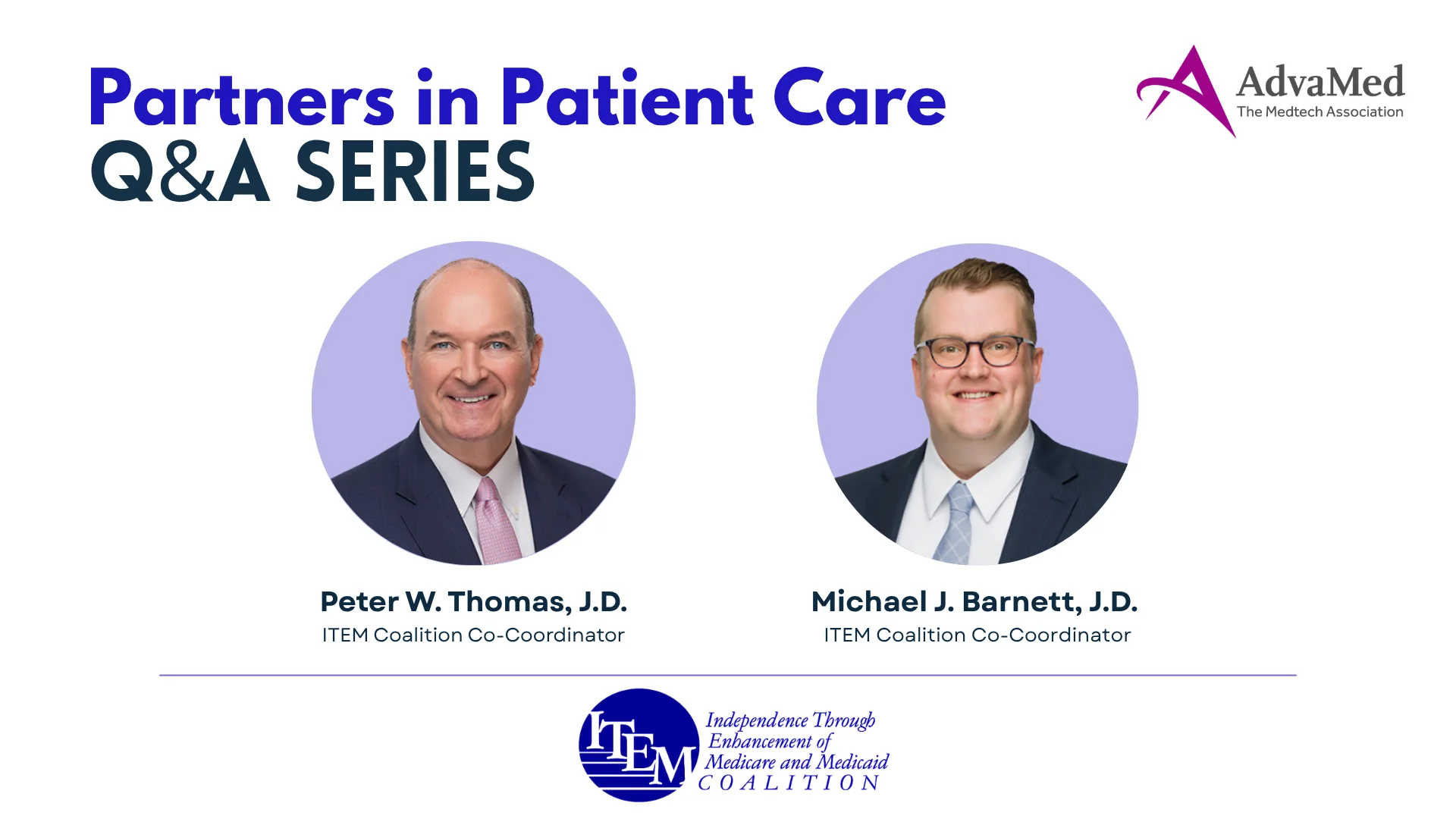
For people living with disabilities and chronic conditions, access to assistive technology can make the difference between dependence and independence. In this installment of AdvaMed’s Partners in Patient Care Q&A series, Peter W. Thomas, J.D., and Michael J. Barnett, J.D., Co-coordinators of the ITEM Coalition, discuss the communities they represent, the barriers patients face, and how collaboration with the medtech community can help improve patient access to assistive technology.

The ITEM Coalition is a national consumer- and clinician-led coalition comprised of 103 national organizations advocating for access to and coverage of assistive devices, technologies, and related services for people of all ages with injuries, illnesses, disabilities, and chronic conditions.

AdvaMed: Who do you represent, how did the organization come to be, and what does your work look like day to day?

Michael Barnett: The Independence Through Enhancement of Medicare and Medicaid (“ITEM”) Coalition is a consumer- and clinician-led coalition comprised of 103 national nonprofit organizations devoted to raising awareness and building support for policies that will enhance access to assistive devices, technologies, and related services for people with disabilities and chronic conditions. Our six-member Steering Committee reflects the breadth of the community we serve, and includes the Amputee Coalition, ALS Association, Christopher & Dana Reeve Foundation, Spina Bifida Association, Team Gleason, and the United Spinal Association.

The ITEM Coalition was created in 2003 to address inadequate access to assistive devices, technologies, and related services. Today, our work focuses on identifying and removing the Medicare, Medicaid, and other federal policy barriers that can prevent people from obtaining the assistive devices and technologies they need to be healthy, functional, and independent.

Day to day, that means working closely with our members to monitor legislation and regulations, engage with Congress and federal agencies, develop coalition comments and recommendations, and advocate on coverage, coding, payment, and other policies affecting access to care. We also bring together diverse patient, disability, clinical, and provider organizations around issues where a unified voice makes a difference.

Ultimately, our strength comes from our members and the lived experiences they bring to the table. Our goal is to ensure those voices are heard when policymakers make decisions that directly affect access to the assistive devices and technologies people depend on.

AdvaMed: What would you most want the medtech community to understand about the patients and families you serve?

Peter Thomas: The patients and families the ITEM Coalition serves are incredibly diverse but share a common need: access to the right assistive technology, equipment, and services at the right time to improve their function and fundamentally change what is possible in their lives. For people living with disabilities or chronic conditions, a wheelchair, prosthetic device, orthotic brace, assistive technology, or other medical device is not simply a product; it can make the difference between dependence or independence, social isolation or community participation, employment or unemployment, and being able to be educated, care for a family, and maximize quality of life.

The ITEM Coalition would also want the medtech community to understand that access does not end when a device becomes available in the marketplace. Patients and families often face complex coverage, coding, payment, and administrative barriers that can prevent them from obtaining assistive technologies their clinicians believe are medically necessary. These barriers can be particularly challenging for people with disabilities and for individuals who rely on Medicare or Medicaid. Our work focuses on ensuring the patient perspective is part of these conversations from the beginning and that innovation ultimately translates into meaningful, timely access for the people these assistive devices and technologies are designed to improve.

AdvaMed: What is your organization’s top policy priority heading into the coming year, and why does it matter to the people you represent?

Michael Barnett: Among the ITEM Coalition’s many priorities heading into 2027, securing Medicare coverage for standing systems in Group 3 power wheelchairs is our top priority. This issue matters because standing systems can provide meaningful health, functional, and independence benefits for people with significant mobility impairments, yet Medicare does not cover these devices despite years of advocacy and clinical evidence. When Medicare coverage does not recognize these needs, beneficiaries can face significant out-of-pocket costs or go without the technology that could meaningfully improve their quality of life.

The ITEM Coalition has been advocating for Medicare coverage of standing systems in Group 3 power wheelchairs for years, including through a pending National Coverage Determination reconsideration request. After six years of waiting for CMS to open a National Coverage Analysis on this issue, we believe it is well past time for CMS to act. This is ultimately about ensuring that Medicare beneficiaries with significant mobility impairments have access to the assistive devices and technologies they need to live more independently and participate fully in their communities.

AdvaMed: What does a strong partnership between a patient organization and the medtech community look like? Are there collaborations that have worked especially well for your community?

AdvaMed: What does a strong partnership between a patient organization and the medtech community look like? Are there collaborations that have worked especially well for your community? Peter Thomas: A strong partnership between a patient/consumer/clinical coalition and the medtech community starts with a shared commitment to putting patients at the center of policy and access decisions. The most effective partnerships are not simply about supporting individual advocacy efforts. Instead, they involve listening to patients and their advocates, understanding the barriers they face, and working together to develop practical solutions that improve access to care and technology.

For the ITEM Coalition, some of our most productive collaborations have involved bringing together patient and disability organizations, clinicians, manufacturers, suppliers, and other stakeholders around a specific access challenge. Each partner brings a different perspective, and that diversity not only adds credibility but also strengthens the advocacy. Medtech companies bring expertise in innovation and the development of new technologies, while patient/consumer organizations help ensure policy discussions remain grounded in the real-world needs of the people who rely on those technologies.

We believe the strongest partnerships are long-term and built on trust, rather than formed only around a particular legislative or regulatory issue.

AdvaMed: Is there anything you’d like to share about your organization or the patient community you serve and advocate for?

Michael Barnett: The medtech community should know that the ITEM Coalition represents the breadth and diversity of the disability, chronic illness, and rehabilitation communities. ITEM brings together more than 100 national non-profit organizations representing these constituencies. While our member organizations have different perspectives and priorities, we share a common goal: ensuring Medicare and Medicaid beneficiaries have access to the medical devices and assistive technologies they need to live healthy, independent, and productive lives.

The ITEM Coalition and its member organizations have a great deal to contribute to conversations about innovation and healthcare access. Patients and people with disabilities understand firsthand what works, what barriers remain, and where innovation is still needed. We see the ITEM Coalition’s role as helping make sure those voices are heard and that innovation translates into meaningful access and better outcomes for the people who need it most.

Get involved: To learn how you can support the ITEM Coalition’s work, contact Michael Barnett at [email protected].

Hear Patient Stories

The Story of Medtech empowers patients to share their experiences with medical technology in an effort to educate, inspire, and create community.

Class (B2B/B2C)
B2B
Ingest Status
Rewritten
Dedupe hash
5b0d192160ca8baee3da5e14b71a20b1
Press Eligible
Yes
Press Eligible Reason
Medtech and patient coalition interview about assistive technology access and healthcare policy.
Source Name
AdvaMed News
Original Summary

<p>For people living with disabilities and chronic conditions, access to assistive technology can make the difference between dependence and independence. In this installment of AdvaMed’s Partners in Patient Care Q&#038;A series, Peter W. Thomas, J.D., and Michael J. Barnett, J.D., Co-coordinators of the ITEM Coalition, discuss the communities they represent, the barriers patients face, and how collaboration with the medtech community can help improve patient access to assistive technology.</p>
<p>The post <a href="https://www.advamed.org/2026/10/14/partners-in-patient-care-a-conversat… in Patient Care: A Conversation with the ITEM Coalition</a> appeared first on <a href="https://www.advamed.org">AdvaMed®</a>.</p>

Image URL
https://www.advamed.org/wp-content/uploads/2026/10/Option-2-1.png
Source Node
Content Hash (SHA-256, erste 32 hex)
877e24727d06af03f591fe94d7a45be8
Transforming Care: Why the VHHA and Andor Partnership Matters
Image File
Original HTML

Healthcare delivery is no longer confined to the walls of a hospital. It spans emergency departments, inpatient units, outpatient clinics, and increasingly, the home. Yet many health systems are still trying to manage this complexity with fragmented technologies and disconnected workflows.

A new partnership between VHHA Solutions and Andor Health signals a different path forward. It highlights how unified, AI-driven infrastructure can support care delivery across the entire continuum.

A Strategic Step Toward Scalable Innovation

VHHA Solutions, an affiliate of the Virginia Hospital & Healthcare Association, has partnered with Andor Health to bring ThinkAndor® to hospitals and care providers across Virginia.

As part of this collaboration, ThinkAndor has been selected as an endorsed platform to help transform care delivery not only in hospitals, but also in non-acute settings such as senior living and behavioral health.

This is significant because it reflects a growing need for technology that works consistently across care environments, rather than forcing providers to adopt different tools for each setting.

Moving Beyond Fragmented Systems

One of the biggest challenges in healthcare today is fragmentation. Systems often rely on a patchwork of solutions for virtual care, communication, monitoring, and care coordination.

This partnership addresses that problem directly.

Through ThinkAndor, healthcare organizations gain access to a single AI-powered infrastructure that supports care from the digital front door to post-acute follow-up.

Instead of switching between platforms, clinicians can operate within a unified environment that brings together data, workflows, and communication.

The impact is straightforward. Less friction for clinicians. Better coordination across teams. More consistent patient experiences.

Supporting the Shift to Value-Based Care

Healthcare policy is rapidly evolving, with increasing emphasis on access, equity, and value-based outcomes. Programs such as the CMS ACCESS Model and Rural Health Transformation initiatives are pushing organizations to rethink how care is delivered and measured.

The VHHA and Andor Health partnership aligns closely with these priorities.

ThinkAndor enables health systems to build care management programs that support chronic conditions, transitional care, and population health initiatives.

By embedding intelligence into workflows, the platform helps organizations meet regulatory requirements while improving both clinical and financial performance.

Expanding Access to Care

Access remains one of the most pressing issues in healthcare, especially in rural and underserved communities.

This partnership aims to close that gap.

With ThinkAndor, providers can extend specialty care, virtual nursing, and monitoring capabilities beyond traditional settings.

That includes:

- Virtual consults in emergency departments

- Remote patient monitoring at home

- Hospital-at-home and community-based care models

- Continuous care coordination across locations

By enabling care delivery wherever patients are, health systems can improve outcomes while reducing unnecessary utilization.

The Role of Agentic AI in Modern Healthcare

At the core of this transformation is agentic AI.

Unlike traditional systems that require manual input, ThinkAndor uses AI agents to analyze data from electronic health records, medical devices, and real-time signals. It then delivers actionable insights directly to care teams.

This capability supports five key areas:

- Digital front door and patient intake

- Virtual hospital workflows and documentation

- Continuous patient monitoring

- Care team collaboration

- Transitions in care and follow-up

The result is a more proactive and coordinated approach to care. Clinicians can act on real-time information rather than reacting after the fact.

Addressing Workforce and Operational Challenges

Healthcare organizations are also facing significant workforce pressures. Staffing shortages, administrative burden, and clinician burnout continue to impact care delivery.

The ThinkAndor platform is designed to help alleviate these challenges.

By automating workflows and optimizing communication, it reduces the time clinicians spend on administrative tasks. It also accelerates time to treatment and improves overall efficiency.

This is not just about technology adoption. It is about enabling care teams to operate at the top of their license and focus on what matters most: patient care.

A Foundation for the Future of Care

What makes this partnership stand out is its focus on infrastructure rather than point solutions.

ThinkAndor is positioned as a foundation that health systems can build on as care models continue to evolve. It supports everything from acute care to home-based recovery within a single platform.

This approach allows organizations to scale innovation without adding complexity. It also ensures that new programs and services can be deployed quickly and consistently.

Final Thoughts

The collaboration between VHHA Solutions and Andor Health reflects a broader shift in healthcare.

The industry is moving toward integrated, AI-driven platforms that can support care across the continuum, improve access, and deliver measurable outcomes.

For health systems navigating increasing complexity, that shift is not optional. It is essential.

And partnerships like this one show how the future of care is being built today.

Class (B2B/B2C)
B2B
Ingest Status
Rewritten
Dedupe hash
2a01c61a300fec0ddc3282ea7d2b59e4
Press Eligible
Yes
Press Eligible Reason
Healthcare technology partnership focused on AI-powered care delivery for health systems.
Source Name
Andor Health
Original Summary

Healthcare delivery is no longer confined to the walls of a hospital. It spans emergency departments, inpatient units, outpatient clinics, and increasingly, the home. Yet many health systems are still trying to manage this complexity with fragmented technologies and disconnected workflows.

Image URL
https://andorhealth.com/wp-content/uploads/2026/02/shutterstock_1561815367-3-1024x634.jpg
Source Node
Content Hash (SHA-256, erste 32 hex)
224ecbd65206f124fe9751277efa9dbc
Recognitions Reflect Real Impact: What Andor’s Industry Honors Signal
Image File
Original HTML

Awards in healthcare technology are common. Meaningful recognition is not.

When a platform earns top honors across multiple independent organizations, especially those driven by customer feedback and rigorous evaluation, it signals something deeper than market momentum. It reflects real-world impact.

That is exactly what Andor Health’s latest announcement represents. The company’s ThinkAndor® platform has been recognized by Black Book Research, KLAS, and Frost & Sullivan, marking a sweep of some of the most respected awards in healthcare technology.

This milestone highlights a broader shift in healthcare. The industry is moving toward AI-driven infrastructure that delivers measurable results, not just incremental improvements.

Recognition Backed by Performance and Experience

Each of the honors awarded to ThinkAndor tells a different part of the story.

Black Book Research named ThinkAndor the top-rated virtual care platform for the third consecutive year, with leading scores in workflow integration, provider efficiency, and patient engagement.

KLAS, widely regarded as a gold standard for healthcare technology evaluation, ranked ThinkAndor as Best in KLAS for Virtual Care Platforms in 2026. The platform achieved a score of 92.6, outperforming the category average by a significant margin.

Frost and Sullivan recognized Andor Health with its Transformational Innovation Leadership award for excellence in acute care virtual health. This recognition reflects not only product innovation, but also the company’s ability to execute and deliver measurable impact across the healthcare ecosystem.

Taken together, these honors represent validation from analysts, industry experts, and most importantly, healthcare providers themselves.

From Innovation to Outcomes

Recognition alone does not define success in healthcare. Outcomes do.

What sets ThinkAndor apart is its ability to translate advanced AI into tangible results. Health systems using the platform are seeing measurable improvements in both operational performance and patient care.

Research published in the Annals of Emergency Medicine found that ThinkAndor’s virtual rounding capabilities reduced patients leaving the emergency department without being seen by 17 percent.

Additional studies in the Canadian Journal of Emergency Medicine showed that its digital front door capabilities improved triage efficiency and reduced unnecessary emergency department visits by 64 percent.

These are not marginal gains. They represent meaningful improvements in access, efficiency, and patient safety.

Why Agentic AI Is Driving This Shift

At the center of this recognition is a fundamental change in how technology supports care delivery.

ThinkAndor is built as a multimodal, agentic AI platform. This means it does more than connect systems or display data. It actively analyzes information from electronic medical records, devices, and real-time signals to deliver actionable insights to care teams.

This approach enables healthcare organizations to:

- Streamline clinical workflows

- Reduce administrative burden

- Improve care coordination

- Accelerate time to treatment

The result is a system that supports clinicians in real time, rather than adding complexity to their workflows.

A Platform Designed for Scale

One of the most important themes behind these honors is scalability.

Healthcare organizations are no longer looking for isolated tools that solve a single problem. They need platforms that can support care across the entire continuum, from initial patient access to acute care and beyond.

ThinkAndor is designed to meet that need. It unifies capabilities such as ambient documentation, workflow orchestration, and care team collaboration into a single, integrated infrastructure.

This allows health systems to expand virtual care programs, improve operational efficiency, and deliver consistent experiences across settings without adding fragmentation.

Trust as the Ultimate Measure

Perhaps the most meaningful aspect of these recognitions is how they are earned.

Many of the awards are based on direct, anonymous feedback from healthcare providers. These are the clinicians, administrators, and leaders who rely on the platform every day.

As Andor Health’s leadership has noted, these honors reflect the trust customers place in the platform and the impact it is having on care delivery.

In an industry where adoption depends on both clinical and operational confidence, that trust is critical.

What This Means for Healthcare Leaders

The broader takeaway from this announcement is clear.

Healthcare is entering a new phase where AI is no longer experimental. It is becoming foundational to how care is delivered, coordinated, and scaled.

Platforms like ThinkAndor are leading this transition by:

- Embedding intelligence into everyday workflows

- Delivering measurable return on investment

- Supporting clinicians while improving patient outcomes

For health systems navigating workforce challenges, rising demand, and increasing complexity, this shift is not optional. It is essential.

Final Thoughts

Andor Health’s sweep of industry honors is not just a moment of recognition. It is a reflection of where healthcare is headed.

The future will be shaped by platforms that combine intelligence, interoperability, and real-world performance. Technology that works quietly in the background while enabling clinicians to focus on patient care.

In that future, success will not be defined by features or functionality alone. It will be defined by outcomes, trust, and the ability to scale impact across the continuum of care.

And by that measure, the direction is already clear.

Class (B2B/B2C)
B2B
Ingest Status
Rewritten
Dedupe hash
5845809161e83346a52a34ef0fd25927
Press Eligible
Yes
Press Eligible Reason
Healthcare technology company and platform recognition, performance claims, and industry implications.
Source Name
Andor Health
Original Summary

Awards in healthcare technology are common. Meaningful recognition is not.

Image URL
https://andorhealth.com/wp-content/uploads/2026/03/shutterstock_439213465-3-1024x683.jpg
Source Node
Content Hash (SHA-256, erste 32 hex)
2eff0343be2671ee73595fa421c14c9b
Rural Health Transformation: How AI & Virtual Workforce Models Expand Access
Image File
Original HTML

Rural healthcare systems face a unique and persistent set of challenges. Limited access to specialists, ongoing workforce shortages, and administrative burden continue to strain providers and impact patient outcomes. At the same time, expectations for access, quality, and efficiency continue to rise.

Addressing these challenges requires more than incremental change. It requires a new model for delivering care.

That is the focus behind Andor Health’s latest announcement. By combining the ThinkAndor® platform with PsynergyHealth’s virtual clinical workforce, the company is advancing CMS Rural Health Transformation initiatives with a scalable, AI-powered approach to care delivery.

The Reality of Rural Healthcare Today

Rural providers operate under constraints that are difficult to overcome with traditional solutions. Staffing shortages are common. Documentation demands consume valuable clinician time. Access to specialty care is often limited or delayed.

These challenges are interconnected. When clinicians are stretched thin, workflows become inefficient and patient access suffers.

The result is a cycle that is difficult to break without fundamentally changing how care is delivered.

A New Model: Technology Plus Workforce

The combination of ThinkAndor and PsynergyHealth introduces a different approach. It brings together AI-powered infrastructure and a virtual clinical workforce to create a unified model for care delivery.

ThinkAndor uses multimodal, agentic AI to listen to clinical encounters, generate documentation automatically, and coordinate care across electronic health records.

At the same time, PsynergyHealth provides the operational and clinical services needed to deploy and scale these capabilities. This includes telehealth operations, care navigation, and remote monitoring programs.

Together, they function as what can best be described as a workforce multiplier. Health systems can expand services and improve access without adding additional staff.

Reducing Burden While Increasing Capacity

One of the most immediate benefits of this model is the reduction of administrative burden.

Through ambient AI, ThinkAndor captures and summarizes clinical conversations in real time. This eliminates the need for manual documentation and reduces redundant data entry across systems.

At the same time, intelligent care coordination agents automate tasks such as referrals and follow-ups. This ensures that patients move more efficiently through the care continuum without requiring additional manual effort from clinicians.

The impact is significant. Clinicians spend more time focusing on patient care and less time navigating systems.

Expanding Access to Specialty Care

Access is one of the most critical issues in rural healthcare. Patients often face long travel times or delays when seeking specialty services.

This model addresses that gap through AI-powered triage and telehealth routing. Patients can be connected to the right level of care more quickly, regardless of location.

In addition, remote monitoring and predictive care programs help providers manage chronic conditions such as heart failure, diabetes, and COPD.

By identifying at-risk patients earlier, health systems can intervene sooner and reduce avoidable hospitalizations.

Supporting CMS Rural Health Transformation Goals

The Centers for Medicare and Medicaid Services continues to push for models that improve access, reduce costs, and enhance care quality, particularly in underserved communities.

The combination of ThinkAndor and PsynergyHealth aligns closely with these goals.

By integrating AI, interoperability, and virtual workforce support, the model helps rural providers improve productivity, lower operational costs, and deliver more coordinated care.

It also enables health systems to scale programs that support population health, chronic disease management, and care transitions.

A Platform Built for the Entire Care Continuum

Another key advantage of this approach is its ability to support care across the entire continuum.

ThinkAndor integrates data from electronic medical records, biometric devices, and other sources to deliver real-time insights to care teams.

This allows providers to manage care from initial patient engagement through acute care and into post-discharge follow-up.

Rather than relying on disconnected tools, health systems can operate within a unified environment that supports consistent, coordinated care.

What This Means for the Future of Rural Care

The partnership between Andor Health and PsynergyHealth highlights a broader shift in healthcare.

Technology alone is not enough. Workforce alone is not enough. The future lies in combining intelligent platforms with scalable service models.

This approach enables healthcare organizations to extend their reach, improve efficiency, and deliver better outcomes without increasing complexity.

For rural communities, the implications are significant. Greater access to care. Reduced burden on clinicians. More proactive management of patient health.

Final Thoughts

Rural healthcare has long faced structural challenges that are difficult to solve with traditional approaches.

By combining agentic AI with a virtual clinical workforce, Andor Health is helping redefine what is possible.

The goal is not simply to digitize existing workflows. It is to transform how care is delivered, coordinated, and scaled.

As healthcare continues to evolve, models like this will play a critical role in ensuring that high-quality care is accessible to every community, regardless of geography.

Class (B2B/B2C)
B2B
Ingest Status
Rewritten
Dedupe hash
4704fc8f0136d6611f1fb4f7d7613ff5
Press Eligible
Yes
Press Eligible Reason
Healthcare technology partnership describes an AI and virtual workforce model for rural health systems.
Source Name
Andor Health
Original Summary

Rural healthcare systems face a unique and persistent set of challenges. Limited access to specialists, ongoing workforce shortages, and administrative burden continue to strain providers and impact patient outcomes. At the same time, expectations for access, quality, and efficiency continue to rise.

Image URL
https://andorhealth.com/wp-content/uploads/2026/03/shutterstock_754403641-3-1024x548.jpg
Source Node
Content Hash (SHA-256, erste 32 hex)
dd2265ec635f796820d5447b7bfc7d20
Four Years at #1: What Andor Health’s Black Book Ranking Reveals About the Future of Virtual Care
Image File
Original HTML

Sustained leadership in healthcare technology is rare. The pace of innovation is fast, expectations are high, and customer needs continue to evolve. Achieving the top position once is notable. Earning it four years in a row signals something much more meaningful.

Andor Health has once again been ranked #1 in overall client satisfaction in the 2026 Black Book survey of non-EHR virtual care platforms. This marks the fourth consecutive year the company has received this recognition, based entirely on validated feedback from healthcare leaders and frontline users.

This milestone is not just about consistency. It reflects a deeper alignment with where healthcare delivery is headed.

Recognition Built on Real-World Experience

Black Book Research evaluates healthcare technology through direct client feedback. In 2026, more than 1,100 healthcare professionals across care settings contributed to the survey.

ThinkAndor®, Andor Health’s agentic AI platform, achieved an overall satisfaction score of 9.75 out of 10 and led in 14 of 18 performance categories tied to enterprise virtual care execution.

These categories include:

- Clinical workflow integration and usability

- Interoperability across systems and devices

- Care team collaboration and escalation support

- AI-assisted automation and workflow orchestration

- Customer support and long-term partnership quality

This breadth of performance matters. It shows that success is not driven by a single feature, but by how well the platform performs across the entire care delivery experience.

The Shift from Tools to Infrastructure

One of the most important insights from the Black Book findings is how healthcare organizations are changing the way they evaluate technology.

Providers are no longer prioritizing standalone telehealth tools. They are looking for platforms that function as a unified operating layer across the enterprise.

This shift reflects a growing need for:

- Seamless interoperability across systems

- Coordinated workflows across care settings

- Real-time visibility into operations and outcomes

- Scalable solutions that support multiple programs

ThinkAndor is designed to meet these expectations by serving as a digital infrastructure that connects clinicians, patients, devices, and workflows into a single environment.

Why Agentic AI Is Driving Performance

At the center of this recognition is a new model for how technology supports care delivery.

ThinkAndor uses agentic AI to continuously monitor clinical context and automate both routine and complex tasks. This includes documentation, patient observation, and workflow orchestration.

Rather than requiring clinicians to search for information or initiate processes, the platform delivers insights and actions in real time.

This enables healthcare organizations to:

- Reduce administrative burden

- Improve care coordination

- Optimize staffing and throughput

- Accelerate clinical decision-making

The result is a system that works alongside care teams, not one that adds friction to their workflows.

Measuring What Matters: Outcomes and Value

Recognition is meaningful only when it reflects measurable impact.

Black Book respondents consistently associated Andor Health with strong performance in areas such as interoperability, workflow orchestration, and long-term platform value.

These capabilities translate into outcomes that matter to health systems:

- Improved operational efficiency

- Expanded access to care through virtual models

- Better coordination across the care continuum

- Increased confidence in long-term technology investments

As healthcare organizations continue to navigate staffing challenges and rising demand, these outcomes are becoming essential rather than optional.

A Signal of Where the Market Is Headed

The significance of this fourth consecutive ranking extends beyond a single company.

It highlights a broader transformation taking place across healthcare technology. According to Black Book, buyers are increasingly favoring platforms that can support enterprise-wide virtual care rather than isolated solutions.

This includes capabilities such as:

- Virtual nursing and remote observation

- Specialist consultations and care escalation

- Home-based care and remote patient monitoring

- Integrated analytics and command center visibility

AI is also evolving from a feature into a core workflow utility, driving automation, real-time insights, and operational resilience.

Trust as the Foundation

Perhaps the most important takeaway from this recognition is trust.

As Andor Health’s leadership noted, repeated recognition is a reflection of client confidence and the outcomes being achieved in real-world settings.

In healthcare, trust is earned through consistent performance, measurable results, and the ability to adapt to changing needs.

Four consecutive years at the top suggests that this trust is not only established, but sustained.

Final Thoughts

Healthcare is entering a new phase where technology is no longer evaluated in isolation. It is judged by how well it supports the entire care delivery ecosystem.

Andor Health’s continued leadership in the Black Book rankings reflects this shift. It shows that the future of virtual care will be defined by platforms that integrate intelligence, workflows, and interoperability into a unified system.

For healthcare leaders, the message is clear.

The next generation of care delivery will not be built on disconnected tools. It will be powered by intelligent infrastructure that scales with the needs of both clinicians and patients.

Class (B2B/B2C)
B2B
Ingest Status
Rewritten
Dedupe hash
8a3fe75b5a708236756ec20b0c8ce265
Press Eligible
Yes
Press Eligible Reason
Healthcare technology company news about virtual care and AI platform performance for healthcare professionals.
Source Name
Andor Health
Original Summary

Sustained leadership in healthcare technology is rare. The pace of innovation is fast, expectations are high, and customer needs continue to evolve. Achieving the top position once is notable. Earning it four years in a row signals something much more meaningful.

Image URL
https://andorhealth.com/wp-content/uploads/2026/03/shutterstock_1085068571-3-1024x463.jpg
Source Node
Content Hash (SHA-256, erste 32 hex)
734df5ffb0ef759f0e0405d19f1ad476
From Fragmented Touchpoints to Intelligent Conversations: The Rise of Multimodal AI in Healthcare
Image File
Original HTML

Healthcare has no shortage of communication tools. Patient portals, call centers, mobile apps, and messaging platforms all promise better engagement. Yet for many patients, the experience still feels disconnected.

A symptom is entered in one place. A call is made in another. A follow-up gets lost somewhere in between.

This fragmentation is not just inconvenient. It is costly, inefficient, and often impacts outcomes.

Andor Health’s latest announcement points to a different future—one where patient conversations are no longer siloed, but intelligently orchestrated across the entire care journey.

The Problem: Conversations Without Continuity

Today’s healthcare ecosystem is built around isolated points of interaction. Patients move between websites, portals, and phone systems, often repeating the same information at every step.

These disconnected experiences create friction for patients and additional workload for clinicians.

Even as digital tools have expanded, most solutions still operate in silos—each handling a piece of the journey, but none managing it end to end.

The result is a system that reacts to patient needs rather than guiding them.

A New Approach: AI That Drives the Conversation

Andor Health is advancing a model that changes this dynamic entirely.

With expanded multimodal agentic capabilities, ThinkAndor® enables voice-based and conversational AI interactions that actively guide patients through their care journey—from initial access to post-acute follow-up.

This is not just about adding another communication channel. It is about transforming how those channels work together.

Instead of waiting for patients to navigate the system, AI agents:

- Initiate and manage conversations

- Understand patient context in real time

- Recommend next best actions

- Coordinate workflows behind the scenes

The experience becomes less transactional and more like a guided journey.

From Entry Point to Intelligent Orchestration

Traditional digital health strategies often focus on the “front door” experience—how patients first access care.

ThinkAndor extends far beyond that.

Its multimodal AI infrastructure orchestrates conversations across every stage of the continuum:

- Initial triage and intake

- Virtual waiting rooms and care navigation

- Inpatient communication and coordination

- Post-discharge follow-up and monitoring

This creates a continuous thread of engagement—one that follows the patient rather than forcing the patient to restart at every touchpoint.

Personalization at Scale

One of the most powerful aspects of this approach is personalization.

ThinkAndor’s agentic AI can analyze a patient’s medical history, current symptoms, and prior interactions to tailor each conversation.

This enables interactions that feel relevant and timely:

- Guidance before a procedure

- Real-time education after a diagnosis

- Automated follow-ups triggered by lab results

- Ongoing support for chronic condition management

Rather than generic messaging, patients receive context-aware engagement that adapts to their needs.

Solving the “Last Mile” of Care

Healthcare has long struggled with what many call the “last mile” problem—the gap between clinical intent and patient action.

Appointments are missed. Instructions are misunderstood. Follow-ups fall through.

This is where agentic AI has a measurable impact.

By actively managing conversations and workflows, ThinkAndor helps close that gap—automating outreach, coordinating next steps, and ensuring continuity of care.

The result is a system that not only informs patients but also helps ensure that care plans are executed.

Reducing Burden While Improving Access

This shift is not just about patient experience. It directly addresses operational challenges as well.

Administrative burden and call center costs continue to rise, contributing to clinician burnout and inefficiency.

By automating patient interactions and workflow orchestration, multimodal AI can:

- Reduce reliance on call centers

- Streamline intake and triage processes

- Free up clinical staff for higher-value tasks

- Improve access without increasing staffing levels

It is a model that expands capacity while reducing strain.

Why Multimodal Matters

The term “multimodal” is more than a technical distinction. It represents a fundamental shift in how AI interacts with healthcare data and communication channels.

ThinkAndor integrates multiple inputs—voice, text, clinical data, and real-time signals—to create a unified understanding of each patient’s journey.

This allows AI agents to move seamlessly across channels, maintaining context and continuity at every step.

For patients, it means fewer gaps. For clinicians, it means better visibility. For health systems, it means a more coordinated approach to care.

A Concierge Experience for Healthcare

Perhaps the simplest way to describe this evolution is through experience.

Instead of navigating a fragmented system, patients are guided through a coordinated journey—one that anticipates needs, removes friction, and supports better decisions.

It is a shift from reactive care to proactive orchestration.

From disconnected touchpoints to continuous conversation.

From systems that manage data to systems that manage care.

Final Thoughts

Healthcare is entering an era where communication is no longer just a feature. It is the foundation of care delivery.

Andor Health’s vision of a multimodal AI infrastructure reflects this shift. By enabling intelligent, continuous patient conversations across the continuum, it moves the industry closer to a model that is more connected, more efficient, and more human-centered.

The future of healthcare will not be defined by how many tools are available.

It will be defined by how well those tools work together—guided by AI that understands, adapts, and acts in real time.

And increasingly, that future is being built around conversation.

Class (B2B/B2C)
B2B
Ingest Status
Rewritten
Dedupe hash
022fcf5e2dd380834569c8fd35497544
Press Eligible
Yes
Press Eligible Reason
Healthcare technology article about Andor Health’s multimodal AI product and its operational applications.
Source Name
Andor Health
Original Summary

Healthcare has no shortage of communication tools. Patient portals, call centers, mobile apps, and messaging platforms all promise better engagement. Yet for many patients, the experience still feels disconnected.

Image URL
https://andorhealth.com/wp-content/uploads/2026/04/Image20for20Briscoe20Blog-1-4-1024x683.jpg
Source Node
Content Hash (SHA-256, erste 32 hex)
8d31e291f78744e102e5b8fc551d7655
Why Care Requires an AI-Native Clinical Services Infrastructure
Image File
Original HTML

Healthcare was built around the visit.

A patient develops symptoms, schedules an appointment, receives treatment, and leaves. Days, weeks, or months pass before another interaction occurs. While this model has served acute care well for decades, it falls short for chronic disease, where patient needs evolve every day, not just during scheduled appointments.

As healthcare shifts toward value-based care and outcomes-based reimbursement, health systems need a fundamentally different operating model. One that continuously monitors patients, identifies risks before they become crises, and coordinates timely interventions at scale.

That is why Andor Health and Psynergy Health launched the ACCESS Clinic, powered by ThinkAndor®, the industry’s leading AI-native clinical services operating system. The initiative combines AI reasoning, a licensed virtual clinical workforce, and an approved CMS ACCESS Model clinic into a single, accountable model for continuous care.

Moving Beyond AI That Documents

Most healthcare AI today focuses on improving productivity during a patient encounter. Ambient documentation, note generation, and clinical summaries reduce administrative burden, but they still depend on the traditional visit as the center of care.

The next generation of AI extends well beyond documentation.

ThinkAndor® continuously analyzes information from electronic health records, remote patient monitoring devices, patient-reported outcomes, and wearable technologies. Rather than simply summarizing information, AI agents reason across the patient’s longitudinal record, identify meaningful clinical changes, prioritize interventions, and prepare recommendations for clinician review. Every decision remains under the oversight of a licensed clinician, ensuring responsible, accountable AI.

The result is a model where AI performs the continuous operational work surrounding care while clinicians focus on the decisions that require human expertise.

Why Continuous Care Matters

More than two-thirds of Medicare beneficiaries live with chronic conditions that require ongoing management rather than episodic treatment. Traditional healthcare models often detect problems only after patients experience deterioration significant enough to require hospitalization.

Continuous care changes that equation.

By combining remote monitoring, longitudinal patient engagement, AI reasoning, and coordinated clinical intervention, providers can identify changes earlier, intervene sooner, and prevent unnecessary emergency department visits and hospital admissions.

This approach aligns directly with the CMS ACCESS Model, which rewards organizations for improving patient outcomes over time rather than simply delivering more visits. The ACCESS Clinic extends these capabilities to Medicare beneficiaries nationwide through coordinated programs focused on cardiometabolic disease, chronic kidney disease, musculoskeletal conditions, behavioral health, transitional care management, and other chronic conditions.

Technology Alone Doesn’t Improve Outcomes

Healthcare organizations have invested heavily in software over the past decade, yet clinicians continue to face workforce shortages, growing administrative demands, and increasing patient complexity.

Technology by itself cannot solve those challenges.

Successful transformation requires technology, clinical services, and operational accountability working together.

The ACCESS Clinic combines:

- AI agents that continuously analyze patient data and automate clinical workflows.

- A licensed workforce of physicians, advanced practice providers, nurses, dietitians, and care coordinators who validate recommendations and deliver care.

- Deep integration with existing clinical workflows and electronic health records.

- A reimbursement model designed around measurable patient improvement rather than episodic encounters.

Rather than handing software to health systems and expecting them to operationalize it, the model delivers both the technology and the clinical services required to achieve outcomes.

Proven at Enterprise Scale

The foundation behind the ACCESS Clinic is already operating across more than 40 health systems, supporting over 20 million patients in nearly every U.S. state. AI agents have completed more than 35 million clinical and patient interactions while helping organizations improve both operational and clinical performance.

Health systems leveraging the platform have achieved outcomes including:

- 180% increase in patients seen following hospital discharge

- More than 40% reduction in unplanned readmissions

- 45% reduction in total cost of care

- 24% reduction in hospital readmissions

- Automated care pathways supporting remote patient monitoring and chronic disease management

These results demonstrate that continuous, AI-enabled care can improve patient outcomes while helping health systems address workforce constraints and financial pressures.

The Future Is Accountable AI

Healthcare is entering a new era.

The conversation is no longer centered on whether AI can generate a note or summarize a chart. The real opportunity is creating AI-native clinical services that continuously support patients, augment clinicians, and improve measurable outcomes.

The ACCESS Clinic represents an important step toward that future by bringing together AI reasoning, clinical expertise, and accountable care delivery into a single operating model.

Because the future of healthcare isn’t defined by better software.

It’s defined by better outcomes.

Class (B2B/B2C)
B2B
Ingest Status
Rewritten
Dedupe hash
75823c977331fcde8039b6e8736759ed
Press Eligible
Yes
Press Eligible Reason
Healthcare AI platform and clinical services launch aimed at health systems and professionals.
Source Name
Andor Health
Original Summary

Healthcare was built around the visit.

Image URL
https://andorhealth.com/wp-content/uploads/2026/07/shutterstock_1644820069-1024x576.jpg
Source Node
Content Hash (SHA-256, erste 32 hex)
31e7f9f403405eb6a2a826aa44911290