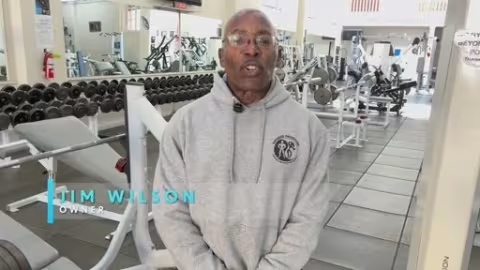
South San Francisco, Calif. -- September 28, 2026 -- A new HelloNation article breaks down exactly what beginners can expect walking into their first fitness boxing class, drawing on insights from Jim Wilson and Futaba Takashima of Physique Magnifique in South San Francisco, California. No prior boxing experience is required, and skills are built progressively as the class moves along.
Classes open with a full-body warm-up before any punches are thrown
Sessions typically start with light jogging, jumping jacks, mobility drills, and bodyweight exercises to raise heart rate and prepare the shoulders, hips, and legs for movement.
Stance and footwork come before punching technique
Instructors introduce a proper boxing stance to support balance, followed by basic footwork such as moving forward, backward, and side to side.
The jab, cross, hook, and uppercut form the technical foundation
According to the article, correct punching technique draws on the hips, legs, shoulders, and core, not just arm movement. As participants grow comfortable with single punches, instructors add combinations, often starting with a jab-cross before layering in hooks. Depending on the gym, drills may involve heavy bags, pads, or shadowboxing.
Fitness boxing skips sparring entirely
Wilson and Takashima note a key distinction: fitness boxing focuses on technique and conditioning, with no sparring or taking punches from an opponent, unlike competitive boxing.
Strength intervals fill the gaps between rounds
Squats, lunges, push-ups, planks, jump rope, and cardio intervals are commonly mixed in between punching drills, engaging the upper body, legs, and core throughout the session.
Feeling uncoordinated on day one is normal
The article points out that juggling combinations, stance, and footwork simultaneously takes concentration, and instructors typically offer simplified versions of exercises for beginners working at their own pace.
Gear requirements differ by gym
Some facilities supply fitness boxing gloves and equipment, while others expect participants to bring their own. Comfortable athletic clothing and supportive shoes round out what's needed for a first session.
By the end of a first class, participants will likely have run through several punches, combinations, and conditioning drills, though the article stresses that mastering every movement immediately isn't the expectation.