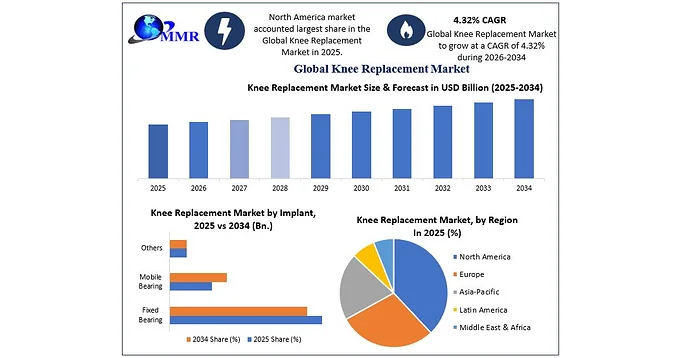
PUNE, India, Sept. 25, 2026 /PRNewswire/ -- The Global Knee Replacement Market was valued at USD 12.17 Billion in 2025 and is projected to expand at a 4.32% CAGR from 2026 to 2034, reaching USD 17.81 Billion by 2034, according to a new analysis by Maximize Market Research.
Global Knee Replacement Market
The Global Knee Replacement Market Report 2026 provides a comprehensive analysis of knee replacement market trends, orthopedic implant adoption, knee arthroplasty procedures, robotic-assisted knee replacement, AI-enabled surgical planning, implant technologies, minimally invasive orthopedic surgery, outpatient arthroplasty, cementless implants, patient-specific implants, smart implants, digital orthopedics, healthcare infrastructure, reimbursement trends, competitive landscape, technology advancements, and market forecasts through 2034. The market covers knee replacement solutions across Total Knee Replacement, Partial Knee Replacement, Kneecap Replacement, and Complex Knee Replacement, with implant technologies including Fixed Bearing, Mobile Bearing, and Others, supporting the treatment of severe osteoarthritis, rheumatoid arthritis, degenerative joint disorders, chronic knee pain, mobility impairment, and complex knee conditions.
The rising prevalence of knee osteoarthritis, aging population, increasing obesity rates, growing demand for mobility-restoring treatments, and rising knee replacement procedure volumes are supporting the expansion of the global knee replacement market. Increasing adoption of robotic-assisted knee replacement, AI-powered surgical planning, computer-assisted navigation, patient-specific instrumentation, advanced orthopedic implants, minimally invasive knee surgery, and enhanced recovery protocols is transforming modern orthopedic care. Growing healthcare expenditure, improved access to specialized orthopedic services, favorable reimbursement policies, and increasing awareness of advanced knee replacement procedures are further creating opportunities for orthopedic device manufacturers and healthcare providers.
Advancements in robotic-assisted surgery, cementless knee implants, porous implant coatings, 3D-printed orthopedic implants, smart implants, digital rehabilitation, remote patient monitoring, and personalized orthopedic care are reshaping the knee replacement landscape. Increasing investments by orthopedic companies in robotic surgery platforms, advanced biomaterials, implant design, AI-enabled surgical technologies, outpatient arthroplasty, and digital orthopedic solutions are creating new opportunities across hospitals, orthopedic centers, and ambulatory surgery settings. Product launches, strategic acquisitions, robotic technology expansion, surgeon training programs, implant innovation, and geographic expansion are expected to strengthen the global knee replacement market through 2034.
Get Full PDF Sample Copy of Report: (Including Full TOC, List of Tables & Figures, Chart) @ https://www.maximizemarketresearch.com/request-sample/57801/
Global Knee Replacement Market gains momentum as rising osteoarthritis prevalence, population aging, increasing demand for mobility-restoring treatments, rapid adoption of robotic-assisted knee replacement, advancements in cementless and patient-specific implants, AI-enabled surgical planning, minimally invasive procedures, and smart orthopedic technologies accelerate innovation in joint replacement care: Maximize Market Research unveils key market insights.
Global Knee Replacement Market Size & Forecast
Global Knee Replacement Market Trends & Insights
- North America leads the Global Knee Replacement Market, supported by advanced healthcare infrastructure, high knee replacement procedure volumes, favorable reimbursement policies, strong presence of orthopedic device manufacturers, and widespread adoption of robotic-assisted knee replacement, AI-enabled surgical planning, computer-assisted navigation, advanced orthopedic implants, and outpatient arthroplasty.
- Asia-Pacific represents a high-growth region, driven by rapid population aging, rising prevalence of knee osteoarthritis, increasing healthcare expenditure, improving orthopedic healthcare infrastructure, growing awareness of knee replacement surgery, medical tourism, and increasing adoption of robotic surgery, minimally invasive knee replacement, advanced knee implants, and digital orthopedic technologies across China, India, Japan, South Korea, Australia, and other emerging markets.
- Robotic-assisted knee replacement is gaining rapid adoption, supported by the increasing use of AI-powered surgical planning, robotic navigation, patient-specific instrumentation, real-time surgical guidance, and computer-assisted orthopedic surgery. These technologies are helping healthcare providers improve implant positioning, surgical precision, joint alignment, procedural efficiency, and postoperative recovery while supporting the adoption of advanced total and partial knee replacement procedures.
- Cementless and advanced knee implants are gaining traction, driven by demand for improved biological fixation, implant longevity, reduced wear, and better long-term clinical outcomes. Advances in porous implant coatings, 3D-printed orthopedic implants, advanced biomaterials, fixed-bearing implants, mobile-bearing implants, and patient-specific implant designs are supporting innovation across total knee arthroplasty and complex knee replacement procedures.
- Outpatient knee replacement and minimally invasive orthopedic surgery are expanding, supported by enhanced recovery after surgery (ERAS) protocols, improved anesthesia, shorter hospital stays, digital rehabilitation, ambulatory surgery centers (ASCs), and remote patient monitoring. The shift toward outpatient arthroplasty, minimally invasive knee surgery, faster recovery, personalized rehabilitation, and value-based orthopedic care is creating new opportunities for healthcare providers and orthopedic device manufacturers.
- Smart implants and digital orthopedics are shaping the future of knee replacement, with increasing research and investment in connected orthopedic implants, wearable rehabilitation devices, AI-enabled postoperative analytics, remote patient monitoring, digital rehabilitation platforms, and personalized orthopedic treatment. These technologies are supporting continuous recovery monitoring, early identification of postoperative complications, and more personalized patient care.
Rising Incidence of Knee Osteoarthritis and Growing Surgical Demand Drive Market Growth
The increasing prevalence of knee osteoarthritis, rheumatoid arthritis, obesity, age-related joint degeneration, chronic knee pain, and mobility impairment is driving demand for knee replacement procedures worldwide. The growing aging population and rising number of patients seeking long-term pain relief and improved mobility are increasing the volume of total knee arthroplasty, partial knee replacement, and revision knee replacement procedures. Growing awareness of advanced orthopedic treatments and improved access to specialized healthcare are further supporting market expansion.
High Procedure Costs and Limited Access to Specialized Orthopedic Care Restrain Market Growth
The high cost of knee replacement surgery, advanced orthopedic implants, robotic-assisted surgical systems, AI-enabled surgical technologies, and postoperative rehabilitation can restrict market penetration, particularly in cost-sensitive and developing healthcare markets. Limited reimbursement coverage, shortages of specialized orthopedic surgeons, unequal access to advanced hospitals, and the high investment required for robotic surgery infrastructure can also create challenges for the adoption of premium knee replacement technologies.
Advancements in Robotic-Assisted Surgery and Advanced Implants Create Opportunities
Rapid advancements in robotic-assisted knee replacement, AI-powered surgical planning, computer-assisted navigation, patient-specific instrumentation, cementless knee implants, 3D-printed orthopedic implants, smart implants, and advanced biomaterials are creating new opportunities across the knee replacement market. These technologies are supporting greater surgical precision, improved implant positioning, enhanced joint alignment, faster recovery, and improved long-term patient outcomes. Increasing investment by orthopedic device manufacturers in next-generation knee implants, robotic surgery platforms, digital orthopedics, and personalized orthopedic care is further expanding market opportunities.
Complex Surgical Procedures and Unequal Healthcare Infrastructure Create Challenges
The adoption of advanced knee replacement technologies can be affected by the complexity of surgical procedures, postoperative rehabilitation requirements, and variations in healthcare infrastructure across regions. Limited availability of robotic-assisted surgery systems, specialized orthopedic centers, trained surgeons, advanced diagnostic imaging, digital rehabilitation platforms, and modern implant technologies can restrict adoption in emerging markets. In addition, postoperative complications, implant wear, revision surgery, and long-term rehabilitation requirements can increase the overall treatment burden for patients and healthcare providers.
Get Insightful Data on Regions, Market Segments, Customer Landscape, and Top Companies (Charts, Tables, Figures and More) https://www.maximizemarketresearch.com/request-sample/57801/
Global Knee Replacement Market Segmentation
The Global Knee Replacement Market is segmented by Product, Implant, End-User, and Region.