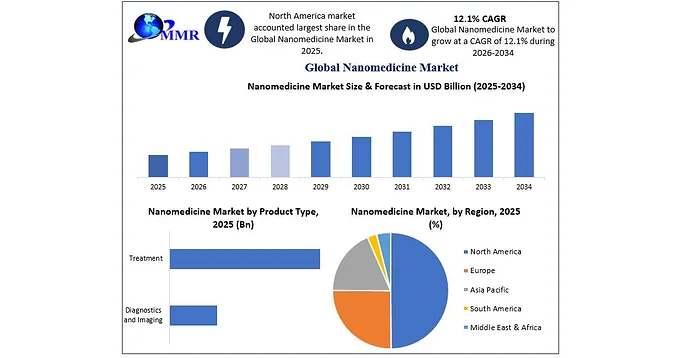
PUNE, India, Sept. 24, 2026 /PRNewswire/ -- The Global Nanomedicine Market was valued at USD 207.91 Billion in 2025 and is projected to expand at a 12.1% CAGR from 2025 to 2034, reaching USD 581.2 Billion by 2034, according to a new analysis by Maximize Market Research.
Global Nanomedicine Market
The Global Nanomedicine Market Report 2025 provides a comprehensive analysis of market trends, nanotechnology adoption, nanomedicine applications, clinical developments, therapeutic innovations, diagnostic technologies, drug delivery systems, regulatory developments, competitive landscape, technology advancements, and market forecasts through 2034. The market covers nanomedicine applications across diagnostics and imaging, treatment, drug delivery, vaccines, regenerative medicine, implants, and other healthcare applications, supporting the development of advanced solutions for cancer, infectious diseases, cardiovascular disorders, neurological conditions, ophthalmic diseases, and other chronic and complex conditions.
The rising prevalence of chronic and complex diseases, growing demand for targeted therapies, increasing adoption of personalized medicine, and advances in nanoscale technologies are supporting the growth of the global nanomedicine market. Increasing use of nanoparticle-based drug delivery, nanodiagnostics, nano-enabled vaccines, nanostructured implants, and precision therapeutic platforms is transforming disease diagnosis and treatment. Growing investments in nanotechnology research, pharmaceutical R&D, biotechnology, clinical development, and advanced healthcare technologies are further expanding opportunities for nanomedicine-based products and therapies.
Advancements in nanocarriers, lipid nanoparticles, nanoparticle-based drug delivery, nano-enabled diagnostics, nanobiosensors, nanostructured implants, regenerative medicine, targeted cancer therapies, and precision medicine are reshaping the nanomedicine landscape. Increasing research into oncology, infectious diseases, cardiology, neurology, ophthalmology, orthopedics, and immunology is creating new opportunities for pharmaceutical, biotechnology, medical device, and nanotechnology companies. Product launches, clinical developments, strategic collaborations, technology investments, regulatory advancements, and expansion of nanotechnology applications are expected to accelerate innovation and strengthen the global nanomedicine market through 2034.
Get Full PDF Sample Copy of Report: (Including Full TOC, List of Tables & Figures, Chart) @ https://www.maximizemarketresearch.com/request-sample/39223/
Global Nanomedicine Market gains momentum as rising chronic disease prevalence, growing demand for targeted drug delivery, increasing adoption of nanotechnology-based diagnostics and therapeutics, advances in nanoparticle platforms and precision medicine, and expanding applications across oncology and other therapeutic areas accelerate healthcare innovation: Maximize Market Research unveils key market insights.
Global Nanomedicine Market Size & Forecast
Global Nanomedicine Market Trends & Insights
- North America leads the Global Nanomedicine Market, supported by advanced healthcare infrastructure, strong pharmaceutical and biotechnology R&D, significant investment in nanotechnology, and widespread adoption of advanced diagnostic and therapeutic technologies.
- Asia-Pacific represents a high-growth region, driven by expanding healthcare infrastructure, increasing investments in nanotechnology research, rising disease burden, growing pharmaceutical R&D, and increasing adoption of nanomedicine applications across China, Japan, India, and other emerging markets.
- Nanotechnology-based drug delivery is gaining adoption, supported by the growing use of nanoparticles, lipid nanoparticles, liposomes, and other nanocarriers for targeted drug delivery, improved therapeutic efficacy, enhanced bioavailability, and reduced treatment-related side effects.
- Nanomedicine applications in oncology and diagnostics are expanding, with increasing development of nano-enabled cancer therapies, molecular diagnostics, imaging technologies, biosensors, and precision treatment platforms for early disease detection and targeted intervention.
- Precision medicine is driving nanomedicine innovation, with growing research into personalized therapies, advanced nanomaterials, targeted delivery systems, regenerative medicine, nano-enabled vaccines, and next-generation treatment platforms across oncology, infectious diseases, cardiology, neurology, ophthalmology, and orthopedics.
Increasing Adoption of Nanotechnology-Based Drug Delivery Drives Market Growth
The growing adoption of nanotechnology in drug delivery is driving demand for more precise and effective therapeutic solutions. Nanoparticles, lipid nanoparticles, liposomes, and other nanocarriers can support targeted drug delivery, improve bioavailability, enhance therapeutic efficacy, and reduce exposure to healthy tissues. Increasing applications across oncology, infectious diseases, cardiovascular disorders, neurological conditions, and ophthalmology are strengthening the role of nanomedicine in advanced healthcare.
High Development and Manufacturing Costs Restrain Market Growth
The high cost associated with nanomedicine research, clinical development, specialized manufacturing, quality control, and regulatory compliance can limit market expansion. Complex production processes and the need for advanced expertise and infrastructure can increase development costs compared with conventional pharmaceutical formulations, creating affordability and commercialization challenges, particularly in cost-sensitive healthcare markets.
Advancements in Precision Medicine and Nano-Enabled Therapeutics Create Opportunities
Rapid developments in nanoparticle-based drug delivery, lipid nanoparticles, nanodiagnostics, nano-enabled vaccines, regenerative medicine, and targeted therapies are creating new opportunities. Growing research in personalized medicine, cancer treatment, molecular diagnostics, and advanced therapeutic platforms is further expanding the application scope of nanomedicine and encouraging pharmaceutical and biotechnology companies to invest in next-generation solutions.
Regulatory Complexity and Limited Specialized Infrastructure Create Challenges
The absence of standardized regulatory approaches specifically tailored to nanomedicine, combined with complex product classification, safety assessment, characterization, and approval requirements, remains a challenge. Limited access to specialized nanotechnology manufacturing facilities, skilled professionals, advanced testing capabilities, and supporting healthcare infrastructure in developing markets can also restrict the adoption and commercialization of innovative nanomedicine products.
Get Insightful Data on Regions, Market Segments, Customer Landscape, and Top Companies (Charts, Tables, Figures and More) https://www.maximizemarketresearch.com/request-sample/39223/
Global Nanomedicine Market Segmentation
The Global Nanomedicine Market is segmented by Product Type, Application, Indication, and Region. Rising demand for targeted drug delivery, increasing adoption of nanotechnology-based diagnostics and therapeutics, growing prevalence of chronic and complex diseases, advances in personalized medicine, and expanding research and development in nanotechnology are supporting market development across these segments.
North America Leads the Nanomedicine Market with Strong Healthcare Infrastructure and R&D Capabilities
North America held the largest share of the Global Nanomedicine Market in 2025, supported by advanced healthcare infrastructure, strong pharmaceutical and biotechnology research, high healthcare expenditure, and significant investment in nanotechnology. The United States represents a major market due to its established research ecosystem, leading pharmaceutical and biotechnology companies, advanced clinical infrastructure, and increasing adoption of nanotechnology-based drug delivery, diagnostics, targeted therapies, and precision medicine. Canada and Mexico are also contributing through expanding healthcare capabilities, research initiatives, and growing adoption of advanced medical technologies.
Europe represents an important market, supported by established healthcare systems, strong pharmaceutical and biotechnology industries, and increasing investments in nanotechnology and biomedical research. Germany, the United Kingdom, France, Italy, Spain, Sweden, Austria, and other European countries are witnessing increasing adoption of nanomedicine across drug delivery, diagnostics and imaging, vaccines, regenerative medicine, and targeted therapies. Growing clinical research, technological development, and regulatory initiatives are further supporting regional market development.
Asia Pacific is expected to witness strong growth as healthcare infrastructure, pharmaceutical R&D, and nanotechnology capabilities continue to expand. China, Japan, India, South Korea, Australia, and other regional markets are contributing to market development through increasing investments in nanotechnology research, clinical applications, drug delivery systems, nano-enabled diagnostics, vaccines, and precision medicine. China is emerging as a major nanotechnology and nanomedicine hub, supported by research capabilities, government-backed initiatives, and expanding pharmaceutical and biotechnology activity.
Middle East & Africa is gradually developing as healthcare infrastructure, specialized medical services, and access to advanced technologies improve. GCC countries, South Africa, Egypt, Nigeria, and other markets are investing in modern healthcare facilities, advanced diagnostics, pharmaceutical development, and specialized treatment capabilities.