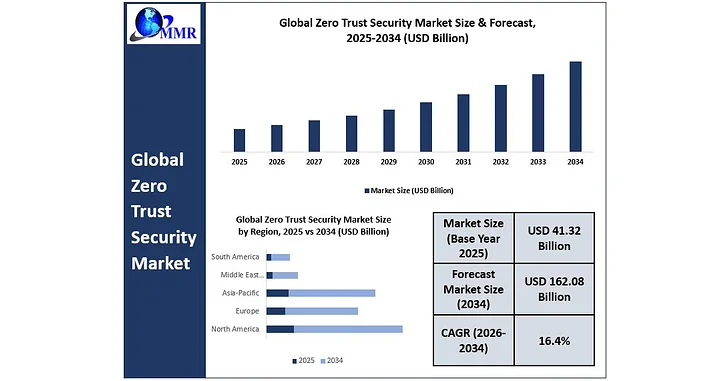
CHICAGO, Sept. 23, 2026 /PRNewswire/ -- The Global Zero Trust Security Market was valued at USD 41.32 Billion in 2025 and is projected to expand at a strong 16.4% CAGR from 2026 to 2034, reaching approximately USD 162.08 Billion by 2034, according to a new analysis by Maximize Market Research.
Global Zero Trust Security Market
The Global Zero Trust Security Market Report 2025 provides a detailed analysis of market trends, growth, and forecasts through 2034. The market is gaining strong momentum as businesses move away from traditional perimeter-based security and adopt a "never trust, always verify" approach to protect users, devices, applications, networks, and data. Growing cloud adoption, remote and hybrid work, rising cyber threats, and the need for stronger identity and access controls are encouraging organizations to strengthen their Zero Trust security frameworks.
The shift toward multi-factor authentication, endpoint security, network security, API protection, security analytics, and automated security controls is further supporting market growth. At the same time, enterprises are investing in cloud-based security solutions that can provide continuous monitoring and access verification across increasingly distributed IT environments. As organizations face more complex digital risks, Zero Trust is becoming an important part of modern cybersecurity strategies across financial services, healthcare, IT, manufacturing, retail, and other industries.
Get Full PDF Sample Copy of Report: (Including Full TOC, List of Tables & Figures, Chart) @ https://www.maximizemarketresearch.com/request-sample/83776/
Global Zero Trust Security Market gains momentum as businesses strengthen digital defenses with identity-first and cloud-based security: Maximize Market Research unveils key insights.
Global Zero Trust Security Market Size & Forecast:
Zero Trust Security Market Trends & Insights:
- North America remains a major regional market, supported by strong cybersecurity spending, advanced IT infrastructure, cloud adoption, and growing demand for Zero Trust security, identity and access management, network security, and endpoint protection.
- Asia-Pacific is emerging as a key growth region, driven by rapid digital transformation, expanding cloud infrastructure, remote and hybrid work, rising cyber threats, and increasing investments in Zero Trust Architecture, multi-factor authentication, cloud security, and access control.
- Cloud-based Zero Trust security is gaining strong adoption as organizations move applications, workloads, and sensitive data to cloud environments. Businesses are increasingly using continuous authentication, device verification, identity-based access, network segmentation, and cloud security controls.
- Security automation and real-time monitoring are becoming important market trends, with enterprises adopting security analytics, threat intelligence, AI-driven security, endpoint security, API security, SOAR, and automated incident response to improve threat detection and protect digital assets.
Cloud Adoption, Rising Cyber Threats, and Identity Security Drive Global Zero Trust Security Market Growth Opportunities
The Global Zero Trust Security Market is gaining strong momentum as organizations move toward cloud-based infrastructure, remote and hybrid work environments, and distributed IT networks. Rising cyberattacks, data breaches, unauthorized access, and identity-based threats are increasing demand for Zero Trust Architecture, identity and access management, multi-factor authentication, network security, endpoint security, and data security. Growing enterprise focus on continuous user verification and least-privilege access is creating new Zero Trust Security Market Growth Opportunities across industries.
Implementation Complexity, Legacy Systems, and Integration Challenges Restrain Global Zero Trust Security Market Growth
The Zero Trust Security Market faces challenges related to the complexity of implementing Zero Trust frameworks across existing IT infrastructure. Organizations using legacy applications, traditional network security systems, and multiple security platforms may require significant integration, configuration, and security policy management. The need for continuous authentication, device verification, network segmentation, endpoint monitoring, and access control can also increase operational requirements, creating challenges for organizations with limited cybersecurity resources and technical expertise.
Cloud Security, AI Analytics, and Automated Threat Detection Unlock Global Zero Trust Security Market Opportunities
Zero Trust security is moving toward a more technology-driven approach as organizations adopt cloud security, AI-driven security analytics, behavioral monitoring, threat intelligence, automated incident response, API security, endpoint protection, and Security Orchestration, Automation and Response (SOAR). Growing use of cloud applications, connected devices, APIs, and distributed workloads is creating demand for continuous monitoring and identity-based security. At the same time, increasing focus on data protection and secure remote access is creating Zero Trust Security Market Growth Opportunities for cybersecurity providers offering integrated and scalable solutions.
Get Insightful Data on Regions, Market Segments, Customer Landscape, and Top Companies (Charts, Tables, Figures and More) https://www.maximizemarketresearch.com/request-sample/83776/
Cloud Security, Identity Protection, and Automation Transform Global Zero Trust Security Market
The Global Zero Trust Security Market is evolving as organizations strengthen cloud security, identity protection, endpoint security, network security, data security, and access management across distributed digital environments. Growing adoption of Zero Trust Architecture, multi-factor authentication, continuous verification, least-privilege access, security analytics, AI-driven threat detection, API security, and automated incident response is helping businesses improve visibility and protect critical applications, devices, users, workloads, and data. The increasing use of cloud platforms, remote access, connected devices, and digital applications is further creating demand for scalable Zero Trust security solutions that provide continuous monitoring, adaptive access control, threat detection, and faster response to emerging cyber risks.
Cloud Security and Identity Protection Shape Global Zero Trust Security Market Segmentation Insights
Global Zero Trust Security Market by Authentication Type, Deployment Model, Solution Type, and Industry Vertical is shaped by the growing need to protect users, devices, applications, networks, workloads, and data from unauthorized access and cyber threats. Increasing cloud adoption, remote and hybrid work, identity-based attacks, and complex digital environments are strengthening demand for multi-factor authentication, cloud-based security, network security, endpoint security, data security, API security, security analytics, and security policy management. Organizations are also adopting Zero Trust solutions to support continuous authentication, least-privilege access, device verification, threat monitoring, and real-time security controls across distributed IT infrastructure.
By Authentication Type
- Single-Factor Authentication
- Multi-Factor Authentication
By Deployment Model
- On-Premises
- Cloud-Based
By Solution Type
- Network Security
- Data Security
- Endpoint Security
- Security Orchestration Automation & Response
- API Security
- Security Analytics
- Security Policy Management
- Others
By Industry Vertical
- IT & ITES
- Financial & Insurance
- Retail & Trade
- Utilities
- Manufacturing
- Healthcare & Social Assistance
- Others
Immediate Delivery Available | Buy this Research Report (Insights, Charts, Tables, Figures and More) https://www.maximizemarketresearch.com/checkout/83776/
North America Leads While Asia-Pacific Accelerates: Key Regional Insights Shaping the Global Zero Trust Security Market
North America remains a major region in the Global Zero Trust Security Market, supported by strong cybersecurity spending, advanced digital infrastructure, high cloud adoption, and the presence of major cybersecurity and technology companies. Organizations across the U.S. and Canada are increasingly adopting Zero Trust Architecture, identity and access management, multi-factor authentication, endpoint security, network security, cloud security, and security analytics to protect critical data and digital infrastructure. Growing cyber threats, remote and hybrid work, and the need for continuous user and device verification are further strengthening demand for Zero Trust security solutions across government, financial services, healthcare, IT, and other industries.
Asia-Pacific is emerging as an important growth region in the Global Zero Trust Security Market, supported by rapid digital transformation, expanding cloud infrastructure, increasing internet and connected-device usage, and rising cybersecurity investments. China, India, Japan, South Korea, Singapore, and Australia are contributing to regional adoption as enterprises strengthen identity security, access control, endpoint protection, network segmentation, API security, data security, and threat detection. Growing use of cloud applications, remote access, digital services, and AI-driven security is creating significant Zero Trust Security Market Growth Opportunities across the region.
Cisco, Palo Alto Networks & Microsoft Drive Global Zero Trust Security Market with Identity, Cloud and AI Security Innovations
Cisco Systems Inc. is strengthening its Zero Trust security capabilities through identity-based access controls, network security, endpoint protection, secure access, and continuous monitoring.