Huawei Unveils New UnifiedBus Computing Architecture for SuperPoDs and Clusters
Image File
Original HTML

Huawei Unveils New UnifiedBus Computing Architecture for SuperPoDs and Clusters

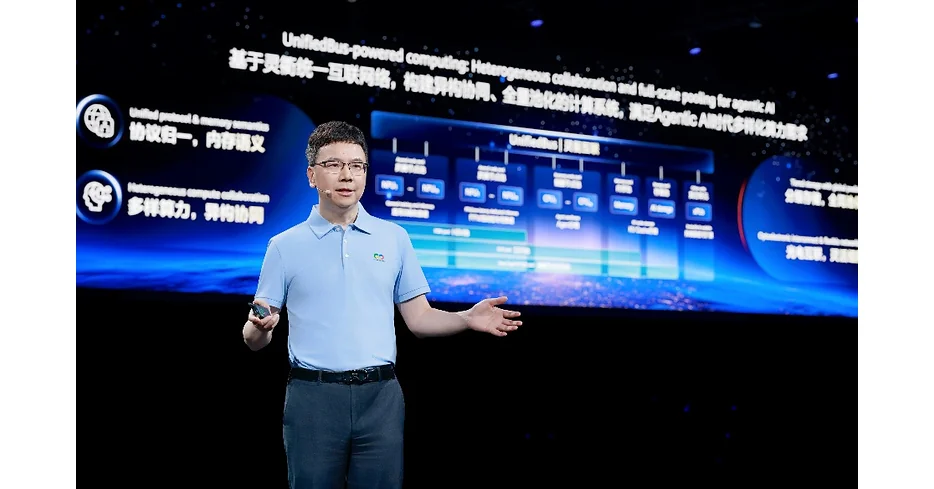
SHANGHAI, Sept. 21, 2026 /PRNewswire/ -- In a keynote speech on computing architecture innovation at HUAWEI CONNECT 2026, Yang Chaobin, Huawei's Executive Director of the Board and CEO of the ICT Business Group, unveiled new details about the UnifiedBus interconnect architecture, announced a series of computing products based on this architecture, and explained how the company has collaborated with open-source communities to enable application innovation by customers, partners, and developers.

In a traditional computing architecture, resource utilization declines as a cluster scales. As little as 20% of a 100,000-NPU cluster's computing capacity is actually utilized by models, with a vast amount of compute sitting idle during data communications. A 10 trillion-parameter model, which requires massive amounts of intermediate data to train, far exceeds the capacity of the memory on a single accelerator under traditional architectures. Interconnection and communications between components within a cluster have become a key performance bottleneck for computing systems.

According to Yang, Huawei's solution to this bottleneck is its new computing architecture, powered by the interconnect technology called UnifiedBus, which facilitates collaboration between clusters and SuperPoDs. This architecture has been designed to support the boom in compute demand that is emerging as new agentic applications hit the market. UnifiedBus-powered computing systems have four key features:

- Unified protocol and memory semantics: More than ten interconnect protocols have been combined under the UnifiedBus protocol, which increases interconnect bandwidth from 100 GB/s level to TB/s level and reduces round-trip time (RTT) latency from 7 microseconds to 2 microseconds. This protocol also enables unified global memory addressing within SuperPoDs.

- Heterogeneous compute collaboration: UnifiedBus directly interconnects CPUs, NPUs, memory, and solid-state drives (SSDs) to enable decentralized, peer-to-peer access between them and flexible CPU-NPU mixing. In addition, tiered hardware acceleration for Transformer enables Attention-FFN disaggregation (AFD).

- Tiered storage with global pooling: UnifiedBus uses hybrid-media resource pooling to support the caching of activations. Double Data Rate (DDR) memory serves as the alternative memory for NPUs, reducing latency for search, recommendation, and advertising services, and doubling the performance of vector retrieval for 100 billion-level data items with thousands of dimensions. This also reduces the per-NPU HBM capacity requirements for the training of 10 trillion-parameter models, and improves cluster model FLOPs utilization (MFU).

- Optoelectronic interconnect and flexible networking: UnifiedBus serves as a global ultra-high bandwidth, ultra-low latency "data highway", enabling flexible scaling of compute.

Yang then moved on to unveil Huawei's newest UnifiedBus interconnect products that cover interconnection within cabinets, between cabinets, and across clusters. This enables elastic scaling from a single cabinet to a million-NPU cluster.

- Within cabinets, the UnifiedBus LinkBlade eliminates circuit losses with a cable-free design, which reduces copper cabling within a 4,096-NPU SuperPoD by about 196 kilometers.

- Between cabinets, the UnifiedBus LinkDevice supports 176 ports, with 1.6 Tbit/s bandwidth per port, delivering 280 Tbit/s all-optical interconnection. This is the industry's highest-bandwidth, highest-port-count high-speed bus-protocol interconnect device, with an RTT latency as low as 2 microseconds.

- Across clusters, the UnifiedBus UBG switch provides a massive radix fan-out capacity of up to 1,024, meaning it can support a million-NPU SuperCluster and evolution towards supporting tens of trillions of model parameters.

Yang also launched Huawei's UnifiedBus-powered agentic AI SuperCluster, which is comprised of TaiShan 950 and Atlas 960 SuperPoDs, OceanStor M900 memory storage, and a Xinghe UBG switch. This cluster enables diverse compute collaboration and tiered resource pooling.

Beyond SuperPoDs, Huawei has also applied the UnifiedBus technology to its compute appliances. The company has developed a new series of UnifiedBus-based appliances (supporting one to eight NPUs) and Kunpeng and Ascend modules, which enable small and medium-sized enterprises to run trillion-parameter models locally.

On the ecosystem front, Yang said that Ascend is collaborating with open-source frameworks like DeepSeek Harness, OpenCode, and openJiuwen to develop fully open-source intelligent management, inference acceleration, and security framework agent plugins.

Yang promised, "Huawei is committed to innovating at the system level, building a computing-foundation product portfolio, and going open source and open system. We will continue working with customers, partners, and developers to help this ecosystem thrive and offer the world a new option for compute."

SOURCE Huawei Technologies Co., Ltd

Share this article

Class (B2B/B2C)
B2B
Ingest Status
Need Review
Dedupe hash
prn_302884533
Press Eligible
Yes
Press Eligible Reason
QA FAIL (need review): TARGET misattributes the role of Attention-FFN disaggregation and overstates UBG switch capabilities by omitting 'evolution towards' from the source's claim about supporting tens of trillions of model parameters.
Source Name
Unknown Company
Original Summary

<p>SHANGHAI, Sept. 21, 2026 /PRNewswire/ -- In a keynote speech on computing architecture innovation at HUAWEI CONNECT 2026, Yang Chaobin, Huawei's Executive Director of the Board and CEO of the ICT Business Group, unveiled new details about the UnifiedBus interconnect architecture,...</p>

Image URL
https://mmx.prnewswire.com/media/MS1992412/20260921033142EDT_image_1.jpg?id=OA2959814&p=facebook
Generated Article_json
{"target_audience": "b2b", "is_medical": false, "ai_generated_title": "Huawei Unveils UnifiedBus Architecture to Fix AI Cluster Bottlenecks", "body_html": "<p><strong>Shanghai -- [CURRENT_DATE] --</strong> Huawei has unveiled a new computing architecture called UnifiedBus, designed to eliminate the interconnect bottlenecks that leave as little as 20% of a 100,000-NPU cluster's compute capacity actually utilized by AI models. The announcement was made by Yang Chaobin, Huawei's Executive Director of the Board and CEO of the ICT Business Group, in a keynote at HUAWEI CONNECT 2026.</p><h5>Interconnect bottleneck limits trillion-parameter model training</h5><p>Yang said traditional computing architectures cannot keep pace with agentic AI workloads because a 10 trillion-parameter model generates intermediate data volumes that exceed the memory capacity of any single accelerator. Idle compute time during data communication has become the primary constraint on cluster performance.</p><h5>UnifiedBus protocol lifts bandwidth to TB/s level</h5><p>UnifiedBus merges more than ten interconnect protocols into a single standard, raising interconnect bandwidth from the 100 GB/s range to terabit-per-second levels while cutting round-trip latency from 7 microseconds to 2 microseconds. The protocol also enables unified global memory addressing across SuperPoDs, allowing CPUs, NPUs, memory, and SSDs to access resources peer-to-peer through Attention-FFN disaggregation.</p><h5>DDR pooling doubles vector retrieval performance</h5><p>By using DDR memory as an alternative tier for NPUs, UnifiedBus doubles vector retrieval performance for datasets exceeding 100 billion items with thousands of dimensions, while cutting latency for search, recommendation, and advertising workloads. The tiered pooling also lowers per-NPU HBM requirements for training 10 trillion-parameter models and improves cluster model FLOPs utilization.</p><h5>New hardware scales from single cabinets to million-NPU clusters</h5><p>Huawei introduced three UnifiedBus products spanning intra-cabinet, inter-cabinet, and cross-cluster connectivity. The LinkBlade uses a cable-free design that removes roughly 196 kilometers of copper cabling from a 4,096-NPU SuperPoD. The LinkDevice supports 176 ports at 1.6 Tbit/s each, delivering 280 Tbit/s of all-optical interconnection with 2-microsecond RTT latency — which Huawei describes as the industry's highest bandwidth and port count for a bus-protocol interconnect device. The UBG switch offers a radix fan-out of up to 1,024, enabling a single SuperCluster to scale to one million NPUs and support tens of trillions of model parameters.</p><h5>Agentic AI SuperCluster combines four hardware lines</h5><p>Yang launched a UnifiedBus-powered agentic AI SuperCluster built from TaiShan 950 and Atlas 960 SuperPoDs, OceanStor M900 memory storage, and a Xinghe UBG switch, aimed at heterogeneous compute collaboration and tiered resource pooling at scale.</p><h5>Compute appliances bring trillion-parameter models to SMEs</h5><p>Beyond large clusters, Huawei extended UnifiedBus to a new line of compute appliances supporting one to eight NPUs, paired with Kunpeng and Ascend modules, intended to let small and medium-sized enterprises run trillion-parameter models on local infrastructure.</p><h5>Ascend teams with open-source frameworks on agent tooling</h5><p>Huawei said its Ascend platform is working with open-source frameworks including DeepSeek Harness, OpenCode, and openJiuwen to build open-source plugins for intelligent management, inference acceleration, and security. \"Huawei is committed to innovating at the system level, building a computing-foundation product portfolio, and going open source and open system,", "meta_description": "Huawei unveils UnifiedBus computing architecture and interconnect hardware at HUAWEI CONNECT 2026, targeting AI cluster bottlenecks and trillion-parameter model training.", "seo_keywords": "Huawei, UnifiedBus, AI infrastructure, NPU cluster, interconnect architecture, SuperPoD, agentic AI, HUAWEI CONNECT 2026", "companies": ["Huawei Technologies Co., Ltd."], "industries": ["AI Infrastructure"], "markets_regions": ["China", "Global"], "news_type": ["product_launch", "technology_unveiling"], "products": ["UnifiedBus"], "themes": ["digital_transformation", "product_innovation"], "events": ["HUAWEI CONNECT 2026"], "cta_text": "Details on UnifiedBus architecture and interconnect products were presented at Huawei's ICT Business Group keynote.", "learn_more": "", "fact_check": {"accuracy_score": 100, "legal_risk": "low", "corrections_made": [], "recommendation": "publish"}}
Content Hash (SHA-256, erste 32 hex)
167f1c54996300dc11fd1b3c59241901