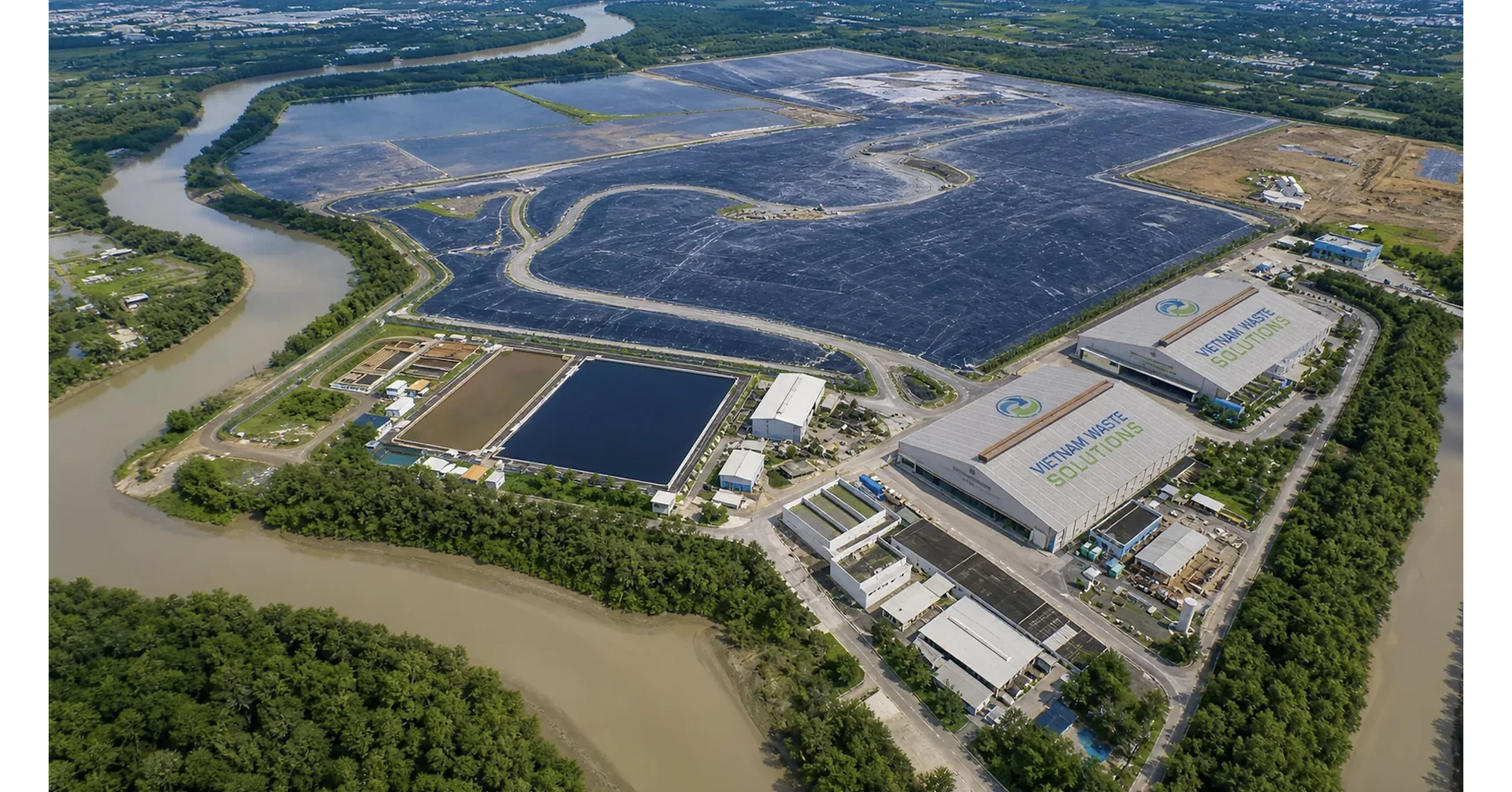
Vietnam Waste Solutions (VWS), the California-owned operator of Ho Chi Minh City's largest engineered landfill, is now embracing an expansion and conversion. Plans include a 50- to 60-megawatt waste-to-energy plant and specialized recycling lines that would supplement VWS's existing systems, and a landfill-gas system already running on site.
OAKLAND, Calif., Sept. 14, 2026 /PRNewswire/ -- Vietnam Waste Solutions (VWS), the wholly owned Vietnamese subsidiary of Oakland-based California Waste Solutions (CWS), is spending hundreds of millions of dollars to further Vietnam's 2050 net-zero target by converting the country's first U.S. Subtitle D sanitary landfill into a larger clean-power and resource-recovery complex.
Vietnam Waste Solutions - Da Phuoc Integrated Solid Waste Facility (DPI)
The 341-acre landfill outside Ho Chi Minh City in Da Phuoc was the first U.S.-standard waste landfill built in the mid-2000s and it receives and buries up to 6,500 tons of municipal solid waste a day, or roughly 2.4 million tons a year. The landfill services over half the household waste generated by Ho Chi Minh City's residents. Ho Chi Minh City disposes of around 10,000 tons of household waste every day.
About $200 million has already been invested in developing the existing Da Phuoc environmental complex. That investment established the landfill and its supporting systems and is separate from the proposed 50- to 60-megawatt waste-to-energy plant. The conversion now on the table is pivotal in Vietnam's shift toward renewables as the country seeks to join America and Europe as a major green industrial economy.
"The renewable proposal is consistent with our core philosophy to be constantly improving on existing resources, both for the benefit of CWS and its subsidiaries and for our customers and the places they live in," said Michael Duong, President of California Waste Solutions. "The Duong family has never taken any shortcuts when it comes to environmental innovation. In addition, the City's visionary leadership is always easy to work with on long-range solutions like this, which has been a huge help to the plans."
Da Phuoc Integrated Solid Waste Facility (DPI) has already been producing electricity for years from captured landfill gas, enough to support operations at the complex. The latest plans are an expansion of those operations: a waste-to-energy plant rated at 50 to 60 megawatts, plus specialized recycling lines that would supplement material-recovery systems already running on site.
This year, VWS formally proposed the waste-to-energy conversion enhancement at Da Phuoc Integrated Solid Waste Facility (DPI) and is working through appraisal and permitting. The added capacity is viewed by the company as a further contribution to a cleaner Ho Chi Minh City.
Since so much of the city's waste is handled by VWS, the conversion of the giant landfill toward greater recovery and on-site power is intended to support Vietnam's 2050 net-zero target. The project would cut the volume of residual material requiring long-term burial while recovering electricity from waste that cannot otherwise be economically reused or recycled.
CWS will be responsible for running the energy systems, while day-to-day construction and operations will be carried out by Vietnamese contractors which VWS has spent years working with and training.
A landfill built to a U.S. rulebook
The Da Phuoc landfill dates back more than two decades. In the 1990s, as Hanoi and Washington normalized political relations, Ho Chi Minh City asked CWS to build a U.S.-standard waste disposal unit. CWS agreed as long as it was made the sole owner of the landfill and it was built to U.S. environmental standards.
Environmentally friendly liner systems, a commercial-grade landfill leachate plant of a kind associated with large private water-treatment firms, and gas-collection hardware sourced from the United States was not the cheapest path to go down. Still, the expense was worth it, said David Duong, founder and CEO of California Waste Solutions, since it was the route that made the site bankable and durable long-term.
"We are all about quality as the main driver of everything we do," said David Duong. "At the end of the day, I want to stand by what I've committed to doing and say, 'This is the absolute best anyone could have done.' That's really the goal of the company since our early days picking up trash on the streets of Oakland for recycling. It's the same today."
The liner system was designed to isolate waste from surrounding soil and groundwater. Leachate generated within the landfill is collected instead of moving uncontrolled through the site, then directed to dedicated treatment systems. Gas generated as organic material decomposes is also collected and has become a source of electricity for the complex.
Da Phuoc Integrated Solid Waste Facility (DPI) became one of the first major catalysts for Vietnam's new energy efficiency in an economy that has been growing rapidly. DPI is still the only landfill in Vietnam modelled on the U.S. Subtitle D standard, making it one of the country's most essential components to Ho Chi Minh City's environmental protections as the country works toward net zero by 2050.
Water treatment is a core part of Da Phuoc Integrated Solid Waste Facility (DPI)
The original DPI concept placed unusual emphasis on water and leachate management for a waste facility developed in Vietnam at the time. VWS operates dedicated systems to collect and treat leachate and wastewater generated by the complex, including biological processing, membrane filtration and reverse-osmosis technology.
The system allows VWS to reuse treated water for operating needs rather than relying entirely on fresh groundwater, including road and equipment washing, dust control, irrigation, odor management and other facility functions. VWS says the treated water leaving its process is already cleaner than water measured in nearby local waterways, a comparison the company attributes to its own operating and water-quality data.
International engineering has played an important role. German environmental engineering company Wehrle has supplied technology associated with leachate treatment at Da Phuoc Integrated Solid Waste Facility (DPI).
Recycling and composting were built into the system years ago
Material recovery has been part of Da Phuoc Integrated Solid Waste Facility (DPI) long before the current waste-to-energy proposal. VWS operates recycling and material-separation infrastructure designed to pull recyclable commodities from incoming waste. Dutch firm Bollegraaf is the provider of the sorting, separation and processing equipment.
The existing recycling systems matter to the new project because waste-to-energy is not intended to replace material recovery. Plans for the next phase include additional specialized recycling lines that would complement the systems already operating at the site.
Organic material follows another route. DPI has operated composting systems for years. Austrian firm Komptech provides VWS with organic grinding, turning, aerating and screening equipment for composting and soil amendments.
Taken together, different portions of the municipal waste stream are directed toward different processes according to what can still be recovered.
Da Phuoc Integrated Solid Waste Facility (DPI) was producing energy before the new project
Electricity generation is already an established part of the site. VWS has captured landfill gas for years as organic material decomposes beneath the landfill. Instead of allowing that gas to escape uncontrolled, the collection system directs it toward energy-recovery equipment used to support operations at Da Phuoc Integrated Solid Waste Facility (DPI).
That existing landfill-gas system is separate from the proposed 50- to 60-megawatt waste-to-energy plant. Landfill-gas energy is produced from gas created through decomposition after waste has been placed in the landfill. The proposed plant would process residual municipal waste before final disposal and recover energy directly from that material.
The new facility would therefore expand an energy-recovery strategy already operating at Da Phuoc rather than introduce electricity generation to the site for the first time.
International technology, operated increasingly by Vietnamese specialists
From its earliest years, Da Phuoc Integrated Solid Waste Facility (DPI) was built around technology sourced from the United States, Europe and other established environmental-engineering markets. Wehrle supplied technology for water and leachate treatment. Bollegraaf supplied recycling and material-separation systems. Komptech equipment supports organic processing and compost production. U.S.-sourced components have been used in landfill-gas management, while the proposed waste-to-energy expansion would introduce another generation of international power and waste-treatment technology.
The equipment, however, represents only one side of the operating model. VWS spent years transferring knowledge to Vietnamese engineers, operators, supervisors and contractors. Today, according to VWS, the operation is staffed almost entirely by Vietnamese employees, with one U.S. employee remaining on site.
That transition was intentional. The same philosophy is expected to guide the new waste-to-energy development. CWS would continue to provide technical and operating oversight, while Vietnamese contractors and employees would perform much of the construction and long-term operational work.
David Duong built the California-to-Vietnam connection
The Da Phuoc story began thousands of miles from Ho Chi Minh City. David Duong, founder and chief executive officer of California Waste Solutions and president and chief executive officer of Vietnam Waste Solutions, rebuilt his life in the United States after his family left Vietnam.