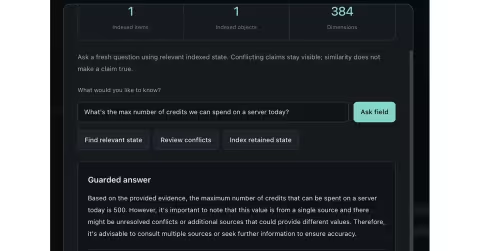
Fort Lauderdale, Fla. – September 11, 2026 -- Intersignal has demonstrated cross-device context sharing through its Braid protocol, showing a local large language model on a MacBook Air incorporate a 500-credit spending limit transmitted from a connected system into its response.
Braid moves beyond message delivery to actual context use by receiving models
The demonstration confirmed that a shared parameter -- the 500-credit limit -- was not just received but applied by the target model in its output. Intersignal calls this dynamic "machine osmosis," describing how information introduced in one part of a connected setup becomes usable context elsewhere without manual re-entry of instructions or constraints.
Channels feature organizes model-to-model exchanges by topic
Intersignal also introduced Braid Channels, which creates dedicated, topic-specific streams for communication between models instead of a single undifferentiated feed. The company positions Channels as a tool for separating project instructions, operating parameter updates, and research workflows across multiple models running on user-controlled machines.
Protocol targets local-network AI setups without cloud mediation
Braid operates over local networks, allowing connected systems to exchange context without routing through a centralized cloud service. Intersignal is targeting local AI hobbyists, independent developers, and researchers who run workflows spanning multiple models and devices, framing the tool as a way to make existing local AI setups work together rather than forcing consolidation into a single service or model.
Intersignal is inviting users to reproduce the demonstrated workflow and test Channels, with software releases and documentation available through the project's website.