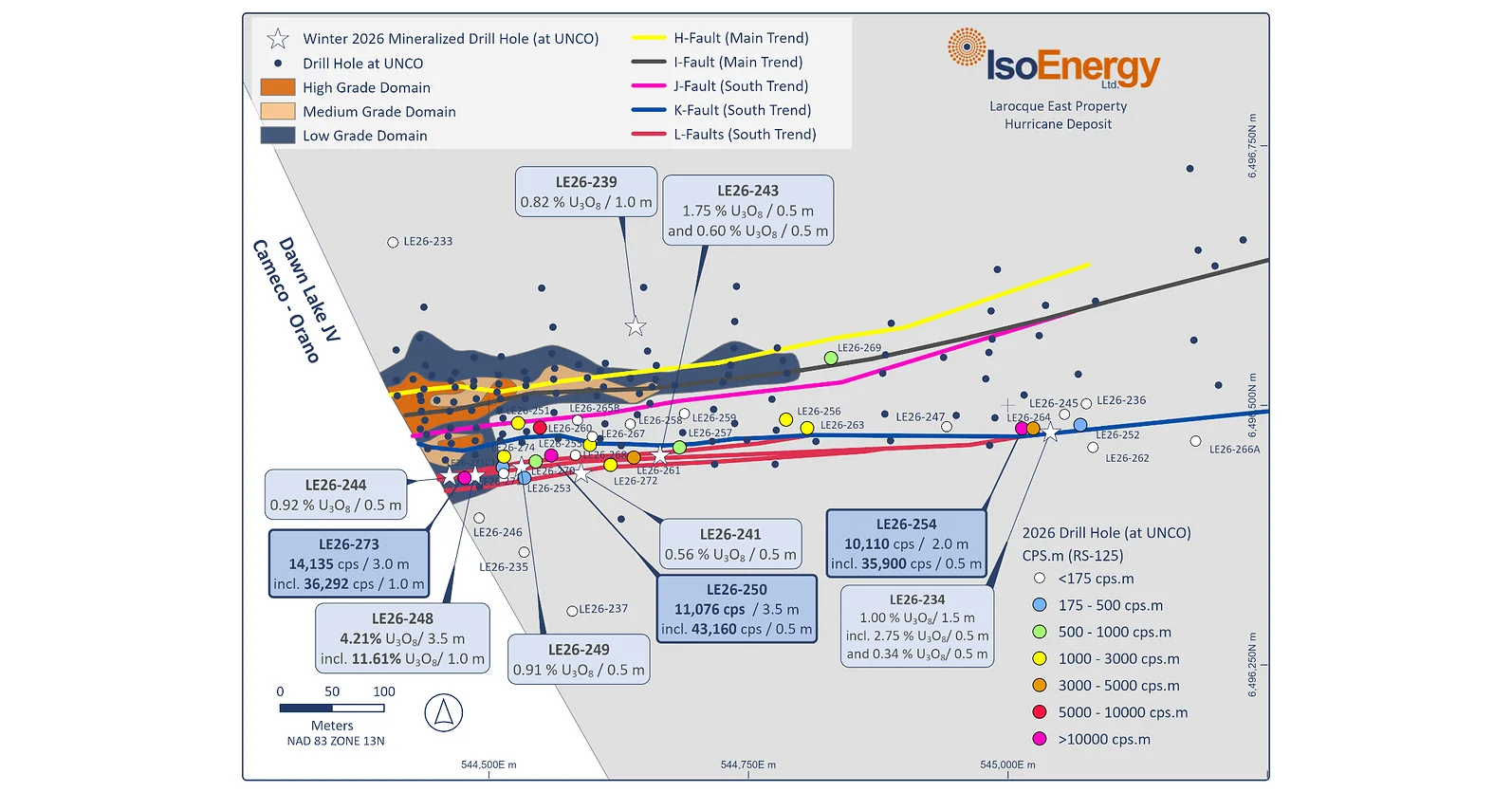
TORONTO, September 8, 2026 /PRNewswire/ -- IsoEnergy Ltd. ("IsoEnergy", or the "Company") (NYSE American: ISOU); (TSX: ISO) is pleased to report on radioactive zones intersected in summer drilling along the Hurricane South Trend on the Larocque East project (the "Project"), which hosts the high-grade Hurricane deposit ("Hurricane" or the "Deposit"). Summer drilling at Larocque East totaled 10,159 m in 26 holes, for a year-to-date total of 16,963 m in 43 drill holes (Figure 1). The summer program was expanded from a planned 8,000 m, 20-hole program to follow up on encouraging winter and early summer results (see news release dated July 8, 2026). Highlights of drill core radiometric results and uranium geochemistry from the winter holes were reported on April 7, 2026 and May 12, 2026, respectively. All samples from the summer program have been submitted to SRC Geoanalytical Laboratories and results will be reported when available.
Hurricane hosts a current Mineral Resource of 48.6 Mlb U3O8 at 34.5% U3O8 Indicated, and 2.7 Mlb U3O8 at 2.2% U3O8 Inferred (see "Qualified Person Statement" below). The Project benefits from excellent infrastructure, located approximately 40 km northwest of the McClean Lake mill, and features relatively shallow mineralization at approximately 325 m depth, supporting efficient exploration and future development optionality. The Deposit is located on the Larocque Trend, an important regional structure that also hosts other notable high-grade occurrences including those on Cameco and Orano's Dawn Lake joint venture.
Highlights
The summer drill program successfully intersected widespread, strongly elevated radioactivity over a strike length of 600 m along the South Trend.
18 of the 26 holes returned intervals at or above the cut-off of >350 cps threshold over 0.5 m, 13 holes returned 1,000 cps or greater, and three holes returned over 35,000 cps including the strongest radioactivity drilled to date on the South Trend. All radioactivity results reported herein are measured on drill core as total counts per second ("cps") with three readings averaged over each 0.5 m sample interval.
Drill holes LE26-250 and LE26-273 intersected strongly elevated radioactivity on the L fault zone along strike east and west of mineralization previously reported in winter drill hole LE26-248 (4.21% U3O8 over 3.5 m, including up to 11.6% U3O8 over 1.0 m).
LE26-250, drilled 75 m east of LE26-248 and outside the existing Hurricane footprint, intersected 11,075 cps over 3.5 m, including 43,160 cps over 0.5 m (see news release dated July 8, 2026).
LE26-273, drilled 11 m west of LE26-248, intersected 14,135 cps over 3.0 m, including 36,292 cps over 1.0 m. Like LE26-248, LE6-273 was drilled in the southernmost portion of the Deposit footprint in an area previously interpreted as within the low-grade shell. This interpretation will be revisited once uranium geochemistry results are available.
Drill hole LE26-254 intersected strongly elevated radioactivity, on strike west of previously reported mineralization in winter drill hole LE26-234 (1.00% U3O8 over 1.5 m, including up to 2.75% U3O8 over 0.5 m), on the interpreted L fault zone 510 m east of the existing Hurricane footprint.
LE26-254, drilled 28 m west of LE26-234, intersected 10,110 cps over 2.0 m, including 35,900 cps over 0.5 m.
Dan Brisbin, Vice President Exploration, commented, "Our Larocque project team and contractor partners safely completed an expanded summer program despite a temporary demobilization in June due to a nearby wildfire. Nearly half of the holes drilled in 2026 intersected elevated radioactivity. Multiple holes along the Hurricane South Trend returned strongly elevated results, including thirteen of the twenty-six summer holes at 1,000 cps or greater, both inside the Hurricane deposit footprint and along strike of it. Geochemical results are pending, and those assays, together with the geological observations from drill core, will shape how we define targets for 2027."
Hurricane Resource Expansion Drilling
Summer drilling focused on expansion of the Hurricane mineral resource. Twenty-six holes were completed to target, with three holes abandoned in sandstone, for a total of 10,159 m. This was expanded from a planned 8,000 m in twenty holes based on early encouraging results. Aside from one hole (LE26-269) that tested the eastern extension of the Hurricane Main trend (Figure 1), all drilling was focused on the Hurricane South Trend. Within the South Trend, six holes tested J and K faults, and seventeen holes tested L fault. LE26-273 tested the L fault within the existing Deposit footprint and extended the zone of elevated radioactivity associated with mineralization intersected by winter hole LE26-248 (4.21% U3O8 over 3.5 m, including up to 11.6% U3O8 over 1.0 m) 11 m to the west.
The Hurricane area geological interpretation is being updated based on information gathered from the forty-three drill holes completed in 2026. Geochemical results will be added when received, and new and existing information integrated during evaluation of 2027 drill target potential.
The east-striking structures at Hurricane are grouped into three trends: the North Trend (not shown, minor unnamed faults north of the deposit), Main Trend (H and I faults), and the South Trend (J, K and L faults).
West L Fault Target
LE26-255, LE26-257, LE26-261, LE26-268, and LE26-270 to LE26-274 were drilled to follow up on strong radioactivity intersected in drill holes LE26-248 and LE26-250 on the L-fault zone. A strong illite spectral mineralogy signature dominates through the lower 150 m of sandstone with the lowermost five metres of sandstone dominantly characterized by a mix of illite and chlorite in most holes.
The West L fault target area was a major focus of the summer drill program. Many of the drill holes tested the optimal target position, specifically LE26-250, LE26-261, LE26-268, and LE26-273, where the results correlate with strongly elevated radioactivity. The Company is advancing a geological model for the area to assess its potential based on the winter and summer results.
LE26-250, drilled 75 m east of LE26-248, intersected 11,075 cps over 3.5 m, including 43,160 cps over 0.5 m (see news release dated July 8, 2026). This hole was drilled outside of the existing Hurricane footprint.
LE26-253 intersected elevated radioactivity averaging 620 cps over 0.5 m between 337.5 and 338.0 m, about 3 m above the unconformity (see news release dated July 8, 2026). The sandstone column is dominantly illitic.
LE26-255 was drilled 30 m east of LE26-250 to test for mineralization The sandstone below 130 m is strongly illitic, transitioning to a mixture of chlorite and illite within 5.0 m of the unconformity. The sandstone is strongly altered with clay and limonite centred on fault zones 70 m above the unconformity. A 0.5 m graphitic fault was intersected 20.0 m below the unconformity.
LE26-257 was completed to test mineralization between LE26-243 and LE22-115A. It intersected an average of 686 cps from 326.5 to 331.0 m, including 1,960 cps and 1,225 cps over 0.5 m intervals. The sandstone column is dominantly illitic below 100 m. Limonite, chlorite, and secondary hematite alteration are associated with the mineralized interval.
LE26-261 intersected 1,094 cps over 3.0 m from 331.0 to 334.0 m. The sandstone column is dominantly illitic starting 215 m above the unconformity.
LE26-268 intersected 1,115 cps over 1.0 m from 329.5 to 330.5 m. The sandstone is dominantly illitic, apart from a 35 m interval in the lower sandstone.
LE26-270 intersected 870 cps over 1.0 m from 327.5 to 328.5 m. The sandstone column is dominantly illitic throughout, with the basal 2.0 m consisting of a mixture of illite, chlorite, and sudoite.
LE26-271 didn't intersect elevated radioactivity, but significant alteration and structure were intersected starting 100 m above the unconformity. Fault-controlled hydrothermal hematite was intersected at 287 m and 302 m. Spectral clay analysis shows strong illite starting 200 m above the unconformity.
LE26-271C1 intersected 498 cps over 1.0 m from 330.0 to 331.0 m. The sandstone is dominantly illitic with mix of illite and chlorite from 5 m above the unconformity
LE26-272 intersected elevated radioactivity over 3.0 m from 322.5 to 327.0 m, featuring a maximum of 1,893 cps over 0.5 m. Illite dominated sandstone starts 200 m above the unconformity.
LE26-273 intersected elevated radiometry from 328.0 to 331.0 m, averaging 14,135 cps, including 36,292 cps over a 1.0 m interval.
LE26-274 intersected elevated radioactivity from 330.0 to 333.0 m, with a peak reading of 1,190 cps over a 0.5 m interval.
J and K Fault Targets
Drillholes LE26-251, LE26-258, LE26-259, LE26-260, LE26-265B, and LE26-267 targeted interpreted J fault at the unconformity.
LE26-251 was drilled to test the J fault at the unconformity (see news release dated July 8, 2026). The sandstone column is illitic starting 180 m above the unconformity. The lower sandstone is moderately bleached, with frequent desilicified and argillized intervals centered on structure. Elevated radioactivity up to 1,580 cps was intersected over 0.5 m from 331.5 m to 332.0 m within an interval with strong sooty pyrite alteration, and within a broader interval straddling the unconformity which averages 980 cps over 3.0 m from 331.0 m to 334.0 m. The hole intersected the unconformity 6 m north of optimal target. LE26-258 was drilled to test the K fault at the unconformity. The hole intersected a strongly graphitic and pyritic unit that hosts multiple faults. The unconformity intercept in this hole is interpreted to be 10 metres south of the optimal target.
LE26-259 was drilled to test the K fault at the unconformity. The hole did not intersect elevated radioactivity. A strongly graphitic fault is present 26 m below unconformity. The drill hole is interpreted to be 4 m north of the optimal target.