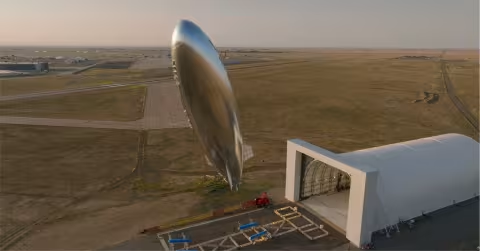
Tokyo – September 07, 2026 -- Sceye's Service Test 1 (ST1) stratospheric platform completed a transpacific flight of more than 15,000 kilometers from New Mexico to Japan in 13 days, demonstrating mobile broadband connectivity through SoftBank Corp.'s core network using unmodified consumer devices.
Sceye and SoftBank achieve 68-millisecond round-trip latency using onboard edge computing
The mission installed a server directly on the high-altitude platform system (HAPS), enabling data processing to occur onboard rather than through internet-based cloud infrastructure. This cut communication latency by more than 40% compared to cloud processing, marking what the companies describe as the first global test of a mobile core network and web server installed on a HAPS.
ST1 operated in Japanese airspace for over seven days at 16.5km altitude
The platform maintained position with a station-keeping radius of just 5 kilometers over an extended period. During the deployment, Sceye and SoftBank tested SMS, voice calls, internet access and video streaming from the stratosphere, alongside emergency calls using a disaster-alert system and drone communication protocols.
SoftBank backed Sceye's HAPS infrastructure with an investment in 2025
The partnership aims to position HAPS and non-terrestrial networks as infrastructure that complements terrestrial towers and satellite constellations, supporting future AI, IoT, aerial communication, edge computing and 6G applications. ST1 carried SceyeCELL, described as the first "cell tower in the sky" of its kind, designed to deliver mobile broadband directly to standard devices across wide areas. At full operational capacity, a single Sceye HAPS is designed to cover an area equivalent to roughly 500 terrestrial cell towers.
Mission launched August 9, 2026, building on an earlier 10,000km endurance flight to Brazil
ST1 departed New Mexico at 7:00 a.m. MDT on August 9, 2026, following Sceye's Endurance Program completed earlier this year, in which its SE2-HAPS flew over 10,000 kilometers to the Brazilian coast to validate long-duration performance ahead of the Service Test Program. At the time of this announcement, ST1 remained airborne, returning across the Pacific toward the United States.
Mikkel Vestergaard Frandsen, founder and CEO of Sceye, said the flight demonstrates the capability required to establish the stratosphere as a viable infrastructure layer for AI, edge computing and 6G. Junichi Miyakawa, President and CEO of SoftBank Corp., said the flight represents a step toward commercializing HAPS as a new form of societal infrastructure combining Sceye's flight technology with SoftBank's communication systems.