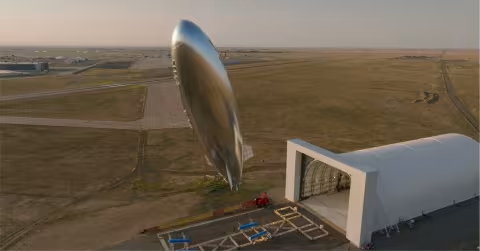
Tokyo – September 07, 2026 -- Sceye's Service Test 1 (ST1) stratospheric platform completed a 15,000-km flight from New Mexico to Japan in 13 days, marking the company's first Asia deployment and a milestone toward commercial High-Altitude Platform Systems (HAPS) infrastructure.
Conducted with SoftBank Corp. (TOKYO:9434), ST1 launched August 9, 2026, at 7:00 AM MDT and operated within Japanese airspace for over seven days, maintaining a station-seeking radius as low as 5 km while flying at approximately 16.5 km altitude.
Platform delivers mobile broadband to unmodified devices via SoftBank's core network
The mission carried SceyeCELL, described as a first-of-its-kind stratospheric cell tower, demonstrating text messaging, voice calls, internet access and video streaming to standard devices. Sceye and SoftBank also tested emergency alert messaging for large-scale disasters and drone communications to advance a planned 3D communications network.
Sceye states one HAPS unit at full scale is designed to cover an area equivalent to approximately 500 terrestrial towers, positioning the technology as a complement to ground networks and satellite constellations rather than a replacement.
Onboard processing cuts latency by over 40% versus cloud computing
A server installed directly on the HAPS enabled data processing onboard the platform, achieving an average round-trip response time of 68 milliseconds -- more than 40% faster than internet-based cloud processing. Sceye and SoftBank say this marks the first successful test combining a mobile core network and web server on a HAPS, with response processing completed entirely onboard before results relayed to smartphones.
The mission also confirmed communications performance equivalent to terrestrial networks while reducing radio interference with ground-based base stations.
SoftBank invested in Sceye's HAPS infrastructure in 2025
SoftBank Corp. backed Sceye's stratospheric platform last year as part of a strategy to build Non-Terrestrial Network (NTN) infrastructure spanning ground, sky and space. Junichi Miyakawa, President & CEO of SoftBank Corp., said the Japan trial marks an important step toward HAPS commercialization and gives the companies confidence to pursue a three-dimensional communications network integrating AI and communications technologies.
Mikkel Vestergaard Frandsen, Founder and CEO of Sceye, said the trans-Pacific flight demonstrates performance required to make the stratosphere viable infrastructure for AI, edge computing and 6G applications.
ST1 builds on prior 10,000-km Endurance Program flight to Brazil
The mission follows Sceye's Endurance Program, completed earlier in 2026, when its SE2 HAPS flew more than 10,000 km from New Mexico to Brazil's coast and remained over its operational area for several days to validate long-duration performance. At the time of announcement, ST1 remained in flight, returning toward the United States over the Pacific Ocean.