October 1, 2026
Most people don’t interact with Thermo Fisher Scientific firsthand. Still, the company's tools, services and manufacturing capabilities underpin many of the advances that define modern life, from new medicines and diagnostic tests that keep us healthy, to the materials and semiconductors that power the digital economy.
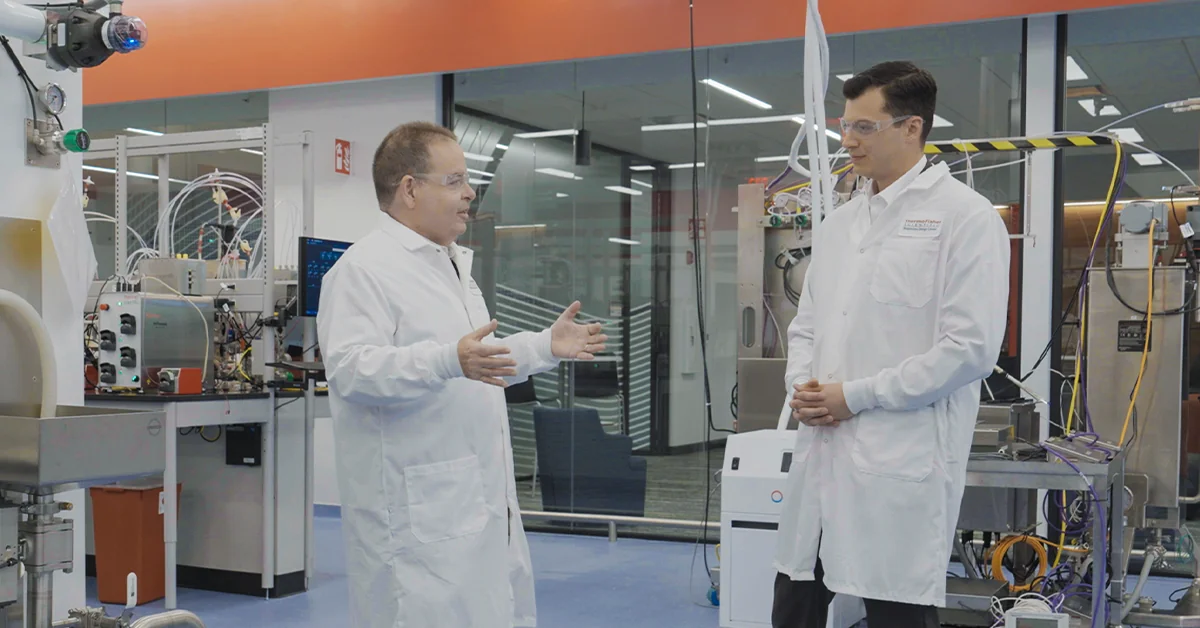
In this episode of Exceptional Leaders, Morgan Stanley’s Head of Life Science Tools and Diagnostics Research, Kallum Titchmarsh, visits Thermo Fisher's biologics and gene-therapy manufacturing facility in Plainville, Massachusetts, for a conversation with the company’s Chairman and CEO Marc Casper. They discuss how Thermo Fisher helps turn discovery into medicine at every stage, and how AI, automation and a relentless customer focus could accelerate the breakthroughs ahead.
MARC CASPER
My mother used to say to me, “We're born with two ears and one mouth, and there's a reason for that.” I think we have a culture in the organization that’s very much about listening, understanding, so that we have real clarity about what those big ideas are and then passionately going after making them a reality to help our customers do their important work. So, we're the company that helps make the world a healthier place.
KALLUM TITCHMARSH
Most people never encounter Thermo Fisher Scientific directly, but its products, technologies, services and manufacturing sit behind many of the scientific advances that shape modern life. From the medicines we take and the tests that doctors rely on to the advanced materials and semiconductors powering the digital world. Two decades ago, Thermo Fisher looked very different. Its roots were largely in lab products and scientific instruments. Then under chairman and CEO Mark Casper, who took the helm in 2009, the company expanded dramatically. Today, Thermo Fisher is now a key partner in everything from research to manufacturing. In a time where science grows increasingly complex. As Morgan Stanley's head of life science tools and diagnostics research, I cover the so-called picks and shovels of drug development. I wanted to know how AI is changing that toolkit and how Casper decides where to invest next. So, I travel to Thermo Fisher Biologics and gene therapy manufacturing facility in Plainville, Massachusetts, to ask him.
Marc, thank you so much for having us out here at this wonderful facility.
Kallum, thanks. It's really a pleasure to be able to have this conversation with you today.
If you had a minute to explain why this company matters to over day lives, what would you say.
We’re the company behind the scenes, and our mission is around enabling our customers to make the world a healthier place. And that enablement can be seen in developing breakthrough diagnostics that a pediatrician or your primary care physician would use to diagnose a complex disease all the way through helping the pharmaceutical and biotech industry identify the new breakthrough medicines. And we take them from the molecule all the way through the commercial production of those medicines, rely on our technologies, our people, our services, really around bringing medicines to patients.
When you took over the company in 2009, this was largely a business addressing the life sciences research community with consumables. You've since spanned way beyond that. What inspired that shift and talk us through your game plan?
we are a customer-focused, customer-centric organization deeply ingrained in customer success, because in our industry, customers are working on ten-year journeys to bring a medicine to market, or they're working on their life's research. And so that intimacy really is important. You get new ideas, and you become a trusted partner. We've been able to both organically invest in our business to expand our offerings, but also, we’ve deployed meaningful capital to be able to grow our business. And over time, we expanded our product offering, becoming a leading company in, you know, high-technology reagents, and then we added electron microscopy, so we kind of filled out the suite of laboratory-based technologies and then ultimately expanded our services offering to help our customers be able to produce medicines and manage complexity and then ultimately execute the clinical trials to determine the safety and efficacy of those medicines. It has all been a journey methodically executed to just help our customers be successful.
How do you stay connected with all your customers?
Probably somewhere in the range of a third of my time is purely on seeing customers, interacting in different ways to understand reality, right? How are we doing? What are the biggest unmet challenges that a customer is facing? Where can we be helpful? How are they thinking about the future? Right? And constantly across the leadership team and all of our colleagues, our customers know that fundamentally, we truly care about their success and we are an extension of their organization.
VOICE OVER: KALLUM TITCHMARSH
Drug development has grown far more complex. New approaches like cell gene therapy carry enormous promise. But turning those scientific breakthroughs into medicines requires specialized infrastructure and expertise. Thermo Fisher has increasingly expanded its capabilities to help customers manage that complexity.
Any examples come to mind from feedback driving maybe a major change in the business?
You know, we have been involved in the development and production of medicines for over 20 years. And over time, through the intensive interactions with our customers, what we saw was there were more modalities and more complexity coming into the biotech and pharmaceutical industry, because it wasn't just a monoclonal antibody, it wasn't just small molecule, but all of a sudden you have cell therapies and gene therapies.
And what those customers wanted was a partner that could help them manage their complexity, so they wouldn't have to be an expert in everything. And that allowed us ultimately to acquire Patheon in 2017. We could give it the resources. And the facility we're in today here in Massachusetts is one of the largest gene therapy sites in the world, and it's a site that we built from the ground up to meet customer demand. And ultimately, what you'll see here is not only, you know, the production of medicines, but you'll also see our collaboration center. You'll see how our technologies are used and how our customers can do their application work in a production setting.
Scale matters at a site like this, designed to move promising therapies from development into production and strip out the bottlenecks where time is measured in patient outcomes. That capability was put to a historic test during the Covid-19 pandemic, when Thermo Fisher mobilized across the company to expand production and support global testing almost overnight.
Maybe we can cast our mind back to 2020. Covid was obviously a really important time. How did you lead your employees through that pivot? And I'm curious whether Covid has changed the way you're thinking about the next hypothetical crisis.
As leaders, our job was to help shape priorities and give the team the resources they needed to be successful. And that backbone allowed us to do some extraordinary things as an organization and made a really big impact on society. Prior to the pandemic, you know, in a good year, we might be producing somewhere between 10 and 100,000 tests, right? Right? And ultimately, during the pandemic, we produced about a billion. What was special is that the team that does that work actually defined the problem set properly. So what the team figured out is, you know, what was the order of magnitude of the number of tests that might be needed to really get the pandemic under control? When you have that problem defined, you want it with a totally different set of solutions. We did some things that in six weeks, we had a factory producing stuff that you'd never be able to do in normal times. But society needed help and governments were supportive and ultimately we were able to step up to the moment and help in our small way of making a difference.
On this Thermo Fisher evolution, acquisitions have been an important part of that. What makes a company a Thermo Fisher company, and which parts of the operating model and culture and non-negotiable?
We've been an active acquirer over the last 20 plus years. And, you know, the way we think about it is ‘Does a company that we might acquire, does it really make the company stronger?’ And most importantly, ‘will customers value it?’ Right. When they read the press release, will their reaction be, ‘Oh that's interesting. That's an important field for me.
I want to learn more’ or is it more skeptical? And it starts with culture. Is there great pride in doing, you know, excellent work? Is it a well-run business? Right? What we're not looking to do is take broken businesses. We're looking at taking businesses and actually grow them more quickly, to expose them to more customers, to help them have the resources to scale more quickly. And it's not that we parachute a bunch of existing colleagues into the business, but we give the existing teams the resources to be successful. And it's worked well, right? And, you know, on day one of an acquisition, maybe the most important message that we give our teams are, ‘The day you joined the original company was the day you joined Thermo Fisher.’ It's not today on the day one. And we want to learn from you, and we want to benefit from your experience, and that collaboration and ownership, it really unlocks incredible potential. And we closed a meaningful acquisition in March of a company called Clario. It's used to be a technology provider for clinical development. And when you're doing a clinical study, it's really important to very easily understand how a patient is reacting to a medicine.
You have a pretty large business outside of healthcare too.