Sophont Launches Holon-S1 to Reveal Tumor Biology from Routine Pathology Slides
Image File
Original HTML

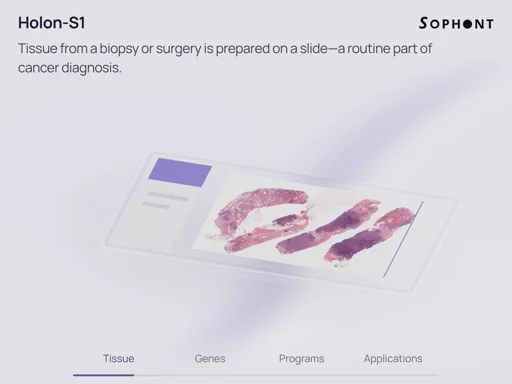
SACRAMENTO, Calif., Oct. 20, 2026 /PRNewswire/ -- Sophont, a frontier medical AI startup, announces Holon-S1, a pan-cancer AI model that predicts spatial gene and biological pathway activity from routine hematoxylin and eosin (H&E) pathology slides. By using widely available pathology slides, Holon-S1 aims to broaden access to insights that typically require costly and time-consuming molecular testing, supporting biomarker discovery and personalized treatment research.

"Most AI pathology solutions infer patient risk profiles without showing clinicians and researchers what biology resulted in the prediction," said Tanishq Mathew Abraham, Ph.D., CEO & Co-Founder of Sophont. "Holon-S1 was designed to uncover the biology behind the answer, showing which genes are active, where in the tumor they are active, and how that is related to whether a patient is likely to respond to treatment. Pathology has historically told us what a tumor looks like. Holon-S1 goes beyond this and tells us what the tumor is doing and where it may be vulnerable."

In a retrospective osteosarcoma patient case study using publicly shared slides, Holon-S1 recovered several insights originally obtained through months of extensive molecular testing.

Holon-S1 identified a fibroblast-associated program including FAP, the gene targeted by a therapy that the patient responded to. Comparing pretreatment and post-treatment slides, quantified increased immune infiltration and decreased cancer proliferation. The model had not been trained on osteosarcoma, suggesting potential generalization to unseen cancer types and analysis of archived slides without new tissue.

In triple-negative breast cancer, a novel biomarker defined by the spatial organization of predicted EREG activity was associated with response to chemotherapy before surgery in discovery and separate held-out cohorts. EREG has been implicated in chemotherapy sensitivity in other cancers; for the first time, this analysis suggested potential relevance in breast cancer. Details appear in Holon-S1's technical report.

Sophont evaluated Holon-S1 across 16 organ types, more than 15 scanners, and formalin-fixed, paraffin-embedded and fresh-frozen tissue. In a controlled comparison, it outperformed two other state-of-the-art models released this year in spatial gene activity prediction and robustness.

Holon-S1 is currently available for research use only. Sophont is designing further retrospective and prospective studies to evaluate potential diagnostic use.

"Biomedical foundation models are advancing at an extraordinary pace, and we are entering an era in which feature extraction and prediction alone may no longer suffice," said Jorge Reis-Filho, Chief Strategy Officer and Operating Partner at Foresite Labs and Venture Partner at Foresite Capital. "Models that combine high predictive accuracy with biological interpretability could enable new approaches to translational research and help us reimagine disease taxonomy and segmentation, as well as play pivotal roles in patient stratification," he added. "I look forward to seeing rigorous, independent evaluations of Holon-S1 against other leading foundation models on biologically and clinically relevant benchmarks."

The company is inviting biopharma and life sciences companies as well as research institutions to collaborate on biomarker discovery, therapeutic target research, and analysis of existing and archived patient cohorts.

Explore Holon-S1: https://sophont.med/holon

About Sophont

Sophont is a frontier medical AI lab building open, multimodal medical foundation models. Founded in February 2025 by Tanishq Mathew Abraham, Ph.D., and Paul Scotti, Ph.D., Sophont has raised $9.22M to date from Kindred Ventures, Upfront Ventures, Jeff Dean (Discovery Loop), Logan Kilpatrick (Google DeepMind), Clem Delangue (Hugging Face), and others. Sophont's mission is to build open medical superintelligence: AI that sees the whole patient, and that every clinician and researcher can use, inspect and build on. Its open releases include OpenMidnight, CortexMAE and Medmarks. Learn more: https://sophont.med.

Media Contact

[email protected]

SOURCE Sophont

Share this article

Class (B2B/B2C)
B2B
Ingest Status
Need Review
Dedupe hash
prn_302914452
Press Eligible
Yes
Press Eligible Reason
Manuelle Prüfung nötig. Risiko: HIGH. Flags: ['medical', 'numbers']. Stichprobe: False
Source Name
Unknown Company
Original Summary

<p>SACRAMENTO, Calif., Oct. 20, 2026 /PRNewswire/ -- Sophont, a frontier medical AI startup, announces Holon-S1, a pan-cancer AI model that predicts spatial gene and biological pathway activity from routine hematoxylin and eosin (H&amp;E) pathology slides. By using widely available pathology...</p>

Image URL
https://mmx.prnewswire.com/media/MS2016952/holon-s1-video-HD.mp4?id=OA3028915&p=thumbnail
Generated Article_json
{"target_audience": "b2b", "is_medical": true, "ai_generated_title": "Sophont Launches Holon-S1 AI to Read Tumor Biology from H&E Slides", "body_html": "<p><strong>Sacramento -- [CURRENT_DATE] --</strong> Sophont has launched Holon-S1, a pan-cancer AI model that predicts spatial gene and pathway activity from routine hematoxylin and eosin (H&E) pathology slides, and in an osteosarcoma case study it recovered insights that originally took months of molecular testing.</p><p>The model is available for research use only. Sophont is designing further retrospective and prospective studies to evaluate potential diagnostic use.</p><h5>Holon-S1 recovers osteosarcoma findings without training on the cancer type</h5><p>In a retrospective case study using publicly shared slides, Holon-S1 identified a fibroblast-associated program that included FAP, the gene targeted by a therapy to which the patient responded. Comparing pretreatment and post-treatment slides, it quantified increased immune infiltration and decreased cancer proliferation.</p><p>The model had not been trained on osteosarcoma. Sophont says this suggests potential generalization to unseen cancer types and analysis of archived slides without new tissue.</p><h5>Spatial EREG biomarker is linked to chemotherapy response in triple-negative breast cancer</h5><p>In triple-negative breast cancer, a novel biomarker defined by the spatial organization of predicted EREG activity was associated with response to chemotherapy before surgery. The association held in a discovery cohort and in separate held-out cohorts.</p><p>EREG has been implicated in chemotherapy sensitivity in other cancers. According to the company, this analysis for the first time suggested potential relevance in breast cancer. Details appear in the Holon-S1 technical report.</p><h5>Sophont tested the model across 16 organ types and more than 15 scanners</h5><p>Sophont evaluated Holon-S1 across 16 organ types, more than 15 scanners, and both formalin-fixed, paraffin-embedded and fresh-frozen tissue. In a controlled comparison, it outperformed two other state-of-the-art models released this year in spatial gene activity prediction and robustness.</p><p>CEO and Co-Founder Tanishq Mathew Abraham said most AI pathology tools infer patient risk without showing the biology behind the prediction, whereas Holon-S1 is designed to show which genes are active, where in the tumor, and how that relates to likely treatment response.</p><h5>Foresite's Reis-Filho calls for independent benchmarking</h5><p>Jorge Reis-Filho, Chief Strategy Officer and Operating Partner at Foresite Labs and Venture Partner at Foresite Capital, said models combining high predictive accuracy with biological interpretability could enable new approaches to translational research, disease taxonomy and segmentation, and patient stratification. He said he wants to see rigorous, independent evaluations of Holon-S1 against other leading foundation models on biologically and clinically relevant benchmarks.</p><p>Sophont is inviting biopharma and life sciences companies and research institutions to collaborate on biomarker discovery, therapeutic target research, and analysis of existing and archived patient cohorts.</p>", "meta_description": "Sophont's Holon-S1 AI predicts spatial gene activity from routine H&E slides across 16 organ types, targeting biomarker discovery. Research use only for now.", "seo_keywords": "Sophont, Holon-S1, pathology AI, H&E slides, spatial gene activity, biomarker discovery, pan-cancer model, triple-negative breast cancer, medical foundation model", "companies": ["Sophont", "Foresite Capital"], "industries": ["Healthcare & Biotech"], "markets_regions": ["United States"], "news_type": ["product_launch", "research_announcement"], "products": ["Holon-S1"], "themes": ["artificial_intelligence", "precision_medicine", "biomarker_discovery"], "events": [], "cta_text": "Explore Holon-S1 and Sophont's research collaboration opportunities", "learn_more": "https://sophont.med/holon", "fact_check": {"accuracy_score": 100, "legal_risk": "low", "corrections_made": [], "recommendation": "publish"}}
Content Hash (SHA-256, erste 32 hex)
fb8021fc7df95d56937d001f8580e516