How far can we push computing?
Nowadays big advances are made by scaling up—think more chips packed into ever-bigger data centers. But as we near the ceiling of what we can build, there’s still plenty of room below, at the fundamental physical limits of computing.
MIT Technology Review Explains: Let our writers untangle the complex, messy world of science and technology to help you understand what’s coming next. You can read more from the series here.
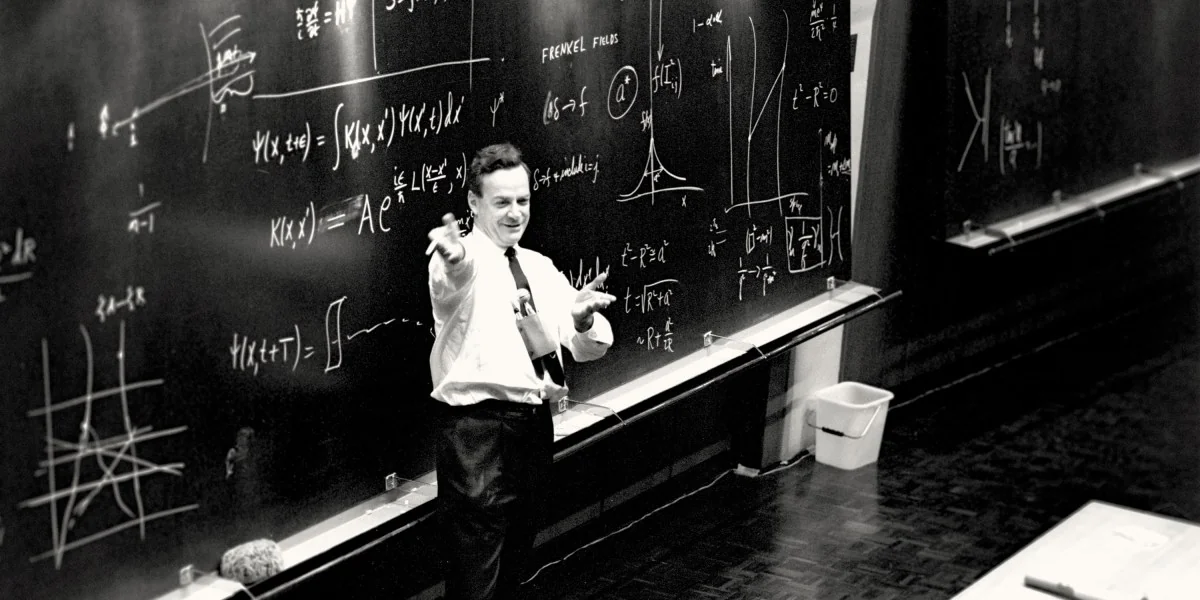
On the evening of December 29, 1959, at an American Physical Society meeting at Caltech, the physicist Richard Feynman gave a lecture called “There’s Plenty of Room at the Bottom,” on how we might manipulate and control things on an extremely small scale. There is no physical law stopping us from writing the entire Encyclopædia Britannica on the head of a pin, he argued, or from storing every book ever written in something the size of a dust speck—or, ultimately, from arranging matter atom by atom. Biology already did versions of this (a living cell keeps its instructions in a wisp of DNA), so all of this was plainly permitted by the laws of physics. We simply had not built the tools yet.
In other words, there was plenty of room at the bottom. He was right, and for decades we descended into that space almost for free. The transistor—the switch at the heart of computer chips—repeatedly halved in size so that chips doubled in density; a computer that once filled a room now fits inside a watch. But that easy descent has now stalled, and the clearest sign is the buildout of data centers. Six of the biggest hyperscalers, the companies that run the world’s largest such facilities, are on track to spend more than $700 billion this year on computing infrastructure, about twice the record they set in 2025, pouring concrete and copper and silicon into new sites faster than the electrical grid can feed them. That buildout buys performance by brute force, adding more of what we already know how to make. The other kind of progress, the kind that made computer chips better, is the one that is quietly running out.
The trend lines that tracked the dramatic improvements of the 20th-century information age are now bending—or breaking—with the dawn of the 21st century’s intelligence age. Moore’s Law, which plots how densely transistors can be constructed on silicon, has slowed down; Dennard’s Law, which states that power consumption in a given patch of computer chip stays the same even as it gets more and more packed with smaller and smaller transistors, has ended; Koomey’s Law, which traces how much computation we can wring from each joule of energy, has begun to flag; Kryder’s Law, which describes how tightly bits can be packed to build magnetic storage, has slowed to a crawl; and Keck’s Law, which charts the exponential rise in the amount of information a single conventional optical fiber can carry, is flattening.
But these scaling laws are merely observations about systems that we have engineered; they are not fundamental physical laws. The physical limits of computing and communications—dictated by quantum mechanics, general relativity, and information theory—lie far below anything in a data center today. The scaling laws chart the descent behind us. The fundamental physical limits chart the room that remains.
Some of these limits may be far out of reach in practice. But they are still worth exploring, because the work pays twice: once in technology development and once in fundamental science. A proof-of-concept system that approaches a limit is at once a technology that forces stalled paradigms to give way and an experiment that deepens our understanding of the physical laws themselves.
The descent
During his 1959 lecture, Feynman offered two prizes of $1,000 each out of his own pocket. One would go to the first person to build a working electric motor smaller than a 0.4-millimeter cube. He expected the challenge to force someone to invent a genuinely new microtechnology. Instead, about a year later, a Caltech-trained engineer named William McLellan turned up with the motor built and running. The quarter-milligram machine, roughly the size of a grain of sand, had been assembled by hand with a toothpick and a watchmaker’s lathe, under a microscope. Feynman, by his own account, was only slightly disappointed. The prize had proved his point in the least interesting way imaginable. The room really was down there, but reaching this first milestone had taken no new technology at all—just an unusually patient man with steady hands.
The second prize aged differently, and more instructively. It was offered to whoever could shrink a page of text by a factor of 25,000 in each direction, small enough for the whole Britannica to fit on a pinhead. That one stood unclaimed for a quarter of a century. It was finally won in 1985 by Tom Newman, a Stanford graduate student who used an electron-beam lithography machine—an ancestor of pattern-making tools used in chipmaking today—to transcribe the opening page of A Tale of Two Cities at the required scale.
The descent was already well underway, however. The year before Feynman’s talk, Jack Kilby, newly hired at Texas Instruments and with no vacation yet to take, spent that July nearly alone in the lab while his colleagues enjoyed time off, and by that September he had wired together a transistor, a capacitor, and three resistors, all made from a single sliver of germanium. This proved that an entire circuit could be carved from one block of semiconductor.
The machine, roughly the size of a grain of sand, had been assembled by hand with a toothpick and a watchmaker’s lathe, under a microscope.
The idea took off, and the number of components on a chip kept doubling on a schedule so regular that Gordon Moore, in a 1965 trade-magazine article, simply drew a line through the trend and extended it into the future. That line became Moore’s Law.
Moore, though, never claimed transistors could shrink forever. He observed that at any given moment there is a certain number of components that makes each one of them as cheap as possible to manufacture. In 1965, that number was 50. Put in too few transistors and you waste the chip; cram in too many and manufacturing errors multiply and yields collapse. It was this cost-minimizing number that was doubling at a steady pace.
Slowing down
Many of the trend lines that measure improvements in computing and communications over time have been flattening. The most famous is Moore’s Law, which tracks transistor density on chips. The clearest slowdown has been in Dennard scaling, shown here as clock speed, which stopped climbing around 2004. In this plot, a straight line would represent a periodic doubling. The more horizontal the line becomes, the slower the doubling.
SOURCES: STANFORD CPU DB; INTEL; APPLE; TECHINSIGHTS; KOOMEY ET AL.; COMPUTER HISTORY MUSEUM; IBM; TOSHIBA; SEAGATE; BELL SYSTEM TECHNICAL JOURNAL; OFC AND ECOC CONFERENCE PAPERS
For four decades the descent came with another gift: Dennard scaling, so named for the IBM engineer Robert Dennard, who spelled it out in 1974. Each time transistors shrank, they also switched faster and drew proportionally less power, so every generation was an automatic win. Around 2004, though, the gift ran out. Chips could no longer shed the heat of running every transistor flat out; clock speeds, which had raced past three gigahertz, stopped climbing, and Intel canceled the four-gigahertz processor it had promised. The industry pivoted to packing multiple processing cores onto a chip rather than making one core faster, and the texture of progress changed.
Progress is now bought mostly by scaling up the system—more chips wired together, more memory feeding them, more power and cooling around them—rather than by shrinking the transistor. This is most visible in AI, where training compute, the total count of arithmetic operations spent to train a model, has doubled roughly every six months since 2010, far faster than the pace of Moore’s Law allows. Little of that progress is due to shrinking. Computer chips still get better, and transistors still improve and get more densely packed, but each new generation arrives more slowly and pays back less in speed and power than the one before it. Nothing in that slowdown is a law of physics, though. The components of computing still sit far above their fundamental limits.
The ultimate computer
Before we get to those limits, it is worth measuring how far the descent has already gone. In the nearly eight decades since the first transistor, the density of transistors on a chip has grown by 10 orders of magnitude—a 1 followed by 10 zeros, or a factor of 10 billion. Now more than 100 million transistors fit in a square millimeter (100 billion or more to a chip). Computational speed has grown even more, by 12 orders of magnitude, or a factor of a trillion; energy per operation has fallen 17 orders of magnitude, from about 100 joules for an early vacuum-tube machine down to a femtojoule—one-quadrillionth of a joule—for a single switch of a logic gate.
These are not small improvements. But the floor, for computing performance, lies lower still. How much lower could we go? Around the turn of the millennium, the MIT physicist Seth Lloyd took the question to its extreme: Imagine an ordinary lump of matter, a kilogram of it—about the mass of a laptop—packed into a liter of space. How much computing could the laws of physics, pushed to their absolute limit, ever wring from that kilogram? In a 2000 paper in Nature titled “Ultimate physical limits to computation,” he worked out the answer and called the imaginary machine the ultimate laptop.
The speed such a machine can achieve is governed by its energy. A kilogram of matter, according to E = mc2, holds about 9 ×10¹⁶ joules, which is roughly what the entire United States draws from its electrical grid every two days.