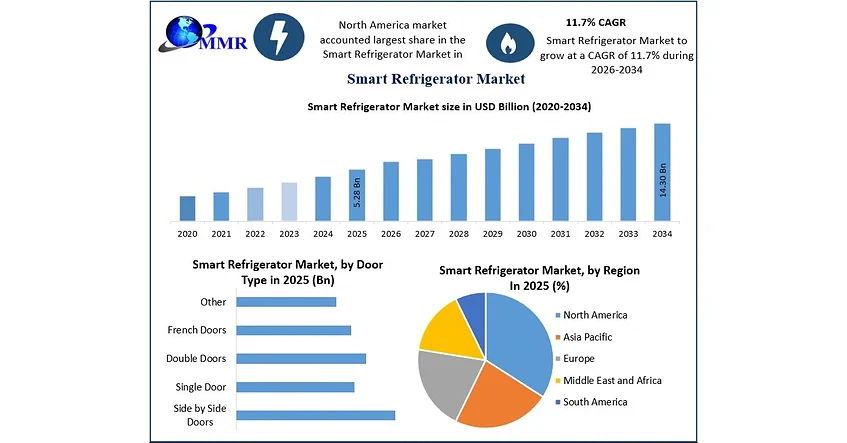
PUNE, India, Oct. 6, 2026 /PRNewswire/ -- The Global Smart Refrigerator Market was valued at USD 5.28 Billion in 2025 and is projected to grow at a CAGR of 11.7% from 2026 to 2034, reaching USD 14.30 Billion by 2034, according to a new analysis by Maximize Market Research.
Explore 120 market data tables and 70 figures across 306 pages, along with a detailed Table of Contents covering the Global Smart Refrigerator Market.
Global Smart Refrigerator Market Size & Forecast
Market Size (Base Year 2025): USD 5.28 Billion
Forecast Market Size (2034): USD 14.30 Billion
CAGR (2026–2034): 11.7%
Base Year: 2025
Forecast Period: 2026–2034
Historical Period: 2020–2025
Global Smart Refrigerator Market Overview
The Global Smart Refrigerator Market continues to expand as consumers increasingly adopt smart homes, connected appliances, AI-enabled kitchens, and energy-efficient home technologies. Smart refrigerators combine advanced cooling with Wi-Fi connectivity, touchscreen displays, internal cameras, voice assistant integration, inventory management, food expiration tracking, remote diagnostics, and energy monitoring. Market growth is supported by rising disposable incomes, urbanization, premium appliance demand, smart home adoption, and growing consumer interest in convenience, food preservation, reduced food waste, and connected living. AI-powered cooling optimization, predictive maintenance, and personalized user experiences are further strengthening the Smart Refrigerator Market size, market share, market demand, and long-term market forecast.
The market is also being shaped by artificial intelligence, Internet of Things (IoT), cloud connectivity, smart inventory tracking, voice-controlled operation, internal cameras, inverter compressors, eco-friendly refrigerants, and sustainable refrigeration technologies. North America remains the leading regional market due to high smart-home penetration, strong purchasing power, premium appliance adoption, and established retail and e-commerce networks, while Asia Pacific is expected to record the fastest growth as urbanization, middle-class expansion, rising incomes, and smart appliance adoption increase across China, Japan, South Korea, and India. Manufacturers are increasingly focusing on energy efficiency, smart home integration, cybersecurity, software compatibility, premium product innovation, and connected kitchen ecosystems to improve their competitive position in the Smart Refrigerator Market.
Get Full PDF Sample Copy of Report: (Including Full TOC, List of Tables & Figures, Chart) @ https://www.maximizemarketresearch.com/request-sample/213712/
The Global Smart Refrigerator Market is evolving as consumers increasingly seek connected, intelligent, energy-efficient, and convenient kitchen appliances. AI-powered food management, IoT connectivity, voice assistants, touchscreen interfaces, remote monitoring, predictive maintenance, inverter technologies, and sustainable cooling systems are creating stronger market opportunities. Companies that combine smart functionality, energy efficiency, cybersecurity, seamless home integration, premium design, and continuous digital innovation are likely to shape the Smart Refrigerator Market through 2034.
Smart Refrigerator Market Growth Drivers, Opportunities & Key Highlights
The Global Smart Refrigerator Market is expanding as smart home adoption, connected appliances, AI-enabled kitchens, rising disposable incomes, and demand for energy-efficient home appliances continue to support growth. Side-by-side refrigerators remain a leading door type because of their large storage capacity, premium design, and integration of touchscreen displays, internal cameras, voice assistants, Wi-Fi connectivity, and AI-powered inventory management. Premium models also remain strong as consumers increasingly invest in advanced smart-home ecosystems and connected kitchen appliances.
New market opportunities are emerging through AI-powered food recognition, smart inventory tracking, voice control, predictive maintenance, eco-friendly refrigerants, inverter compressors, and remote monitoring. In 2026, Samsung expanded its Bespoke AI Refrigerator capabilities, GE Appliances introduced a smart French-door refrigerator with a built-in barcode scanner, LG showcased conversational AI and AI Fresh technologies, and Haier introduced a Wi-Fi-enabled side-by-side refrigerator with Smart Sense AI.
Key Market Highlights
- USD 5.28 Billion: Market size in 2025
- USD 14.30 Billion: Projected market size by 2034
- 11.7% CAGR: Growth during 2026–2034
- North America: Leading regional market
- Asia Pacific: Fastest-growing region
- Side by Side Doors: Leading door type
- Premium: Leading price range
- AI, IoT and Smart Home Integration: Major technology growth drivers
- Energy Efficiency and Sustainable Refrigeration: Key long-term market opportunity
United States Smart Refrigerator Market Advances with AI-Powered Kitchen Innovation
In the United States, the Smart Refrigerator Market strengthened in 2026 as GE Appliances introduced its GE Profile 27.9-cu.-ft. Smart 4-Door French-Door Refrigerator with Kitchen Assistant at CES 2026. The model features a built-in barcode scanner that helps consumers create shopping lists, manage groceries, and support meal planning, with commercial availability announced for April 2026. This development reflects rising U.S. demand for AI-enabled appliances, smart food management, connected kitchens, digital convenience, and premium refrigeration technologies, while reinforcing the country's role in smart-home and intelligent appliance innovation.
The Global Smart Refrigerator Market is segmented by Door Type, Price Range, Distribution Channel, End-User, and Region.
By Door Type, Side by Side Doors hold the leading position in 2025, supported by their premium design, large storage capacity, multiple compartments, spacious freezer sections, and strong integration of smart technologies such as touchscreen displays, internal cameras, voice assistants, Wi-Fi connectivity, and AI-powered inventory management. French Door models are expected to record the fastest growth as consumers increasingly prefer modern kitchen designs, flexible storage, AI-enabled food management, inverter compressors, and interactive displays.
By Price Range, Premium Smart Refrigerators account for the largest share in 2025 because of strong demand for AI, IoT connectivity, touchscreen interfaces, internal cameras, voice assistant integration, and energy-efficient inverter technologies. Economy models are expected to grow rapidly as manufacturers introduce more affordable refrigerators with Wi-Fi connectivity, smartphone applications, energy monitoring, and other essential smart features for middle-income consumers.
Get Insightful Data on Regions, Market Segments, Customer Landscape, and Top Companies (Charts, Tables, Figures and More) https://www.maximizemarketresearch.com/request-sample/213712/
North America Leads the Smart Refrigerator Market as Connected Homes and Premium Appliance Adoption Strengthen
North America remains the leading region in the Global Smart Refrigerator Market, supported by high penetration of smart home technologies, strong consumer purchasing power, and widespread adoption of connected household appliances. The United States remains the major contributor, driven by strong demand for premium refrigerators equipped with artificial intelligence, IoT connectivity, touchscreen displays, voice assistant integration, internal cameras, and energy-efficient cooling technologies. The presence of leading manufacturers, established retail and e-commerce networks, and increasing investment in smart home ecosystems continues to strengthen North America's market position.
Asia Pacific is expected to record the fastest growth, supported by rapid urbanization, rising disposable incomes, expanding middle-class populations, and increasing smart home adoption across China, Japan, South Korea, and India. Europe continues to grow through strict energy-efficiency regulations and demand for sustainable connected appliances, while South America is developing through improving living standards and residential construction. The Middle East & Africa is also expanding as premium residential projects, hospitality infrastructure, urban development, and adoption of modern home appliances increase across major cities.
Global Smart Refrigerator Market Competitive Landscape
The Global Smart Refrigerator Market is highly competitive, with major companies focusing on artificial intelligence, Internet of Things connectivity, smart home integration, energy-efficient cooling, premium design, touchscreen interfaces, internal cameras, voice assistant compatibility, remote diagnostics, and AI-powered food management. Competition is increasingly centered on connected kitchen ecosystems, inverter compressors, eco-friendly refrigerants, predictive maintenance, cloud connectivity, and personalized user experiences.
Major players include Samsung Electronics, LG Electronics, Whirlpool Corporation, Haier Smart Home, BSH Hausgeräte, Electrolux, Panasonic, Hisense, Midea, GE Appliances, Sharp, and Hitachi. Recent developments show that competition is shifting toward AI-enabled features and smarter connected-home platforms. In 2026, Samsung expanded its Bespoke AI Refrigerator Family Hub with Google Gemini-powered AI Vision, GE Appliances introduced a smart 4-Door French-Door Refrigerator with a built-in barcode scanner, LG showcased a SIGNATURE refrigerator with conversational AI and AI Fresh technology, while Haier India introduced a Wi-Fi-enabled side-by-side refrigerator with Smart Sense AI and smart food-management capabilities. Across the market, companies are strengthening their positions through product launches, digital ecosystems, energy-efficiency innovation, smart-home partnerships, and premium connected appliance development.