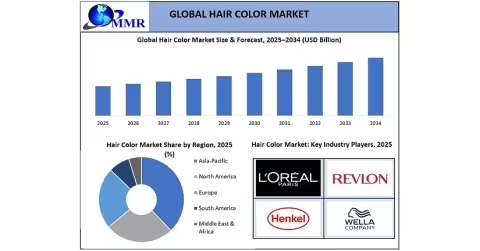
Pune – – October 05, 2026 -- The global hair color market reached USD 31.12 billion in 2025 and is projected to climb to USD 61.18 billion by 2034, expanding at a compound annual growth rate of 7.8% between 2026 and 2034, according to a new analysis from Maximize Market Research.
Permanent color dominates while gray coverage drives repeat purchases
Permanent hair color held the leading product category in 2025, backed by demand for long-lasting results and salon-quality gray coverage. Demi-permanent and semi-permanent formats are gaining share among consumers seeking lower-commitment, frequent shade changes, while root touch-up products benefit from at-home grooming trends.
Generational splits reshape product demand
Fifty percent of Millennials and 59% of Gen Z consumers prefer temporary and semi-permanent hair color products over permanent formulations, the report finds. In the United States, 75% of women dye their hair and more than 64 million people use hair-coloring products, underscoring the scale of the North American base.
Clean-label and ammonia-free formulations accelerate competitive differentiation
Wella Professionals launched its ammonia-free Pure Perfection range with 30 shades in 2026. Henkel expanded its Schwarzkopf and Palette portfolios with bonding technology and natural-origin formulations, while Schwarzkopf Professional grew its IGORA ZERO AMM ammonia-free line to 52 shades. Kao Corporation extended its Liese hair-color range across seven Asian markets, reflecting intensified localized innovation in post-color care.
Germany emerges as a hub for bonding and ammonia-free technology
Henkel's Schwarzkopf relaunched Brillance with 19 shades and bonding technology, introduced LIVE Go Gloss for temporary color refreshes, and pushed IGORA ZERO AMM to 52 ammonia-free shades in the German market. The moves reinforce Germany's role as a center for premium, safety-focused hair-color product development.
Distribution shifts toward e-commerce despite supermarket dominance
Supermarkets held the largest distribution share in 2025 due to broad availability and competitive pricing, while specialty stores and salons remain key for premium and professional products. Online retail is expanding rapidly, supported by digital beauty consultations and direct-to-consumer brands; 38% of consumers now prefer retailers offering home delivery of hair-coloring products.
Asia Pacific positioned as the fastest-growing region
North America remains the leading region on strong consumer spending and an established beauty industry, with the United States as the primary contributor. Asia Pacific is expected to post the fastest growth, driven by rising disposable incomes, e-commerce penetration, male grooming, and youth-led fashion coloring across China, Japan, India and South Korea. The report also notes that 75%-85% of the global population has naturally black hair, a factor shaping regional product formulation priorities.
Competitive landscape centers on cleaner chemistry and personalization
Key players named in the report include L'Oréal S.A., Henkel AG & Co. KGaA, Wella Company, Revlon Inc., Unilever PLC, DARIYA Corporation, The Estée Lauder Companies Inc., Shiseido Company Limited, Kao Corporation, Godrej Consumer Products Ltd., Hoyu Co. Ltd., Amorepacific Corporation, Combe Incorporated, John Paul Mitchell Systems, Keune Haircosmetics and Oriflame Cosmetics S.A. Competition is increasingly concentrated on ammonia-free, vegan, low-damage and personalized shade offerings, alongside salon partnerships and digital retail expansion.