Arlington, Va. – October 05, 2026 -- Info-Tech Research Group has released a new blueprint, Define Your Target AI Infrastructure, aimed at helping enterprises stop overspending on compute hardware by aligning infrastructure design with actual AI workload demands.
Enterprises overbuy compute instead of fixing utilization
Info-Tech's analysis finds that organizations experiencing AI performance issues -- including slow model training and reduced throughput -- typically respond by acquiring additional compute resources, driving up IT costs. The firm argues that greater long-term value comes from maximizing utilization of existing infrastructure and matching architecture decisions to workload requirements rather than adding hardware.
AI traffic patterns differ fundamentally from traditional enterprise networks
Traditional enterprise traffic is primarily user-facing (north-south), tolerating moderate bandwidth and higher latency. AI workloads generate compute-to-compute (east-west) traffic that demands high bandwidth and low latency, making network design a critical and often overlooked constraint on AI performance.
Capacity planning fails because AI workloads are nonlinear
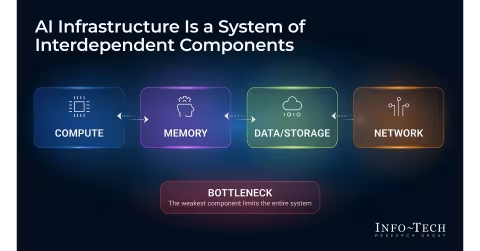
According to the blueprint, standard capacity planning assumptions break down because AI workloads -- training, inference, retrieval-augmented generation (RAG), agentic AI, and edge AI -- are highly variable and place distinct demands on compute, memory, storage, and networking. A single standardized technology approach cannot serve all workload types, requiring tailored architecture decisions for each.
Five-phase framework guides architecture and sourcing decisions
The blueprint structures decision-making into five phases: assessing workload characteristics and AI demand patterns; aligning processor and infrastructure strategies to workload needs; identifying constraints across compute, memory, storage, networking, and physical infrastructure; designing balanced architectures for utilization and future growth; and establishing operational strategies for cost, performance, and risk management.
Workbook tool translates strategy into costed vendor decisions
An accompanying AI Infrastructure Assessment Workbook lets organizations profile workloads, select from seven reference architecture patterns, define infrastructure components, build vendor shortlists, analyze costs, and simulate deployment scenarios to produce a validated, costed summary of target-state AI infrastructure.
John Donovan, principal research director at Info-Tech Research Group, said organizations that treat AI infrastructure as a systems design challenge rather than a hardware acquisition exercise are better positioned to reduce operational risk and improve returns on AI investment.