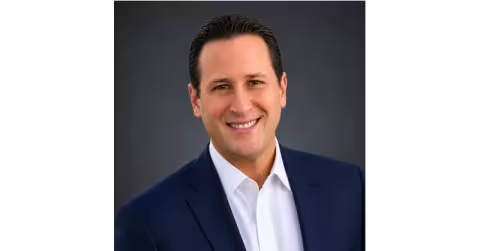
Dallas – October 05, 2026 -- ICAT Logistics has appointed Jonathan Stein as Global Vice President of Sports and Live Events, a newly created position aimed at expanding the specialized freight carrier's footprint in broadcast production and sports logistics.
Stein brings 29 years of broadcast-side experience to a logistics provider he once hired as a client
Stein joins ICAT after most recently leading sales for the Specialty Capture division of NEP, one of the world's largest broadcast services providers. He began his career at Fletcher Chicago in 1997, where he helped commercialize camera systems now standard in live sports coverage, including Above-The-Rim camera rigs and high-frame-rate pylon cameras used for goal-line replay. Over his career he sold these technologies to ESPN, CBS, FOX, NBC and Turner Sports, among others.
Missed equipment windows carry direct financial stakes for broadcasters and advertisers
Broadcast freight operates on tight, fixed deadlines: a crew installing an Above-The-Rim camera system typically needs court access before practice begins, and missing that window can eliminate the camera angle from the broadcast entirely. ICAT frames this as a risk with financial consequences for advertisers, production companies and teams, not merely an operational inconvenience.
ICAT CEO ties the hire to industry expansion beyond traditional networks
"Jonathan has worked alongside the industry's leading networks and production companies throughout his career, and he understands the pressures they face better than anyone," said Brad Stogner, CEO of ICAT Logistics. "As live production expands across broadcasters and streaming platforms, his experience positions ICAT to meet that growth with the precision and responsiveness our customers expect."
Streaming entrants are fragmenting live-event rights and multiplying concurrent productions
Amazon now carries major NFL and NBA programming, Netflix has expanded into live sports, and streaming platforms increasingly produce live events alongside CBS, Turner and ESPN. That fragmentation of rights holders creates more simultaneous productions running at once, raising the odds that a single delayed shipment disrupts an entire broadcast.
Stein's first move will be a proactive communication model for broadcast clients
Stein said his priority is replacing the industry's traditionally reactive logistics approach with proactive updates delivered before clients have to ask, regardless of whether the news is good or bad. "The gear either makes air or it doesn't, and once it doesn't, the excuse has no value to anybody," he said.