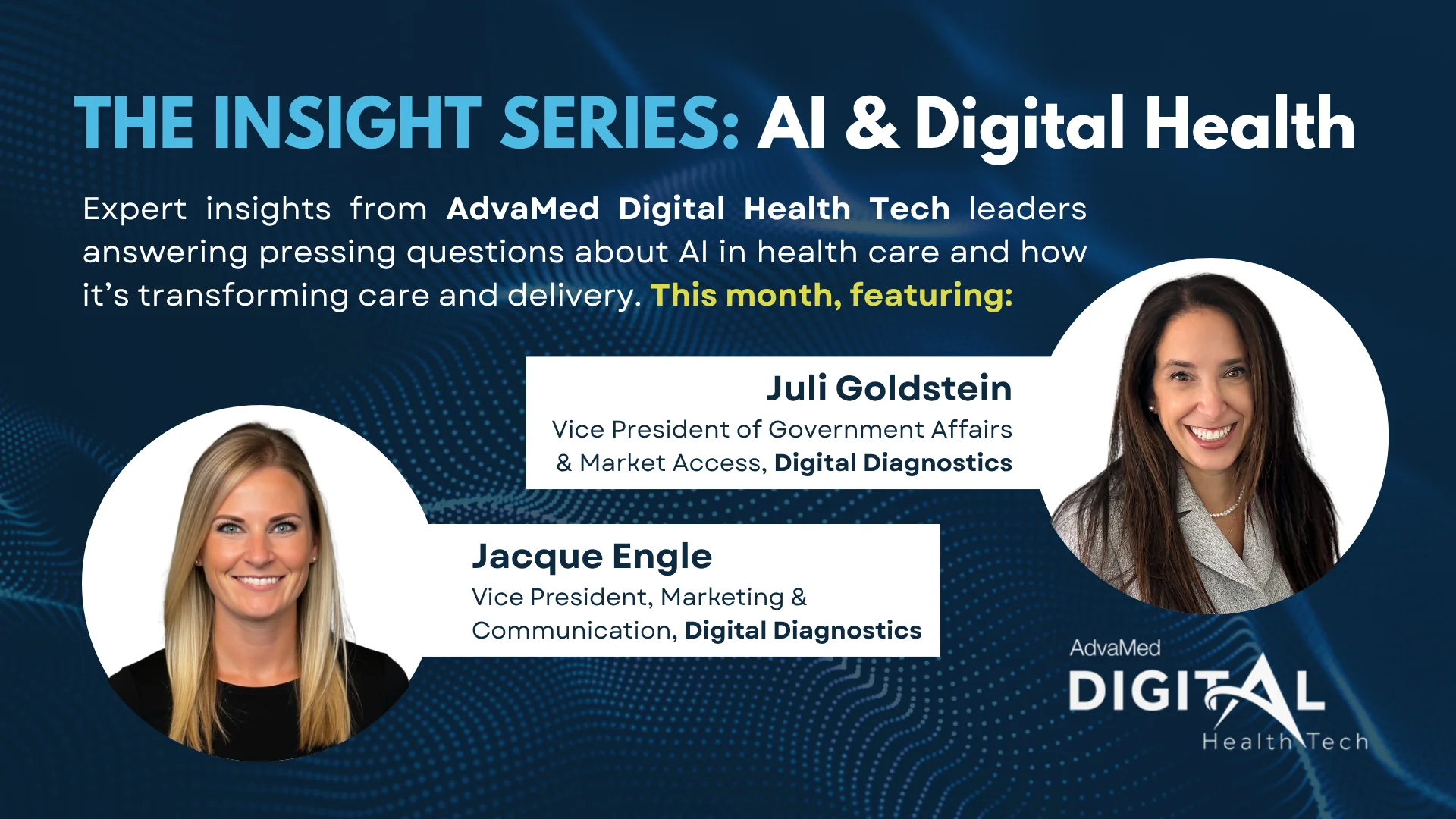
The Insight Series: AI & Digital Health
Image File
Original HTML

AdvaMed’s Digital Health Tech division brings together leading companies developing AI-enabled solutions that are transforming health care, from diagnosis and treatment to clinical decision support and care beyond traditional settings.

“The Insight Series: AI & Digital Health” features industry experts answering key questions to help inform policymakers and the public about how AI is shaping the future of care delivery. Our latest edition features Jacque Engle, Vice President of Marketing & Communication and Juli Goldstein, Vice President of Government Affairs & Market Access at Digital Diagnostics.

AdvaMed: How is artificial intelligence changing health care today, and what should patients know about it?

Jacque Engle: AI is no longer a future promise in health care. It is here and already changing lives. Digital Diagnostics™ is the clearest example of that reality. LumineticsCore® is the first fully autonomous AI diagnostic system cleared by the FDA-in any specialty of medicine. The system is designed to detect diabetic retinopathy, a common complication of diabetes and a leading cause of blindness.

What makes this meaningful for patients is where and how it works. LumineticsCore brings high-quality diagnostic services to the point-of-care thereby meeting patients where they receive care, bridging the gap between specialty and primary care and delivering accessibility, affordability, and access to necessary care. A patient with diabetes can now walk into a primary care or family medicine visit and receive a retinal diagnosis for diabetic retinopathy on the spot, with no specialist appointment needed and no long wait. Perhaps even more impactful, a finding of diabetic retinal disease it more than just a complication from diabetes; it is an early warning sign of impending risk for stroke, kidney failure, and peripheral vascular disease. Detecting diabetic retinal disease in the frontline settings of care, health care providers can make therapeutic changes that prevent acute complications from diabetes. As a whole, that is a fundamental shift in how care is delivered.

Patients should know that FDA authorized AI tools used in their care have gone through rigorous clinical validation and regulatory review. LumineticsCore is not a prototype or a research experiment. It received FDA clearance in 2018 and was one of the first systems to receive breakthrough device designation following the signing of the 21st Century Cures Act, marking a milestone in the integration of AI into medicine as a whole.

AdvaMed: What are the biggest benefits AI brings to patient care today — and what’s just hype?

Juli Goldstein: The real benefits are tangible and measurable. In our pivotal clinical trial, LumineticsCore avoided 91% of unnecessary specialty visits by providing a diagnostic result at the point-of-care showing patients as negative for more than mild diabetic retinopathy. That means fewer burdensome referrals, faster answers related to possible health complications, and a more efficient use of the health care system for patients who do not need specialist follow-up.

The access dimension is equally real. Every year, over 60,000 people go blind from diabetic retinopathy, a condition that is almost entirely preventable if caught early. Yet as few as 15% of people living with diabetes receive the annual eye exam they need. AI can close that gap at scale in a way that simply adding more specialists cannot.

What is hype? The idea that AI can broadly transform care without the hard work of clinical validation, regulatory clearance, workflow integration, and reimbursement infrastructure. Sustainable reimbursement is key to scaling adoption and thereby realizing the potential benefits of medical AI to better health outcomes for all. At Digital Diagnostics, we have pursued all of those pieces deliberately, including achieving industry firsts such as the autonomous AI CPT® code in the medical section of the CPT editorial code book (CPT Code 92229) and attainment for related quality measures that can make reimbursement possible and the technology self-sustaining in clinical practice.

AdvaMed: Should patients be worried that AI tools used in their care are replacing their clinicians?

Jacque Engle: No, not when there is FDA clearance and oversight, and LumineticsCore is a good illustration of why. Clearance under the FDA requires rigorous safety validation and requires ongoing monitoring, oversight, and extensive documentation. The AI-driven system performs the interpretation and delivers a diagnostic report at the point-of-care without the requirement for a remote specialist overread, but that is not the same as replacing the clinician relationship. The clinician still needs to order the exam, educate the patient on the findings from the exam, and use their clinical acumen to make treatment plans and referrals for follow up. It means that a specific, well-defined interpretation task can be performed reliably at the point of care, thereby strengthening the patient – clinician relationship.

LumineticsCore enhances the clinical team. This AI technology has improved satisfaction for both patients and the clinical team by providing clinicians with real-time data to manage diabetes care and patient relationships more effectively. When a patient tests positive for diabetic retinopathy, that result immediately prompts a timely, actionable referral to a specialist, reducing time-to-follow-up from 60 days with a remote reading network to just 5 days with LumineticsCore. Moreover, since a finding of diabetic retinal disease can be a signal of impending risk of cardiovascular and other complications, there have been significant anecdotal stories from providers who have used the results to improve diabetes management together with patients.

AI tools also carry an ethical obligation to work without bias. LumineticsCore has been trained and validated to mitigate bias and ensure the system works equally well for all people, regardless of sex, race, or ethnicity. That commitment to fairness is part of what makes responsible AI a complement to, not a replacement for, human-centered care.

AdvaMed: What does the future of AI look like in health care?

Juli Goldstein: We are at the beginning of a significant expansion. Ophthalmology led the way, and the lessons learned with LumineticsCore are now paving a path for AI diagnostics across many more conditions. AI will move beyond diabetic retinopathy to layering on more diagnoses, with algorithms likely to help diagnose age-related macular degeneration and glaucoma, and a single AI-enabled platform with the capability to potentially diagnose all of these conditions through eye imaging, which holds promise for non-invasive imaging and lowering cost of care.

More broadly, the future will see autonomous AI move into areas of medicine where access gaps are most severe, including chronic disease management, rural communities, and resource-limited settings globally. Autonomous AI increases health care system productivity, which could increase care access and reduce health disparities.

The regulatory and reimbursement infrastructure built around LumineticsCore, the first FDA-cleared device to autonomously diagnose anything in any field of medicine, has created a roadmap others can follow. That infrastructure is as important as the technology itself. As Dr. Michael Abramoff, founder of Digital Diagnostics, has noted: “You cannot buy a fully autonomous, self-driving car that is street-legal, but you can get diagnosed by a ‘street-legal,’ FDA-cleared, bioethically sound, reimbursable autonomous AI.” That is the future we are building toward, together with regulators, providers, payers, health systems, medical associations, and patients.

AdvaMed: If you could change one thing about how we adopt and utilize AI in health care, what would it be — and why?

Jacque Engle: We would accelerate the alignment between innovation, reimbursement, and health care access together, not sequentially.

Too often, a promising AI tool clears the FDA, then sits on the shelf while the reimbursement and coverage debates play out over years. During that time, patients, especially those in rural and vulnerable communities who stand to benefit most, go without. As adoption lags in spite of regulatory approval, the decisions about which operational, reimbursement, and trust-building barriers to prioritize may shape not only a single product’s future but the broader path of AI in medicine.

At Digital Diagnostics, we believe AI developers, policymakers, payers, health systems, associations, and clinicians need to build those pathways in parallel, not in sequence. The potential is too urgent. Digital Diagnostics is paving the way for rigorously validated autonomous and bias-free AI technology to become a new standard of care, contributing to democratizing health care and closing care gaps. But realizing that vision requires policy frameworks that move at the pace of the need, not just the pace of the technology.

AdvaMed: When the Social Security Act was written in 1965 no one could have imagined that a simple eye scan could one day detect the most costly and chronic conditions before symptoms even appear. How do we modernize Medicare and the broader regulatory environment to keep pace with innovations like cutting-edge diagnostics?

Juli Goldstein: LumineticsCore has proven that autonomous AI can deliver a reliable, accessible, FDA-cleared diagnosis at the point-of-care. That was the foundation. What we are building toward now is a platform approach rooted in systemic disease detected using non-invasive, lower cost ocular imaging, connecting patients and providers through a single, seamless delivery platform.

For patients, this means a routine, non-invasive eye exam could one day serve as an early warning system for some of the most serious and costly diseases we face.

Class (B2B/B2C)
B2B
Ingest Status
Rewritten
Dedupe hash
a80f2956b4bd59c7b634b21e17cc8335
Press Eligible
Yes
Press Eligible Reason
Healthcare AI industry interview discussing clinical validation, reimbursement, and adoption of diagnostic technology.
Source Name
AdvaMed News
Original Summary

<p>“The Insight Series: AI &#038; Digital Health” features industry experts answering key questions to help inform policymakers and the public about how AI is shaping the future of care delivery. Our latest edition features Jacque Engle, Vice President of Marketing &#038; Communication and Juli Goldstein, Vice President of Government Affairs &#038; Market Access at Digital Diagnostics.</p>
<p>The post <a href="https://www.advamed.org/2026/07/27/the-insight-series-ai-digital-health… Insight Series: AI &amp; Digital Health</a> appeared first on <a href="https://www.advamed.org">AdvaMed®</a>.</p>

Image URL
https://www.advamed.org/wp-content/uploads/2026/07/DHT-The-Insight-Series-Jacque-and-Julie-Digital-Diagnostics.png
Source Node
Content Hash (SHA-256, erste 32 hex)
d5495529b646a11d6f55959059df6121
Memory Chip Shortages: Implications for Medtech Innovation and Patient Care
Image File
Original HTML

Memory chips power a vast spectrum of medical technologies, from imaging and diagnostic systems to patient monitors, infusion pumps, ventilators, and surgical robotics. AdvaMed estimates that 75 percent to 80 percent of medtech products, excluding personal protective equipment and consumables, use memory chips.

As artificial intelligence, cloud computing, and data-center growth drive global demand, medtech companies are facing shortages, longer lead times, allocation limits, and sharp price increases. These disruptions can delay access to the technologies hospitals, clinicians, and patients rely on every day.

Why the shortage matters

Memory and storage prices have risen sharply, and industry forecasts suggest supply-demand imbalances may persist well into 2027.

Recent news coverage has underscored that these constraints are affecting sectors beyond consumer electronics and artificial intelligence infrastructure. An August 10 New York Times article identified medical technology among the industries facing memory chip shortages, noting that rising demand from data centers is increasing competition for the same components used in medical equipment.

Recent AdvaMed survey results show the breadth of the challenge across the medtech industry. Seventy-five percent of respondents reported memory chip-related constraints, 88 percent reported price increases, and 63 percent reported supplier allocation challenges or limited availability of specific components. Looking ahead, 63 percent said they are uncertain whether they will be able to procure sufficient memory chips, or products incorporating memory chips, to avoid supply chain disruptions, while 56 percent reported being very concerned about overall memory chip supply chain stability.

Companies are experiencing constraints across several categories of memory and storage technologies, including high-speed memory used to run device software and data processing, flash memory used for long-term storage, removable and embedded storage products, and mature components that remain important because many regulated medical technologies have long product lifecycles.

Unique challenges for medical technology

Medtech represents only a small share of global memory demand — around 1 to 2 percent — but its products are indispensable across hospitals, clinics, laboratories, and home-care settings. The sector is especially vulnerable because medical technologies often have longer lifecycles, depend on specific and specialized components, and operate within rigorous regulatory and quality frameworks.

Substituting components is rarely quick. To ensure patient safety and product effectiveness, changes may require validation, testing, documentation, quality review, and regulatory processes, so even available alternatives can take months or years to implement.

In contrast to many technology sectors that can rapidly transition to newer hardware platforms, medtech manufacturers often must support products already deployed throughout health care systems for many years. That makes the continuity of supply especially important.

Impact on manufacturing and innovation

Lead times for some key components have increased substantially, with companies reporting that certain components now take months longer to obtain than they did under normal supply conditions. Supply constraints can delay production, trigger unplanned redesigns, and complicate long-term product planning.

For medical technologies, redesign is not simply a procurement decision. Even when an alternative component is available, manufacturers may need to complete engineering assessments, supplier qualification, software or hardware validation, quality-system documentation, risk analysis, and regulatory assessments to determine whether the change affects safety or effectiveness. Depending on the nature of the modification, FDA review or authorization may be required before the redesigned product can be deployed to patients. These safeguards are necessary to protect patient safety and product performance, but they also mean supply disruptions can slow manufacturing timelines and the pace of innovation.

Patient care at risk

Memory chip constraints are beginning to affect technologies used in diagnosis, monitoring, and treatment. If chip shortages persist, they could disrupt continuity of care, complicate clinical decision-making, and affect patient outcomes, particularly in high-acuity or resource-constrained settings.

These disruptions could also increase pressure on hospitals and health systems already managing constrained resources. When critical technologies are delayed or harder to obtain, the effects can extend beyond manufacturers to clinicians, providers, and patients.

Why health care should be prioritized

Because memory components support products used to diagnose, monitor, and treat patients, disruptions can extend well beyond commercial impacts. Health care should be prioritized in memory allocation, product transitions, and supply planning.

Medtech’s memory needs are comparatively modest, so targeted supplier actions can help protect patient care while requiring only a limited share of overall capacity.

AdvaMed’s call to memory suppliers

AdvaMed encourages memory chip suppliers to recognize medtech as a priority segment and take steps to avoid disruptions. Key actions include:

- Prioritize health care during allocation decisions and periods of constrained supply.

- Provide earlier visibility into component transitions, product discontinuations, allocation decisions, and anticipated supply constraints.

- Engage directly with medtech manufacturers to account for the sector’s longer product lifecycles and regulatory, quality, and patient-care obligations.

- Incorporate health care-specific requirements into long-term supply planning and product transition decisions.

Although medtech represents only a small share of global memory chip demand, targeted supplier action can help protect patient access and strengthen long-term resilience across both the memory chip and medical technology sectors.

Abby Pratt is AdvaMed’s senior vice president for global strategy and analysis.

Hear Patient Stories

The Story of Medtech empowers patients to share their experiences with medical technology in an effort to educate, inspire, and create community.

Class (B2B/B2C)
B2B
Ingest Status
Rewritten
Dedupe hash
0f8ec8c39006e0b6caa55766ad00a17b
Press Eligible
Yes
Press Eligible Reason
Medtech industry analysis on memory-chip supply constraints and their effects on manufacturing, innovation, and patient care.
Source Name
AdvaMed News
Original Summary

<p>Global memory chip shortages are creating growing challenges for the medical technology sector. These disruptions could affect timely patient care and innovation, underscoring the need for collaboration with memory chip suppliers and federal partners to safeguard access to essential medical technologies.</p>
<p>The post <a href="https://www.advamed.org/2026/08/17/memory-chip-shortages-implications-f… Chip Shortages: Implications for Medtech Innovation and Patient Care</a> appeared first on <a href="https://www.advamed.org">AdvaMed®</a>.</p>

Image URL
https://www.advamed.org/wp-content/uploads/2026/08/Blog-Post-Photo-Sizing-1600-x-891-px-8-1024x570.png
Source Node
Content Hash (SHA-256, erste 32 hex)
248b57bdb7a16741ab605d1239fa6c17
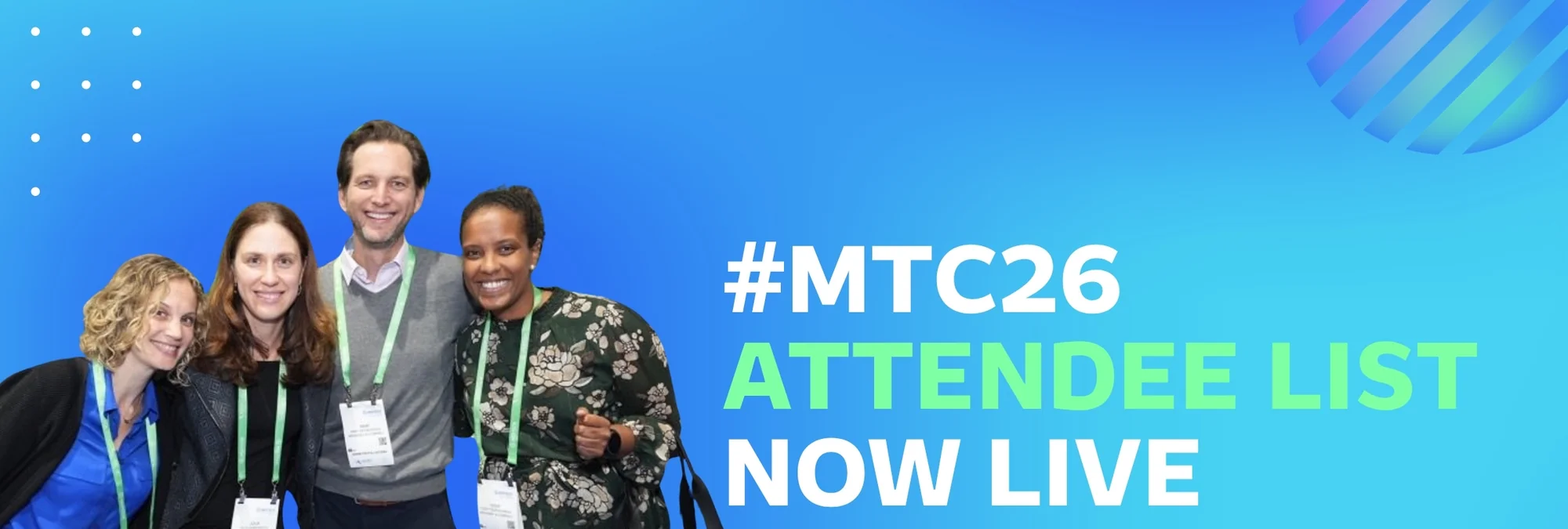
Your First Look at The MedTech Conference Attendee List
Image File
Original HTML

Momentum for The MedTech Conference is exceptionally strong, with leaders and organizations from across the medtech ecosystem already confirmed. If you have not yet registered, now is the time to make plans to join us October 18–21 in Boston!

This year’s theme, “Medtech Moves Us,” reflects both the impact our industry has on patients and the progress we make when we come together. As the proud host of The MedTech Conference and a year-round convener of the industry, AdvaMed is bringing the medtech community together for high-value programming across 7+ stages and more than 20 focus areas.

I’m pleased to share the first 2026 Attendee List Preview, offering an early look at the remarkable range of medtech leaders already registered. The list includes CEOs, senior executives and professionals across business development, strategy, regulatory affairs, policy, investment and innovation. It represents leading global companies, emerging innovators, investors, service providers and organizations from across the medtech ecosystem.

The list is a strong reflection of the quality, diversity and momentum building behind this year’s conference. That momentum is also evident in our recently announced featured keynote discussion, “Pulse of Medtech: Where the Industry Is Going Next,” featuring Mick Farrell of Resmed, Mike Mahoney of Boston Scientific and Ashley McEvoy of Insulet, moderated by John Babitt of EY.

The strength of the conference is further reflected in the industry leaders supporting it, including Abbott, B.Braun Medical, BD, Boston Scientific, Dexcom, EY, GE HealthCare, Hologic, Johnson & Johnson MedTech, Medtronic, Olympus, Philips, PwC, Resmed, Siemens Healthineers, Smith+Nephew, Solventum, STERIS and Stryker.

At a time when direct connection and collaboration are more important than ever, I encourage you to register and join thousands of your peers and industry leaders in Boston.

Let’s make this our most valuable and successful gathering yet.

Scott Whitaker

Scott Whitaker, President and CEO, AdvaMed

Hear Patient Stories

The Story of Medtech empowers patients to share their experiences with medical technology in an effort to educate, inspire, and create community.

Class (B2B/B2C)
B2B
Ingest Status
Rewritten
Dedupe hash
c830e8fcb141c63b218d007b2e1dfc17
Press Eligible
Yes
Press Eligible Reason
Medtech industry conference preview for professionals and industry leaders.
Source Name
AdvaMed News
Original Summary

<p>I’m pleased to share the first 2026 Attendee List Preview, offering an early look at the remarkable range of medtech leaders already registered. The list includes CEOs, senior executives and professionals across business development, strategy, regulatory affairs, policy, investment and innovation. It represents leading global companies, emerging innovators, investors, service providers and organizations from across the medtech ecosystem. </p>
<p>The post <a href="https://www.advamed.org/2026/08/17/your-first-look-at-the-medtech-confe… First Look at The MedTech Conference Attendee List</a> appeared first on <a href="https://www.advamed.org">AdvaMed®</a>.</p>

Image URL
https://www.advamed.org/wp-content/uploads/2026/08/MTC26-Attendee-List-2.jpg
Source Node
Content Hash (SHA-256, erste 32 hex)
6a1b369a8ee9d9ae2bb9e6a6e2528bf5
The Insight Series: AI & Digital Health with Kelly Huang
Image File
Original HTML

AdvaMed’s Digital Health Tech division brings together leading companies developing AI-enabled solutions that are transforming health care, from diagnosis and treatment to clinical decision support and care beyond traditional settings.

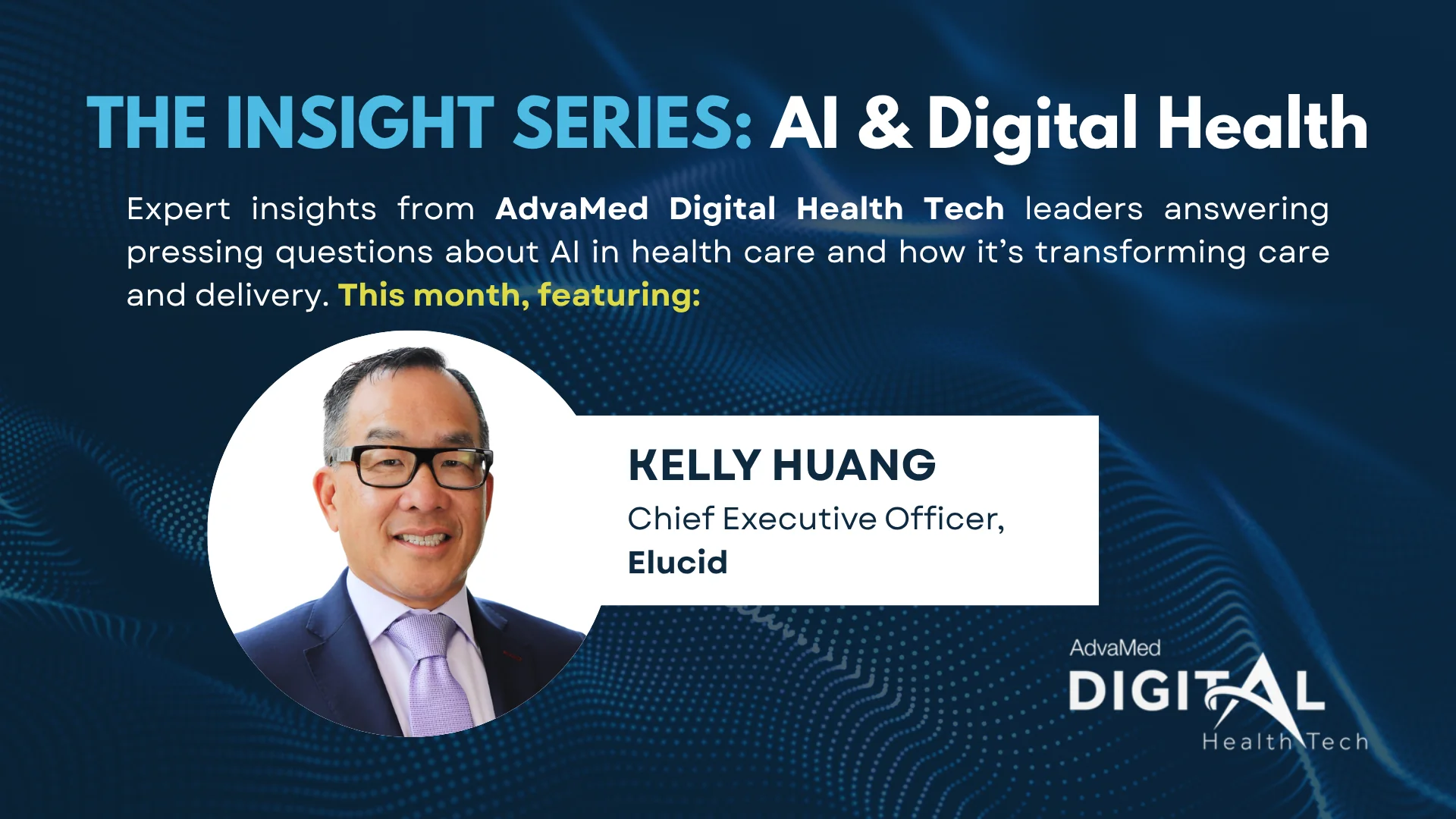
“The Insight Series: AI & Digital Health” features industry experts answering key questions to help inform policymakers and the public about how AI is shaping the future of care delivery. This edition features Kelly Huang, CEO of Elucid, an AI medical technology company focused on providing physicians with a more precise, non-invasive view of atherosclerosis to drive patient-specific cardiovascular care.

AdvaMed: What are the biggest benefits AI brings to patient care today, and what’s just hype?

Kelly Huang: The biggest benefit is turning imaging we’re already collecting into information that physicians could never see before. At Elucid, a patient’s existing coronary CT angiogram can also be analyzed with our Plaque-IQ software to quantify the type and amount of plaque in both coronary and carotid vessels, and, with our BioIntegrated FFR-CT* [CT-derived Fractional Flow Reserve, or the derived pressure and blood flow drop across a narrowed section (stenosis) of a coronary artery] to help physicians understand the overall risk of the patient for heart attack and stroke based on detailed lesion-by-lesion information. Traditionally, plaque type at highest risk for rupture and FFR would be tedious to measure by invasive imaging and pressure wire catheterizations. With Elucid, both of those factors, which the human eye simply cannot extract from a scan, can be quantified from a single, non-invasive test. We see this play out in our own data: two patients can look identical on paper — same total plaque volume and similar degree of stenosis — turn out to have very different disease and overall risk once you look at the biology, because one patient’s plaque is lipid-rich and unstable, and the other’s is calcified and stable. Same data, different disease … understanding the disease through integration of anatomy, biology, and physiology can now lead to more personalized treatment. It is not just about risk calculation; it is turning that risk information into personalized therapy. That’s exactly the kind of progress AI should be leading.

When AI is a black-box that doesn’t change what a physician does next – this is when the result is not pragmatic nor transparent and inspectable by the physician. This becomes the “hype.” We built our platform so physicians can always see the work behind every step (the underlying vessel and lumen segmentation, the plaque composition, the FFR-CT based on integration of all biological and anatomical properties of plaques and vessels, the FFR-CT pullback curve, and the lesion tool) rather than trusting an output they cannot verify. If an AI output doesn’t lead to a different, better-informed clinical decision, it’s a novelty, not a benefit to patient care. Moreover, Elucid always supports the physician in making care decisions. We believe the future of AI replacing doctors is hype. We aim to support better clinical decision making by physicians and closing the gap between need for care and the ability to provide care.

AdvaMed: Your primary focus is cardiovascular diagnostics. How is artificial intelligence changing the way we diagnose serious heart conditions?

Kelly Huang: For years, coronary CT angiography (CCTA) answered one question: is there a blockage, and how severe is it? We think of that period in cardiovascular care as CCTA 1.0, anatomy alone: stenosis, plaque volume, vessel remodeling. The field then moved to what I’d call CCTA 2.0, adding AI-derived plaque or FFR-CT estimates, but largely as separate tools used at different stages of disease. We believe we’re headed toward CCTA 3.0: where anatomy, biology, and physiology are integrated together, at a lesion-by-lesion level, from a single noninvasive scan to enable truly personalized treatment decisions.

The concept of a “serious heart condition” is often oversimplified. In reality, heart disease exists along a broad clinical spectrum, beginning with asymptomatic early atherosclerosis and potentially progressing to a devastating myocardial infarction. Elucid’s platform is designed to support physicians across every stage of this continuum: from primary care physicians and preventive cardiologists to cardiovascular imaging specialists and interventional cardiologists.

By enabling a more thorough and informed assessment of each patient’s disease, Elucid can help clinicians deliver more personalized and comprehensive care. This may include optimizing medical therapy, providing reassurance when appropriate, planning targeted local interventions, or confidently deferring unnecessary procedures. Our Plaque-IQ software applies algorithms trained and validated against ground-truth histology, the gold standard for plaque analysis, so physicians can see the composition of the plaque biology: how much is calcified and stable versus lipid-rich and vulnerable to rupture. Our BioIntegrated FFR-CT* uses invasive FFR as ground truth and integrates anatomy and plaque biology, which can dramatically impact vasodilatory capacity, to predict the FFR values along each vessel. Because anatomy, biology, and physiology come from one internally consistent model of the same artery, our plaque analysis and FFR-CT are always concordant, instead of being estimated separately and reconciled after the fact. It lets physicians non-invasively diagnose disease biology and its functional consequences, not just anatomy.

AdvaMed: When we talk about AI creating efficiency in healthcare, we’re often talking about doing the same things faster. Why do you believe that faster wasn’t the point — and what does it actually take to build AI that changes what happens to a patient, not just how quickly it happens?

Kelly Huang: The main issue is that for the past many years, cardiovascular disease is the number one killer in the developed and the developing world. On the one hand, this highlights the importance of cardiovascular medicine as a field; on the other hand, it shows that we need better pathways, better assessments, and possibly more personalized assessments and solutions. Speed doesn’t help if the underlying decision is still built on the same incomplete information. Reading those same data faster wouldn’t have told either physician what they needed to know, and nearly half of all heart attacks happen in patients who were classified as low risk using traditional factors like age, cholesterol, and family history.

Building AI that changes outcomes means building it to surface something clinically new and actionable: information that wasn’t visible to the physician before, validated rigorously enough that they can trust it and act differently because of it. However, it is important to mention that alongside our focus on equipping physicians with tools and data that can improve patient outcomes and reduce cardiovascular events, we remain equally committed to workflow efficiency. Elucid’s platform is designed to reduce the burden on clinicians by automating repetitive tasks, streamlining workflow, and allowing physicians to spend more time on meaningful patient interaction and care decisions.

AdvaMed: Health tech has largely delivered on its efficiency promise: documentation is faster, queues are shorter, operations are leaner. So why aren’t outcomes keeping pace, and what do you believe the causes are?

Kelly Huang: Efficiency and outcomes are different problems with different solutions. Most digital health tools have optimized the workflow around a clinical decision (how quickly a note gets written, how fast a patient moves through a visit) without changing the substance of the decision itself. If a physician is still stratifying cardiovascular risk using population-level factors, getting them to that same conclusion faster doesn’t prevent the heart attack that occurs in a patient that those factors miss. Improving outcomes requires giving physicians better information to act on, not just faster access to the information they already had. Ultimately, we can’t out-efficiency a diagnostic blind spot. Outcomes will only move when the underlying clinical picture gets more precise, not just faster to produce.

AdvaMed: Healthcare organizations face an overwhelming number of AI solutions. What criteria should health systems use to determine which technologies are most likely to improve patient outcomes and deliver lasting value?

Kelly Huang: I’d point health systems to three things. First, is the technology providing accurate information? What is it validated against? Is it compared to a real ground truth? Second, is the data that it provides reproducible? We have shown excellent reproducibility on all data that Elucid’s platform provides. Third, is there regulatory clearance and, ideally, peer-reviewed and real-world evidence showing the technology changes clinical management, not just that the algorithm performs well in isolation? Fourth, is there transparency? Can physicians see how the AI arrived at its answer? A tool that shows its work, down to the underlying segmentation and plaque composition, earns trust in a way black-box output never will, and that trust is often what determines whether a technology gets used at the point of care or quietly ignored.

AdvaMed: Many healthcare leaders feel they have an AI strategy in place. What blind spots do you see most often, and what risks do organizations face if they underestimate how quickly AI capabilities are evolving?

Kelly Huang: The most common blind spot is treating “AI strategy” as one thing, when in reality the maturity and evidence base behind different AI tools varies enormously; a scheduling algorithm and a diagnostic algorithm trained on histopathology are not in the same category of risk or opportunity and shouldn’t be governed the same way.

Class (B2B/B2C)
B2B
Ingest Status
Rewritten
Dedupe hash
6b0036c311fa936ddd70c4e381745657
Press Eligible
Yes
Press Eligible Reason
Industry interview about AI-enabled cardiovascular diagnostic technology and its clinical applications.
Source Name
AdvaMed News
Original Summary

<p> “The Insight Series: AI &#038; Digital Health” features industry experts answering key questions to help inform policymakers and the public about how AI is shaping the future of care delivery. This edition features Kelly Huang, CEO of Elucid, an AI medical technology company focused on providing physicians with a more precise, non-invasive view of atherosclerosis to drive patient-specific cardiovascular care.  </p>
<p>The post <a href="https://www.advamed.org/2026/08/27/the-insight-series-ai-digital-health… Insight Series: AI &amp; Digital Health with Kelly Huang</a> appeared first on <a href="https://www.advamed.org">AdvaMed®</a>.</p>

Image URL
https://www.advamed.org/wp-content/uploads/2026/08/DHT-The-Insight-Series-Kelly-Huang-Elucid.png
Source Node
Content Hash (SHA-256, erste 32 hex)
2c2859d1cd3b1dd04375d9bcce988463
AdvaMed® in Action: A New Chapter for Digital Health Tech at #MTC26
Image File
Original HTML

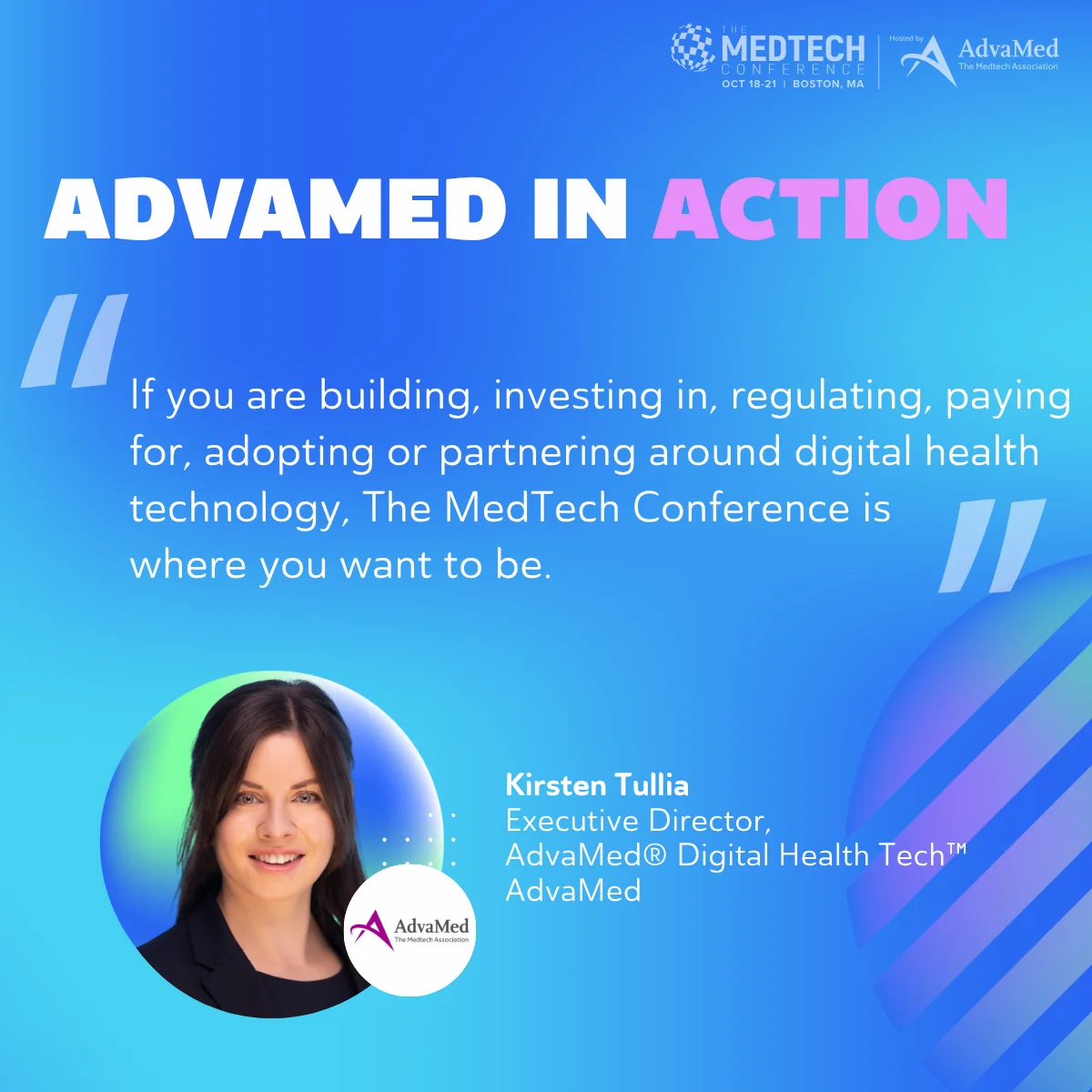
I recently stepped into my new role as Executive Director of AdvaMed Digital Health Tech at an incredibly dynamic moment for our industry.

Digital health is no longer one corner of medtech. Connected devices, software, data, AI, cybersecurity, and entirely new models of care are increasingly woven into how technologies are developed, how clinicians work, and how patients experience care.

My background at AdvaMed has been deeply rooted in coverage, payment, and health care delivery policy, and that experience shapes how I think about the opportunity ahead. Innovation is critical—but our work cannot stop at invention. We also need an environment where safe, effective digital technologies can be adopted, integrated into care, and ultimately reach the patients who can benefit from them.

That is a major focus for AdvaMed Digital Health Tech, and it is one reason I am particularly excited about the conversations coming to The MedTech Conference, October 18–21 in Boston.

Q: What is AdvaMed Digital Health Tech focused on?

A: Our goal is to help build the policy environment that allows digital health innovation to deliver on its potential for patients.

AdvaMed Digital Health Tech’s work spans four interconnected areas: regulation; payment and health care delivery; data access and stewardship; and cybersecurity. Increasingly, progress in one depends on progress in all four. Groundbreaking technologies still need a clear regulatory pathway. Providers need confidence that adoption is sustainable. Data needs to be accessible and used responsibly. And connected technologies need strong, resilient cybersecurity.

Payment and access will continue to be an especially important part of that conversation. AdvaMed has been advocating for greater clarity and predictability around Medicare coverage and payment for software, AI, and other digital health technologies, because innovation can only improve care when patients and providers can actually access it.

What excites me most is these are no longer theoretical conversations. Companies are deploying these technologies today. That makes collaboration among medtech, technology companies, policy leaders, providers, payers, and patients more important than ever, and the MedTech Conference brings us together to ideate, collaborate, and maybe even solve for some of health care’s biggest problems.

Q: How will those priorities show up at #MTC26?

A: Everywhere.

One of the things I like most about this year’s program is that digital health is both a dedicated area of education and a throughline across the conference.

Look at the range of conversations already on the agenda:

- DHT Signal: An AdvaMed Digital Health Tech Town Hall will bring together industry leaders serving on AdvaMed’s Digital Health Tech Board for an interactive town hall discussion on the most pressing policy and advocacy issues facing the future of digital health and AI.

- From Data to Decisions: How Longitudinal Insights Enable Smarter Patient Care, leaders from Philips, WHOOP, NYU Langone, and the CMS Innovation Center will examine how continuous health data can translate into smarter, more informed care.

- Connected Implants: The Next Frontier in Patient Care and Empowerment brings together Edwards Lifesciences, Synchron, and Canary Medical to explore how connectivity is changing what is possible after a device is implanted—and what that can mean for patients, clinicians, and the data connecting them.

Then there is the question of getting innovation into practice. From Innovation to Implementation: Integrating AI with CPT, and Payer Perspectives brings together experts from Medtronic, the American Medical Association, Frank Healthcare Advisors, and the AMA RVS Update Committee to get into the practical realities of coding, payment, and adoption for these technologies.

And as technology becomes more embedded across medtech businesses, the infrastructure around it matters just as much. Equipping Legal and Compliance Programs for the Digital Future of MedTech will bring Boston Scientific, Baxter Healthcare, Cook Medical and Faegre Drinker into a conversation spanning privacy, AI, and cybersecurity.

That range is important. Digital health is not about the newest algorithm or device. It touches the entire path from development to adoption—and the #MTC26 program reflects that.

Q: What feels different about the program this year?

A: There are more ways to engage with the technology and the people behind it.

We begin Sunday with Medtech Frontier AI Day, a Microsoft-sponsored half-day program focused on moving AI from innovation to real-world impact across the medtech enterprise. The program will dig into responsible governance and workforce readiness, intelligent connected care, commercial engagement, product innovation, and market access.

Google is also bringing Build with Gemini, a hands-on workshop where business leaders can learn to build, implement, and scale autonomous AI agents across their organizations (RSVP required).

We’re also expanding on previous successes through the Next Gen Medtech Program. This opportunity—designed for undergraduates, graduate, and PhD students, recent graduated, and early-career professionals—provides participants an opportunity to connect with peers, engage with industry professionals, attend career-focused discussions, and gain firsthand insight into the skills and experiences that contribute to success in the field.

Our DHT Board Chair Robert Cohen (Vice President, Innovation and Technology, Orthopaedic Group at Stryker), will also lead judging on the second iteration of the NextGen Innovation Robotics Challenge, an immersive, one-day engineering competition focused on personalized surgery and healthcare innovation. This hands-on experience is designed to strengthen problem-solving, collaboration, and innovation skills while demonstrating the real-world impact of medtech – I encourage any students interested in engineering, artificial intelligence, robotics, or healthcare innovation to consider applying!

And the technology conversation extends far beyond AI. Across the conference, we’re bringing together medical technology companies, technology leaders, health systems, policy leaders, start-ups and other partners who approach digital health from very different angles. This mix is where some of the most useful conversations happen, and I’m excited to see where we can go as this digital health ecosystem continues to evolve.

Q: Where should attendees look beyond the education rooms?

A: Make time for the Medtech Campus.

Some of the most exciting technology at this conference will not be contained in a panel discussion. BD, Butterfly Network, Dexcom, Edwards Lifesciences, Philips, iRhythm, Solventum, and Stryker are among the companies bringing technology to the Tech in Motion Hub, where you can experience medtech innovation firsthand through live technology demonstrations.

There are also a lot of new names joining the Campus this year. First-time exhibitors include companies such as HCLTech, Health-ISAC, i-GENTIC AI, myQMS.ai, Red Balloon Security, and TENNR. This list alone demonstrates how much the digital-health ecosystem has expanded: medical devices, enterprise technology, cybersecurity, AI, workflow optimization, and infrastructure are increasingly part of the same conversation.

They join a much broader #MTC26 community that already includes companies such as Abbott, BD, Boston Scientific, Dexcom, Edwards Lifesciences, GE HealthCare, Johnson & Johnson MedTech, Medtronic, Philips, Resmed, Siemens Healthineers, Solventum, Stryker, Zimmer Biomet, ZOLL, and many more.

My advice: don’t just move from session to session. Plan a few hours to walk the Campus. Earmark and talk to a company you haven’t met before. See the technology first-hand. Ask how people are solving a problem differently, and see how that influences your own approach to problem-solving. The MedTech Conference is about bringing people together, and the Campus’ structure empowers participants to expand their exposure and experience beyond the learning opportunities of panels. I look forward to meeting folks out on the Campus floor!

Q: What about early-stage innovation?

A: This may be one of the best reasons to come.

The 2026 MedTech Innovator cohort includes 65 early- and mid-stage medical device, diagnostic, and digital health companies selected from more than 1,800 applicants. At #MTC26, attendees can see these companies through sector-based showcase sessions, connect with them through 1:1 partnering, and ultimately help choose the MedTech Innovator 2026 winner during the Finals Tuesday, October 20.

We’re also excited to bring back our wildly successful Pitch & Pour Start-Up Pitch Competition and Happy Hour on Sunday, October 18 where we put 12 early-stage companies focused on military health in front of investors, strategics, and industry decision-makers. Each company gets eight minutes—five to pitch and three for Q&A. This year’s competitors range from wearable trauma-care technologies and rapid diagnostics to smart emergency triage, predictive clinical intelligence, and next-generation wound care.

That is exactly the kind of contrast I love about The MedTech Conference – you can hear from a global company scaling technology across health systems, then turn around and meet a founder working to bring an entirely new solution to market.

Q: What are you personally looking forward to in Boston?

A: The conversations between the conversations.

I’m excited about the panel sessions, but our community is at its best when people with different perspectives have the opportunity to work through difficult questions together.

How do we create regulatory approaches that keep pace with technology while protecting patients? How do we modernize payment systems built for a different era of medicine? How do we unlock the value of health data responsibly? How do we keep increasingly connected technology secure?

Class (B2B/B2C)
B2B
Ingest Status
Rewritten
Dedupe hash
bb2819b197868882e0f4219ef9952254
Press Eligible
Yes
Press Eligible Reason
Industry-focused coverage of digital health policy, technology, and medtech conference programming.
Source Name
AdvaMed News
Original Summary

<p>Kirsten Tullia shares how AdvaMed Digital Health Tech priorities—from AI and cybersecurity to payment and data—will come to life at #MTC26 in Boston.</p>
<p>The post <a href="https://www.advamed.org/2026/09/15/advamed-in-action-a-new-chapter-for-…® in Action: A New Chapter for Digital Health Tech at #MTC26</a> appeared first on <a href="https://www.advamed.org">AdvaMed®</a>.</p>

Image URL
https://www.advamed.org/wp-content/uploads/2026/09/MTC26_Quote-Graphic.png
Source Node
Content Hash (SHA-256, erste 32 hex)
d6d618c9dcfc78a0caa8d76a9d5437a9
AdvaMed® in Action: Where Emerging Medtech Leaders Go Next
Image File
Original HTML

My name is JC Scott. I recently returned to AdvaMed, The Medtech Association, to serve as the Chief Strategy Officer and to lead AdvaMed Accel as Executive Director. Accel is AdvaMed’s dedicated division supporting our over 400 small and emerging medtech company members through advocacy, access and community. It’s not often understood that AdvaMed represents the entire medtech ecosystem, including companies large and small. That diverse and inter-connected community will be on display at The MedTech Conference, October 18–21 in Boston.

Since coming back, I’ve been talking with founders, investors, and industry leaders about what it takes to build and grow a successful company, and how AdvaMed can help. We do that through our public policy advocacy, through access to a deep bench of regulatory and reimbursement expertise, and through building networks and community.

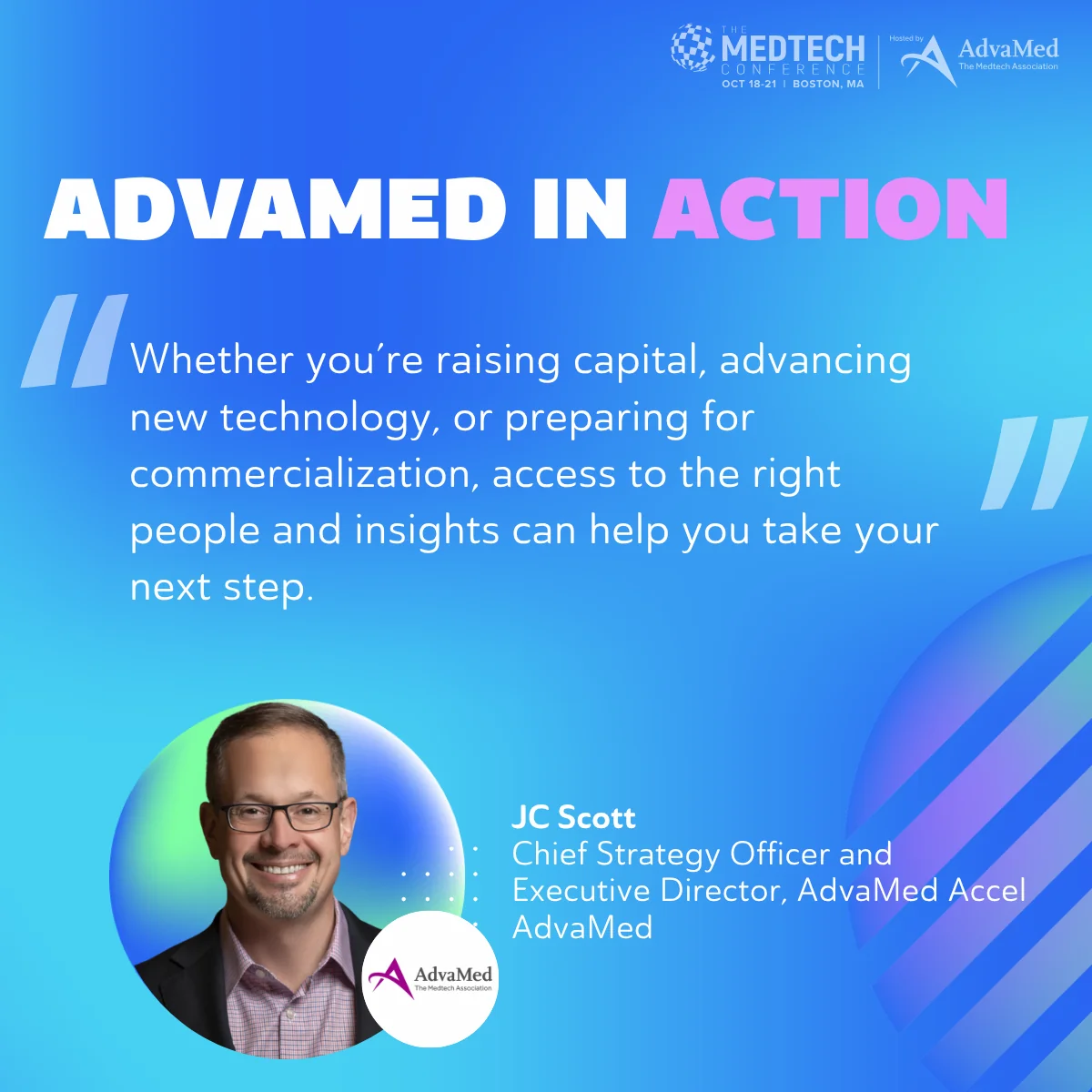
One theme has come up again and again in my conversations: the right relationships can make all the difference. Whether you’re raising capital, advancing new technology, or preparing for commercialization, access to the right people and insights can help you take your next step.

That’s why I’m inviting you to join me at The MedTech Conference. With more than 4,000 attendees and 1,800 companies expected, it’s an opportunity to connect with the people who can help move your business forward.

With the challenges and opportunities facing emerging companies in mind, here are four ways this year’s conference can support your growth

1. Meet investors and strategic partners

Use our Partnering platform to schedule one-on-one meetings with investors, collaborators, potential customers, and strategic partners. Conversations that might take months to arrange can happen over a few days. Partnering is available to Full Access attendees and Full Access exhibitors.

Preview our 2026 investor list here.

2. Understand where capital and opportunity are heading

Hear directly from corporate leaders through Reverse Pitches about the technologies and partnerships they’re exploring. Sessions such as How Family Offices Are Filling the MedTech Funding Gap and Navigating the Early-Stage MedTech Financing Landscape offer additional perspectives on funding your next stage of growth.

3. Build a stronger path to commercialization

Explore practical approaches to bringing your technology to market through Designing for Launch: Embedding Commercialization Early in MedTech Innovation and Working with Academia and Health Systems: A Playbook for Strategics and Startups.

4. Connect with leaders who understand your challenges

Build relationships with fellow executives at the AdvaMed Accel (Start-Up) Leadership Breakfast. Venture-backed medical device CEOs can also explore the Lifeblood MedTech CEO-Only Forum, focused on fundraising, leadership, board management, and growth. Additional registration and approval are required for the forum.

What excites me most about my role is working alongside entrepreneurs tackling some of health care’s most important challenges. I look forward to learning more about your priorities and how AdvaMed Accel can support you.

Join me in Boston. Review our full track of content for Emerging Companies here and register today to begin requesting meetings and build your conference experience around your company’s goals.

Juan Carlos “JC” Scott

JC Scott, Chief Strategy Officer, AdvaMed, Executive Director, AdvaMed Accel

Hear Patient Stories

The Story of Medtech empowers patients to share their experiences with medical technology in an effort to educate, inspire, and create community.

Class (B2B/B2C)
B2B
Ingest Status
Rewritten
Dedupe hash
be24bd0dba5773025612aac5eb853bba
Press Eligible
Yes
Press Eligible Reason
Medtech industry content about supporting emerging companies, funding, commercialization, and business networking.
Source Name
AdvaMed News
Original Summary

<p>JC Scott shares how AdvaMed Accel priorities—from raising capital to building a stronger path to commercialization—will come to life at #MTC26 in Boston.</p>
<p>The post <a href="https://www.advamed.org/2026/09/22/advamed-in-action-emerging-medtech/"…® in Action: Where Emerging Medtech Leaders Go Next</a> appeared first on <a href="https://www.advamed.org">AdvaMed®</a>.</p>

Image URL
https://www.advamed.org/wp-content/uploads/2026/09/MTC26_Quote-Graphic-1.png
Source Node
Content Hash (SHA-256, erste 32 hex)
08fb5632ac87a047b68823877ff71183
AdvaMed® in Action: When Alliances Put Patients First
Image File
Original HTML

When you work in government affairs, it can be easy to spend a lot of time talking about policies, legislation and regulations. But behind every one of those conversations is a patient waiting for an answer, a treatment or a technology that can make a difference in their life.

That is what keeps me focused on building strong relationships across our industry and with the people we ultimately serve. Patient advocates, medtech companies, state associations and policy leaders each bring a different perspective to the table. When we bring those voices together, we have a better opportunity to understand what patients need and turn that understanding into meaningful action.

That spirit of collaboration will be everywhere at The MedTech Conference this October in Boston — and I’m looking forward to seeing it in action.

Q: Why are alliances so important to advancing patient access?

A: Because the people closest to a health care challenge often have the clearest view of what needs to change.

Patient advocacy organizations bring the lived experience of patients and families. Medtech companies bring an understanding of the technologies that can address unmet needs. Our state partners understand what is happening in their communities and with policymakers back home. When those perspectives come together, we can make a stronger case for policies that help patients access the care and technology they need.

Our work with patient advocates around access to Alzheimer’s blood-based diagnostics is one example. AdvaMed worked alongside patient advocacy partners to help policymakers understand why sustainable Medicare reimbursement matters for patients. When Medicare reimbursement expanded, it created a pathway for more patients to access these important diagnostic tools. That is what patient-centered advocacy looks like: bringing the right voices together around a real access challenge.

Q: How is that same approach showing up at the state level?

A: Across the country, we are working with patient organizations and our State Medtech Alliance partners on policies that directly affect access and patient safety.

Our 2026 Patients First Agenda focuses on policies that can improve access to medical technology, accurate diagnostic testing and safe and effective treatments. And our state partners are critical to advancing that work because they understand the unique needs and policy environments in their communities.

That is why the State Medtech Alliance, or SMTA, is so important. It brings state and regional associations together to share best practices, promote the industry and advocate for policies that support innovation.

At #MTC26, we will have the opportunity to bring that community together again — connecting the national conversation with the people doing this work every day at the state and regional level.

Q: Where will attendees see this spirit of collaboration at #MTC26?

A: The patient experience is woven throughout the fabric of the MedTech Conference – with the Patient Pavilion as the hub.This patient-focused area of the exhibit hallcarries patient stories throughout the week — giving attendees the opportunity to meet the people whose lives have been changed by medical technology.

Like Brittany, who could finally get answers for years of exhaustion, a diagnosis of severe sleep apnea helped explain what she had been experiencing — and treatment helped her regain her energy, confidence and independence.

For patients like her, medical technology is not simply a device, diagnostic or treatment. It can mean getting answers. Getting back to work. Moving more freely. Spending more time with family. And getting back to the life they want to live.

That is what makes the Patient Pavilion so powerful. Across stories from Abbott, BD, Dexcom, Edwards Lifesciences, Insulet, Medtronic, Philips, Resmed, Siemens Healthineers, Smith+Nephew, Stryker, Solventum, Vantive and other medtech companies, patients will share what happened when the right technology met the right moment in their lives.

We will hear from patients whose lives have been touched by technologies ranging from diagnostics and imaging to devices that help restore mobility and independence. And attendees will have the opportunity to see some of those innovations up close, including Philips’ portable MRI technology.

These are the stories that put everything else we do into perspective. Behind every policy conversation, reimbursement decision and technology breakthrough is a person — and a family — waiting for access to the technology that can change what is possible.

Q: What other new opportunities for connection are you looking forward to?

A: We are also creating new opportunities for leaders across the industry to connect around the issues most important to them.

For the first time, #MTC26 will host a dedicated gathering for chief medical officers. CMOs sit at a unique intersection of clinical care, innovation and patient needs, and bringing these leaders together creates an opportunity to share perspectives and build relationships around the challenges and opportunities facing our industry.

If you are part of an AdvaMed member company and serve as a CMO, I encourage you to RSVP and join us. It is exactly the kind of focused connection that makes this conference valuable — putting people with shared responsibilities and shared goals in the same room.

Q: What are you most looking forward to at #MTC26?

A: Connecting with the people throughout the medtech ecosystem.

The best part of this work is bringing people together who care deeply about improving health care and giving them the opportunity to find common ground.

I am looking forward to seeing patient advocates, state medtech leaders, CMOs, innovators, policy leaders and industry partners in the same place — sharing ideas, building relationships and finding new ways to work together.

Because when we build stronger alliances, we build a stronger voice for patients.

And that is when medtech is truly in action. 

Bobby Patrick, VI

Bobby Patrick, VI, SVP, Government Affairs; Head of State Government & Regional Affairs; Head of Alliance Partnerships, AdvaMed

Hear Patient Stories

The Story of Medtech empowers patients to share their experiences with medical technology in an effort to educate, inspire, and create community.

Class (B2B/B2C)
B2B
Ingest Status
Rewritten
Dedupe hash
1062846e4c5c913584e1be40e43363c8
Press Eligible
Yes
Press Eligible Reason
Medtech industry advocacy, patient access, and conference news for industry professionals.
Source Name
AdvaMed News
Original Summary

<p>Behind every policy conversation is a patient waiting for access to the care and technology they need. In this edition of AdvaMed in Action, Bobby Patrick explores how collaboration among patient advocates, medtech companies, state partners and policy leaders can help advance patient access and turn shared priorities into meaningful action.</p>
<p>The post <a href="https://www.advamed.org/2026/10/01/advamed-in-action-when-alliances-put…® in Action: When Alliances Put Patients First</a> appeared first on <a href="https://www.advamed.org">AdvaMed®</a>.</p>

Image URL
https://www.advamed.org/wp-content/uploads/2026/09/AdvaMed.org-ADVAMED-IN-ACTION_Web-Header-Preview-300-x-250-px.png
Source Node
Content Hash (SHA-256, erste 32 hex)
151867123949a243c5262ea7326edd82
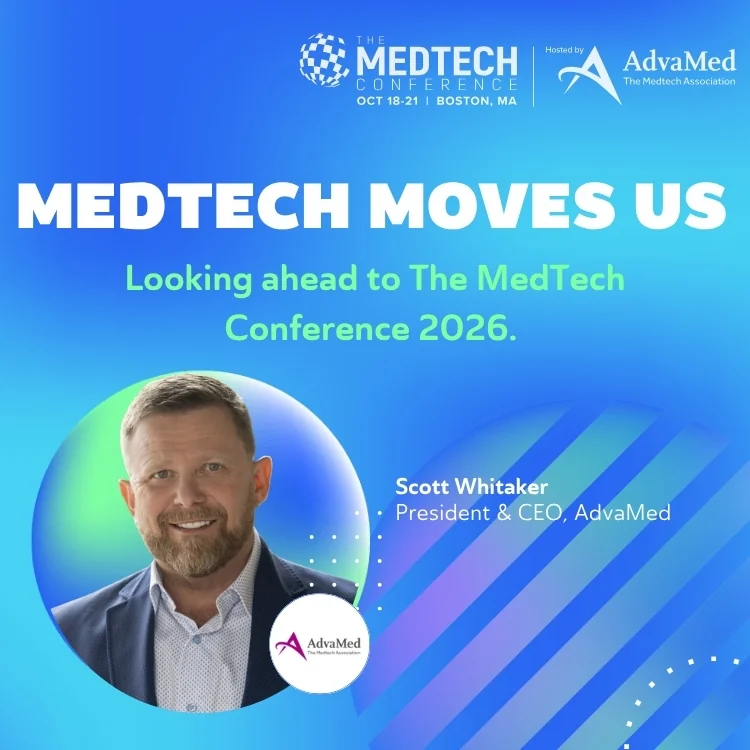
Medtech Moves Us: Looking Ahead to The MedTech Conference 2026
Image File
Original HTML

Momentum is building for The MedTech Conference, October 18–21, 2026, in Boston, and I hope you’ll join us. With AdvaMed member participation at an all-time high, expanding international engagement, and our largest Medtech Campus ever, this year’s conference brings together the people and perspectives shaping what comes next for our industry.

Our shared mission, putting patients first, remains at the center of these conversations. As companies navigate advances in AI, a fast-moving regulatory environment, and new investment and market access opportunities, connecting with the right people and insights matters more than ever.

Our theme, “Medtech Moves Us,” reflects both the impact of our industry and the value of coming together to move it forward. Here’s what awaits you in Boston:

- Record member participation and new connections. Join AdvaMed members, CEOs, and leaders across business development, R&D, regulatory, clinical affairs, and strategy. Nearly half of registered attendees are new, creating fresh opportunities to build relationships across the medtech community.

- Timely education curated by industry leaders. Our education and program team has spent months developing conversations around the decisions facing your business: how AI and digital health are changing care, what it takes to commercialize innovation, and how companies can navigate global markets and improve patient access. Hear directly from medtech executives, policy experts, CMS and senior FDA CDRH leaders.

- Expanded investor programming and business development opportunities. Connect with investors and strategic partners, explore emerging innovations, and hear leading medtech companies outline their investment and partnering priorities through corporate reverse pitches. Make the most of your time in Boston by arranging 1:1 partnering meetings before you arrive.

- Highlights of the Keynote Stage. Hear from Mick Farrell of Resmed, Mike Mahoney of Boston Scientific, Ashley McEvoy of Insulet, and Robbie Marcus of J.P. Morgan in a discussion moderated by John Babitt of EY, with additional perspectives from Johnson & Johnson MedTech and Operation Smile. Get a firsthand perspective from Dr. Michelle Tarver as the Director, CDRH and other senior FDA CDRH leaders on the regulatory issues shaping the future.

- Our largest Medtech Campus ever. With 185+ presenting companies and more than 500 speakers across the Campus and education sessions, you’ll find new ideas, practical insights, and opportunities to do business. Explore live demonstrations in the Tech in Motion Hub, emerging company pitches, and conversations spanning the full medtech ecosystem.

- A growing global community and the next generation of medtech. Strong participation from Europe, the UK, Central America, and our new Nordic-Baltic delegation will bring valuable international perspectives. Dedicated opportunities for students, veterans, and early-career professionals will help connect tomorrow’s leaders with the industry they will help shape.

The value of Boston is what you can take back to your organization: a new relationship, a clearer strategy, or an opportunity that moves your business forward.

Explore the 2026 program and register today.  

Scott Whitaker

Scott Whitaker, President and CEO, AdvaMed

Hear Patient Stories

The Story of Medtech empowers patients to share their experiences with medical technology in an effort to educate, inspire, and create community.

Class (B2B/B2C)
B2B
Ingest Status
Rewritten
Dedupe hash
84715c983ccb19b035b628e9e1dd080f
Press Eligible
Yes
Press Eligible Reason
Medtech industry conference announcement with business, investment, technology, and regulatory programming.
Source Name
AdvaMed News
Original Summary

<p>AdvaMed President &#038; CEO Scott Whitaker looks ahead to The MedTech Conference 2026 in Boston, where “Medtech Moves Us” comes to life through new connections, timely insights, expanded opportunities and the people shaping the future of medtech.</p>
<p>The post <a href="https://www.advamed.org/2026/10/01/scott-whitaker-mtc26-momentum/">Medt… Moves Us: Looking Ahead to The MedTech Conference 2026</a> appeared first on <a href="https://www.advamed.org">AdvaMed®</a>.</p>

Image URL
https://www.advamed.org/wp-content/uploads/2026/10/AdvaMedinAction_BP.jpg
Source Node
Content Hash (SHA-256, erste 32 hex)
a11b5b217d6965ca71ca6f2e93f8b884
When is software not just software?
Image File
Original HTML

When is software not just software? That’s the question at the center of comments AdvaMed recently filed with the U.S. Copyright Office.

At first glance, this may sound like a narrow dispute about medical device repair. In reality, it reflects a broader challenge facing a software-driven economy: how should the law treat software that is distinct from, but connected to, the products it supports?

Consider the difference between software used by clinicians to operate an imaging system and software designed specifically to diagnose, configure, and service that system.

They are not the same thing.

A useful analogy is the difference between a vehicle’s operating software and the specialized diagnostic tools used by technicians to service it. One enables use of the product. The other is a standalone tool with its own functions, users, protections, and market.

In the medical technology sector, servicing and diagnostic software is often licensed separately, protected by separate access controls, and increasingly delivered through cloud-based platforms rather than residing on the device itself.

That distinction matters.

The question before policymakers is not whether medical devices can be repaired. Lawful avenues for accessing service software and documentation exist today and are widely used.

Rather, the question is whether software created, licensed, and distributed as a separate product should be treated the same as software embedded in the device’s operation.

As healthcare and other industries become more dependent on specialized software, the answer will increasingly affect innovation, intellectual property rights, cybersecurity, and patient safety. That’s why this issue matters to AdvaMed and America’s patients.

This issue arises in the context of medical technology, but the underlying question extends far beyond healthcare: how we classify software often determines how we protect it.

Hear Patient Stories

The Story of Medtech empowers patients to share their experiences with medical technology in an effort to educate, inspire, and create community.

Class (B2B/B2C)
B2B
Ingest Status
Rewritten
Dedupe hash
8d9390231b27149743fd6d18a6219593
Press Eligible
Yes
Press Eligible Reason
Discusses software classification, intellectual property, and medical technology industry policy.
Source Name
AdvaMed News
Original Summary

<p>When is software not just software? That's the question at the center of comments AdvaMed recently filed with the U.S. Copyright Office. At first glance, this may sound like a narrow dispute about medical device repair. In reality, it reflects a broader challenge facing a software-driven economy: how should the law treat software that is distinct from, but connected to, the products it supports?</p>
<p>The post <a href="https://www.advamed.org/2026/10/02/when-is-software-not-just-software/"… is software not just software?</a> appeared first on <a href="https://www.advamed.org">AdvaMed®</a>.</p>

Image URL
https://www.advamed.org/wp-content/uploads/2026/10/iStock-2271236323-1024x683.jpg
Source Node
Content Hash (SHA-256, erste 32 hex)
818ff85923ba7ebd415f902c57b68a65
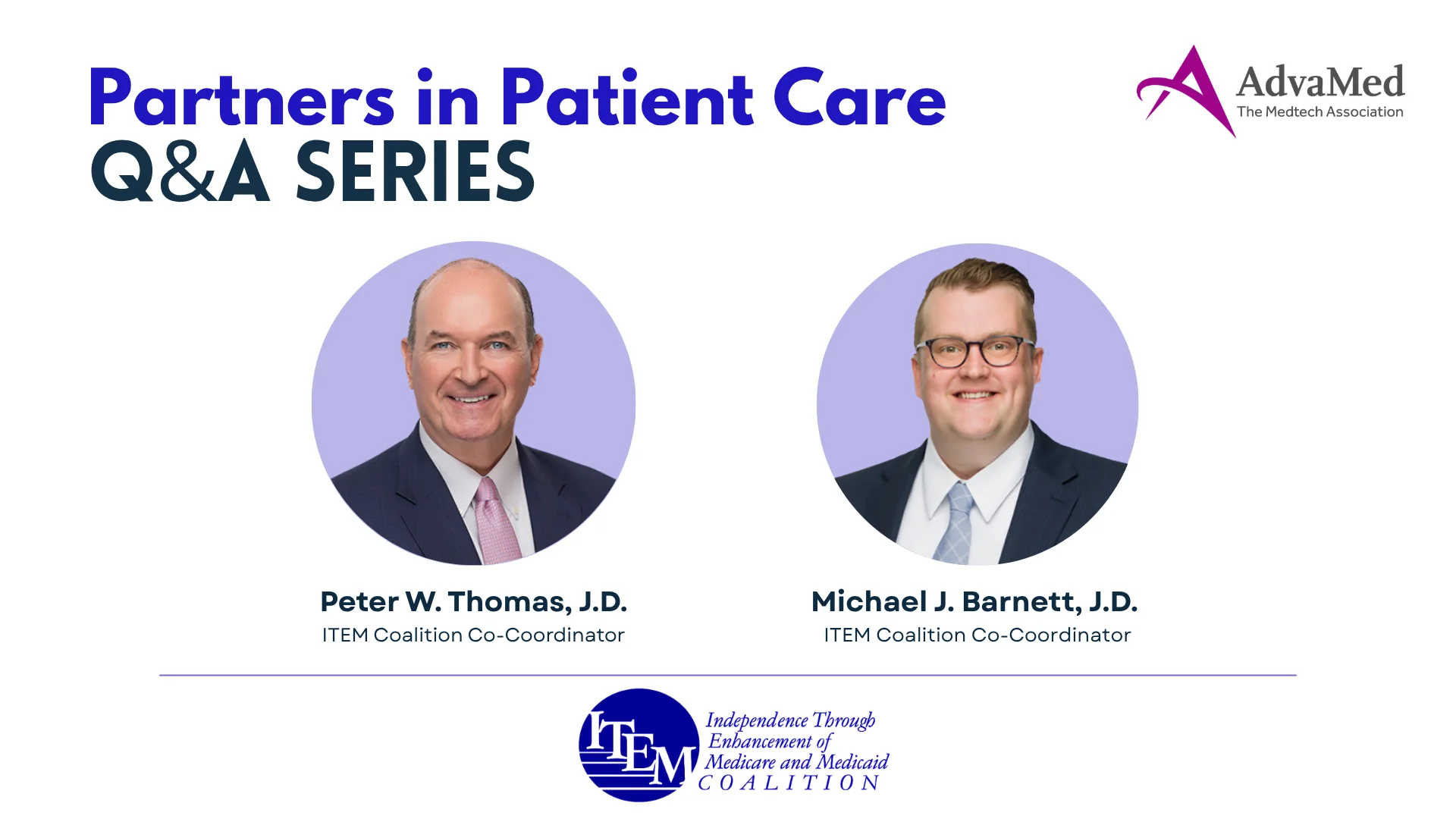
Partners in Patient Care: A Conversation with the ITEM Coalition
Image File
Original HTML

For people living with disabilities and chronic conditions, access to assistive technology can make the difference between dependence and independence. In this installment of AdvaMed’s Partners in Patient Care Q&A series, Peter W. Thomas, J.D., and Michael J. Barnett, J.D., Co-coordinators of the ITEM Coalition, discuss the communities they represent, the barriers patients face, and how collaboration with the medtech community can help improve patient access to assistive technology.

The ITEM Coalition is a national consumer- and clinician-led coalition comprised of 103 national organizations advocating for access to and coverage of assistive devices, technologies, and related services for people of all ages with injuries, illnesses, disabilities, and chronic conditions.

AdvaMed: Who do you represent, how did the organization come to be, and what does your work look like day to day?

Michael Barnett: The Independence Through Enhancement of Medicare and Medicaid (“ITEM”) Coalition is a consumer- and clinician-led coalition comprised of 103 national nonprofit organizations devoted to raising awareness and building support for policies that will enhance access to assistive devices, technologies, and related services for people with disabilities and chronic conditions. Our six-member Steering Committee reflects the breadth of the community we serve, and includes the Amputee Coalition, ALS Association, Christopher & Dana Reeve Foundation, Spina Bifida Association, Team Gleason, and the United Spinal Association.

The ITEM Coalition was created in 2003 to address inadequate access to assistive devices, technologies, and related services. Today, our work focuses on identifying and removing the Medicare, Medicaid, and other federal policy barriers that can prevent people from obtaining the assistive devices and technologies they need to be healthy, functional, and independent.

Day to day, that means working closely with our members to monitor legislation and regulations, engage with Congress and federal agencies, develop coalition comments and recommendations, and advocate on coverage, coding, payment, and other policies affecting access to care. We also bring together diverse patient, disability, clinical, and provider organizations around issues where a unified voice makes a difference.

Ultimately, our strength comes from our members and the lived experiences they bring to the table. Our goal is to ensure those voices are heard when policymakers make decisions that directly affect access to the assistive devices and technologies people depend on.

AdvaMed: What would you most want the medtech community to understand about the patients and families you serve?

Peter Thomas: The patients and families the ITEM Coalition serves are incredibly diverse but share a common need: access to the right assistive technology, equipment, and services at the right time to improve their function and fundamentally change what is possible in their lives. For people living with disabilities or chronic conditions, a wheelchair, prosthetic device, orthotic brace, assistive technology, or other medical device is not simply a product; it can make the difference between dependence or independence, social isolation or community participation, employment or unemployment, and being able to be educated, care for a family, and maximize quality of life.

The ITEM Coalition would also want the medtech community to understand that access does not end when a device becomes available in the marketplace. Patients and families often face complex coverage, coding, payment, and administrative barriers that can prevent them from obtaining assistive technologies their clinicians believe are medically necessary. These barriers can be particularly challenging for people with disabilities and for individuals who rely on Medicare or Medicaid. Our work focuses on ensuring the patient perspective is part of these conversations from the beginning and that innovation ultimately translates into meaningful, timely access for the people these assistive devices and technologies are designed to improve.

AdvaMed: What is your organization’s top policy priority heading into the coming year, and why does it matter to the people you represent?

Michael Barnett: Among the ITEM Coalition’s many priorities heading into 2027, securing Medicare coverage for standing systems in Group 3 power wheelchairs is our top priority. This issue matters because standing systems can provide meaningful health, functional, and independence benefits for people with significant mobility impairments, yet Medicare does not cover these devices despite years of advocacy and clinical evidence. When Medicare coverage does not recognize these needs, beneficiaries can face significant out-of-pocket costs or go without the technology that could meaningfully improve their quality of life.

The ITEM Coalition has been advocating for Medicare coverage of standing systems in Group 3 power wheelchairs for years, including through a pending National Coverage Determination reconsideration request. After six years of waiting for CMS to open a National Coverage Analysis on this issue, we believe it is well past time for CMS to act. This is ultimately about ensuring that Medicare beneficiaries with significant mobility impairments have access to the assistive devices and technologies they need to live more independently and participate fully in their communities.

AdvaMed: What does a strong partnership between a patient organization and the medtech community look like? Are there collaborations that have worked especially well for your community?

AdvaMed: What does a strong partnership between a patient organization and the medtech community look like? Are there collaborations that have worked especially well for your community? Peter Thomas: A strong partnership between a patient/consumer/clinical coalition and the medtech community starts with a shared commitment to putting patients at the center of policy and access decisions. The most effective partnerships are not simply about supporting individual advocacy efforts. Instead, they involve listening to patients and their advocates, understanding the barriers they face, and working together to develop practical solutions that improve access to care and technology.

For the ITEM Coalition, some of our most productive collaborations have involved bringing together patient and disability organizations, clinicians, manufacturers, suppliers, and other stakeholders around a specific access challenge. Each partner brings a different perspective, and that diversity not only adds credibility but also strengthens the advocacy. Medtech companies bring expertise in innovation and the development of new technologies, while patient/consumer organizations help ensure policy discussions remain grounded in the real-world needs of the people who rely on those technologies.

We believe the strongest partnerships are long-term and built on trust, rather than formed only around a particular legislative or regulatory issue.

AdvaMed: Is there anything you’d like to share about your organization or the patient community you serve and advocate for?

Michael Barnett: The medtech community should know that the ITEM Coalition represents the breadth and diversity of the disability, chronic illness, and rehabilitation communities. ITEM brings together more than 100 national non-profit organizations representing these constituencies. While our member organizations have different perspectives and priorities, we share a common goal: ensuring Medicare and Medicaid beneficiaries have access to the medical devices and assistive technologies they need to live healthy, independent, and productive lives.

The ITEM Coalition and its member organizations have a great deal to contribute to conversations about innovation and healthcare access. Patients and people with disabilities understand firsthand what works, what barriers remain, and where innovation is still needed. We see the ITEM Coalition’s role as helping make sure those voices are heard and that innovation translates into meaningful access and better outcomes for the people who need it most.

Get involved: To learn how you can support the ITEM Coalition’s work, contact Michael Barnett at [email protected].

Hear Patient Stories

The Story of Medtech empowers patients to share their experiences with medical technology in an effort to educate, inspire, and create community.

Class (B2B/B2C)
B2B
Ingest Status
Rewritten
Dedupe hash
5b0d192160ca8baee3da5e14b71a20b1
Press Eligible
Yes
Press Eligible Reason
Medtech and patient coalition interview about assistive technology access and healthcare policy.
Source Name
AdvaMed News
Original Summary

<p>For people living with disabilities and chronic conditions, access to assistive technology can make the difference between dependence and independence. In this installment of AdvaMed’s Partners in Patient Care Q&#038;A series, Peter W. Thomas, J.D., and Michael J. Barnett, J.D., Co-coordinators of the ITEM Coalition, discuss the communities they represent, the barriers patients face, and how collaboration with the medtech community can help improve patient access to assistive technology.</p>
<p>The post <a href="https://www.advamed.org/2026/10/14/partners-in-patient-care-a-conversat… in Patient Care: A Conversation with the ITEM Coalition</a> appeared first on <a href="https://www.advamed.org">AdvaMed®</a>.</p>

Image URL
https://www.advamed.org/wp-content/uploads/2026/10/Option-2-1.png
Source Node
Content Hash (SHA-256, erste 32 hex)
877e24727d06af03f591fe94d7a45be8