Inbox In-Fighting: A Window Into BEC Subculture
Image File
Original HTML

Inbox In-Fighting: A Window Into BEC Subculture

If you work in cybersecurity incident response, threat detection, or cyber insurance, you know the standard Business Email Compromise (BEC) playbook.

A threat actor compromises an inbox and immediately sets up email routing rules to hide their tracks and intercept targeted communications. The rules these threat actors create display easily detectable, obvious characteristics.

But what happens when two independent attackers bump into each other inside the same corporate inbox? They don't just quietly ignore each other: they talk. And surprisingly, they often use the names of the inbox rules themselves as a rudimentary chat channel, meaning rules can teach us even more about them than how they redirect email.

These hidden conversations offer a fascinating, rarely seen window into the BEC subculture and provide insights into threat actors' geographies, operational tactics, attitudes, and collaborative dynamics.

How threat actors abuse email routing rules

Abusing inbox rules to evade detection (MITRE ATT&CK T1564.008) is a widespread tactic. Threat actors seek persistent access to compromised accounts to gather sensitive data, launch secondary phishing campaigns, or communicate with high-value targets. In the meantime, they do not want the compromised individual to notice any strange incoming emails or security alerts.

To the attacker’s advantage, most email platforms support automated rules by default. Threat actors can easily exploit this functionality to hide, redirect, or forward emails containing flagged keywords, such as “invoice” or “confidential.”

Inside the rule name chat room

When multiple attackers compromise a high-value target, their paths can overlap. One threat actor might delete another’s hiding rules or launch a clumsy attack that risks exposing the compromise for everyone.

Less commonly observed, individual threat actors may actually communicate within the name of an inbox rule, as Coalition Incident Response* (CIR) recently documented in an investigation:

The recorded threat actor is observing, calculating, and highly aware of the other intruder's presence. They act independently but appear willing to work together to ensure neither ruins the payout.

Sometimes, the interactions are far less polite. In another incident, CIR observed a prolonged, heated argument between two threat actors fighting for control over an inbox, all documented in a sequence of rule names.

Note: The following sequence contains the exact rule names created by the attackers, featuring heavy use of language consistent with Nigerian Pidgin and similar regional vernaculars:

Takeaways from attacker activity

Beyond the sheer novelty of attackers fighting across inbox rule names, these chats provide important threat intelligence:

Geography and Culture

The heavy use of Nigerian Pidgin ("Make We Nor Cast" / "Owfa Wetin De") strongly ties this specific activity to well-documented West African BEC rings, although language alone does not establish the threat actors’ location or identity. "Nor cast the box" can be read as "don't expose or ruin the compromised inbox," while "chop this box" means to profit from it.

Tactics and Target Casing

The attackers aren't just blindly sending invoices; they often study the organization's specific approval workflows. One threat actor explicitly notes that wire transfers require CEO approval via an online portal, but ACH transfers do not require administrator approval. They are doing their homework once in the inbox. The time this takes can benefit the defender, and it also shows the importance of non-IT protections such as secure payment approval workflows.

Tradeoff Analysis

"Make U No Use $12K Job Spoil Dis Box Naw." The attackers are actively weighing the risk vs. reward. One actor is warning that the other is attempting a "small" $12,000 scam that might alert the victim and ruin a potentially much larger payday.

Email providers should adopt a “secure by default” posture

The fact that threat actors can comfortably create dozens of rules with full-sentence names, explicitly routing "invoice" and "wire" emails to the RSS Feeds folder, is a serious gap in default platform security.

Microsoft and other major email providers have the telemetry to see this happening at scale, yet organizations remain vulnerable to the exact same rudimentary techniques year after year. In most organizations, legitimate rule creation is rare, and legitimate use of some of these built-in folders is even rarer.

If we want to actually materially reduce BEC, providers need to adopt a "secure by default" posture. For example:

- Disable inbox rules by default. Most users do not need complex, custom email routing rules. Email providers should make this an opt-in feature that requires admin approval, and keep an eye on the much-reduced attack surface.

- Alert on or even block sentence-length or nonsensical rule names. No legitimate user names a rule BRO IF U RELAX AND AGREE TO WORK WITH ME WE GO CHOP THIS BOX. Or a few commas or periods (,, or ..).

- Alert on payment-related criteria. A rule automatically moving emails containing "ACH", "Wire", or "Invoice" out of the primary inbox should immediately trigger a high-severity alert, in the spirit of risky Sign-ins and other Entra protections.

- Disable common "hiding places" by default. Threat actors love routing emails to the RSS Feeds or Conversation History folders because users rarely check them. These should be disabled by default, and even when available, should only accept routing from known-approved sources (not via rules).

- Disable external forwarding by default. Whether via SMTP or an inbox rule, auto-forwarding corporate mail to an external address should be blocked out of the box.

Threat actors are quite literally chatting with each other in our inboxes because they feel safe doing so. If teams or users really need these features, their administrators can turn them back on, in the meantime improving baseline defaults. Until the platforms we rely on start aggressively blocking these easily detectable evasion techniques by default, BEC will continue to drive cyber claims.

Start monitoring for suspicious activity

We believe that email providers play an important role in systematically reducing the popularity of BEC among cyber attackers. But we also know that a sweeping change to inbox rule features is likely not coming tomorrow. In the meantime, businesses should take appropriate measures to reduce their risk and mitigate suspicious activity before it escalates to financial loss.

To prevent the fraudulent transfer of funds, every second counts. Wirespeed Automated Detection & Response (ADR) is designed to contain threats in milliseconds and automatically take action when suspicious mailbox rules are created. Wirespeed ADR uses deterministic logic to confirm threats as malicious and reset credentials via API to block further activity — with 99% of detections resolved in under 754 milliseconds.**

Learn more about how Wirespeed stops attacks with deterministic speed.

LIGHTNING-FAST SPEED. LASER PRECISION.

Wirespeed Automated Detection & Response

Start your free 30-day trial >
Class (B2B/B2C)
B2B
Ingest Status
Rewritten
Dedupe hash
5f511dad1aa4a2fd338871672c94a3fa
Press Eligible
Yes
Press Eligible Reason
Cybersecurity threat intelligence and business email compromise prevention for security professionals.
Source Name
Coalition Inc
Original Summary

Coalition Incident Response has observed threat actors using the names of inbox rules to communicate. What did we learn from hidden chats?

Image URL
https://images.ctfassets.net/o2pgk9gufvga/5aOGuJRcvAJGc3eFxgC0zm/9ba6f704ca0c952d76dbc520d648cadb/Wirespeed-Inbox-In-Fighting.png
Source Node
Content Hash (SHA-256, erste 32 hex)
e40f0d54fd24b8ef6f448822328d2e2e
4 Key Takeaways from Activate Europe 2026
Image File
Original HTML

4 Key Takeaways from Activate Europe 2026

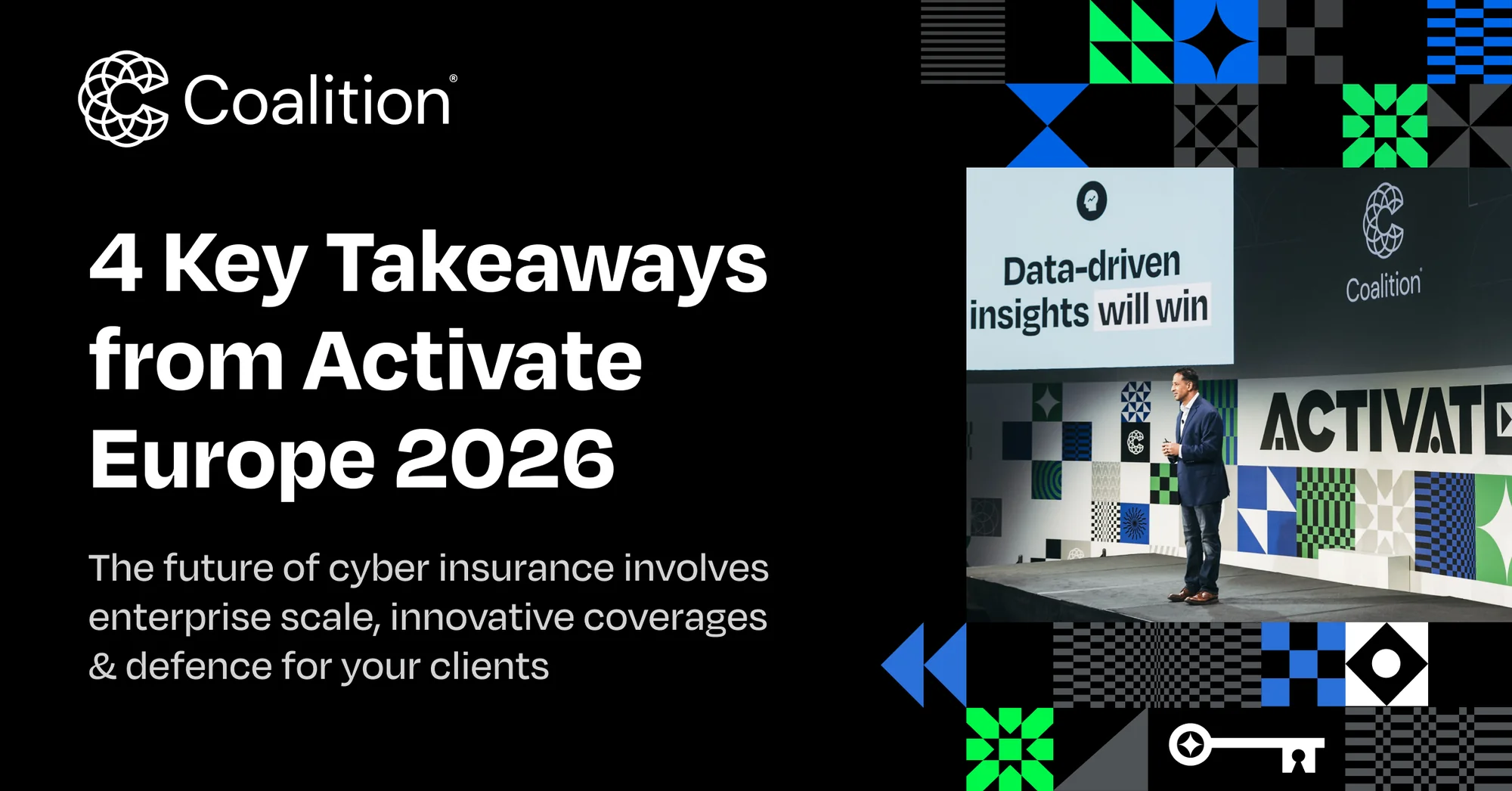
Activate Europe debuted in London this week, marking our largest cyber broker events outside of the US.

Our flagship event making it across the pond is a testament to Coalition’s commitment to building an international broker and customer community. We were thrilled to have filled the room with not only brokers but also underwriters, reinsurers, incident response firms, legal experts, and other professionals who were as eager to discuss the future of cyber insurance as us.

Here are 4 key takeaways from Activate Europe 2026 so you can catch up or relive the highlights.

1. Our partnership with Allianz unlocks enterprise scale

Cyber risk is a global problem. Attacks bypass physical borders, and interconnected ecosystems aren’t limited to singular countries. One outage can be felt worldwide.

Traditional insurance can struggle to address the worldwide nature of digital risk, which is why our (not so) secret master plan has always been to offer a different model for cyber risk: Provide a comprehensive insurance product, invest our profits in a security platform for policyholders, and use the data to build better tools for the future. That’s Active Insurance.

More customers give us more insight. More insight helps us improve how we identify, manage, and respond to cyber risk. The innovation compounds, allowing us to offer better protection, fewer losses, and better products. But how can we apply it globally and at scale?

In July, we announced a long-term strategic partnership with Allianz to bring Active Cyber Insurance to the global enterprise market at scale. Allianz provides AA rated capacity, global reach, and infrastructure behind international programs.* Coalition offers real-time risk intelligence, data-driven underwriting, active protection, and specialised claims response.

Our partnership gives Coalition global presence at scale with 130,000+ global policyholders and $1 billion global GWP on a proforma basis.

Our partnership gives Coalition global presence at scale with 130,000+ global policyholders and $1 billion global GWP on a proforma basis. With a broader view of cyber risk across this portfolio — which includes 49 of the US Fortune 500**— we’re positioned to help more businesses across 20+ geographies manage cyber risk before, during, and after an incident.

Now, brokers can offer enterprise clients meaningful limits with a cyber insurance provider that truly understands their clients’ cyber risk exposure. From sole trader to FTSE, we can help brokers protect their entire client portfolio.

2. Coverages need to keep up with the speed of cyber risk

There’s a reason the traditional approach to insurance doesn’t typically work with cyber. Digital risk is unlike any other.

This places a lot of responsibility on brokers to keep up with new technology and emerging threats, dedicating time and resources to be truly “cyber ready.” The same rule applies to available coverages, which need to adapt to the real threats you educate your clients about every day. In the last year, no risk has been more prevalent than AI.

Coalition is continuing to update coverage to align with the AI risks businesses experience:

- Deepfake Response Endorsement: Designed to proactively address the growing threat of deepfake technology. Following an event, provides technical analysis by a deepfake forensics firm, legal work to remove the deepfake, and crisis communications support.

- Enhanced AI Coverage Endorsement: Clarifies coverage related to AI in three key areas: Media Liability coverage for AI output, Tech E&O coverage for the use of AI systems, and Service Fraud Loss for LLMjacking incidents.

- AI Regulatory Coverage (COMING SOON): Offers regulatory coverage tailored for different segments’ unique needs, including both enterprise and SMEs.

Aside from the emerging risk of AI, business interruption has become the “new normal” in an increasingly interconnected digital world. Widespread operational disruptions and supply chain bottlenecks are often attached to significant financial losses. Take for example the fallout of the Jaguar Land Rover (JLR) breach, which halted manufacturing for over five weeks, causing an estimated £1.9 billion in total economic impact. Coalition is responding by offering coverage for similar events:

- Key Customer Coverage (COMING SOON): Helps policyholders replace lost profits if a key customer is hit by a cyber incident and has to pause or cut back orders.

We know brokers are working hard to stay current in cyber. We aim to make sure our coverage shows up where you and your clients need it most.

3. Widespread cyber adoption requires empowered teams

Small and medium-sized enterprises (SMEs) make up 90% of companies worldwide, yet only 1 in 5 has standalone cyber coverage. Cyber specialists have the expertise and relationships needed to move the needle on adoption, but not always the time left in the day.

Most specialists are bogged down by administrative tasks and manual workflows, leaving little time leftover for training frontline brokers on cyber risk or directly advising clients. Without a clear way to scale specialist-level knowledge, how can we elevate cyber from a “niche” line to a widely adopted coverage across industries?

Pitch Genius enables your entire team to deliver client-ready presentations and lead cyber conversations with confidence. Once you quote, Pitch Genius delivers an automatic, client-ready presentation. You’ll find:

- The ‘why’: You receive trends and stats specific to your client’s industry.

- Case studies: Real-world examples offer clients specific insights to what a cyber incident could look like at their business.

- Coverage highlights: Showcase the coverage that matters most to the client in plain language.

- Broker branding: The client presentation will reflect your firm.

You shouldn’t need to rely on a singular specialist to sell cyber. Our US brokers have already generated more than 63,000 presentations with Pitch Genius.

Pitch Genius enables your entire team to deliver client-ready presentations and lead cyber conversations with confidence.

Find Pitch Genius inside Broker IQ, your intelligent cyber insurance workspace designed to help maximise quoting efficiency and accelerate sales.

4. Helping clients stop the leading cause of claims is easy

Business email compromise (BEC) is the #1 reason businesses file cyber claims, with attack frequency jumping 15% year-over-year. In some cases, potential losses can be hundreds of thousands of pounds with days to weeks of business downtime.

The risk is increasing as attackers turn to generative AI to accelerate attacks at scale. Grammatically perfect messages tailored for individual recipients enable threat actors to evade detection and AI-powered phishing has resulted in a new email-based attack every 19 seconds.

What if you could help your clients automatically contain attackers in seconds and prevent BEC? Login Security provides 24/7 inbox monitoring and defence from inside Coalition Control, which is included with the policy.***

- Built for email: Login Security is specifically designed to help stop BEC by monitoring for suspicious logins from unusual locations, impossible travel, and the creation of malicious inbox rules.

- Immediate action: Automatically kicks out bad actors by terminating active sessions or requiring a password reset to help prevent further malicious behavior and reduce manual workloads for security teams.

- Easy installation: No EDR or MDR software required — launch straight from Coalition Control.

With Login Security, you can give your clients the additional layer of protection they need, without the push for new software, costly add-ons, or additional headcount that typically delays crucial security decisions. And hundreds of policyholders have already completed the easy one-time integration!

Build the future with us

Activate might be over, but the innovation never ends. We'll take our learnings from Activate 2026 to build the future of insurance — and plan for next year!

Class (B2B/B2C)
B2B
Ingest Status
Rewritten
Dedupe hash
4897c10a9fecc5f155dfd9579d6eb313
Press Eligible
Yes
Press Eligible Reason
Cyber insurance industry event takeaways covering partnerships, coverage, broker tools, and security products.
Source Name
Coalition Inc
Original Summary

Discover how Active Insurance is evolving on the global stage with updates and announcements from Activate Europe 2026.

Image URL
https://images.ctfassets.net/o2pgk9gufvga/6npsKa09iAYAVJKoQHOIzU/e9ce178ae9eee2c76a6279a07707050e/Coalition_Blog_Activate-Europe-2026-Takeaways.png
Source Node
Content Hash (SHA-256, erste 32 hex)
92386c2571ed972efab8f4f7708dc479
How Third Wave Innovations Shifted from Reactive Triage to Automated Verdicts
Image File
Original HTML

How Third Wave Innovations Shifted from Reactive Triage to Automated Verdicts

Third Wave Innovations operates on the principle that modern cybersecurity must move beyond pure technical policing and serve as an active business enabler. For nearly a decade, the Texas-based managed security service provider (MSSP) has operated as a trusted partner for small to midsized businesses that need cybersecurity without the cost of building it themselves.

To protect their clients effectively, the leadership team at Third Wave continuously evaluates technology based on real-world operational efficiency. The MSSP intentionally avoids feature-bloated software that complicates workflows, choosing instead to invest in highly responsive, lean technologies that eliminate daily friction for their engineering teams.

Technical Overload: The Constraints of Traditional Frameworks

While planning to expand its managed security offerings, Third Wave hit an operational ceiling with its legacy technology stack. Traditional architectures rooted in heavy security information and event management (SIEM) and extended detection and response (XDR) systems proved overly complex and correlation-dependent.

The legacy frameworks forced security analysts to exhaust critical billable hours sorting through a high-volume waterfall of low-context background alerts. Instead of focusing on proactive risk reduction, the security operations center (SOC) was trapped in exhaustive investigations, attempting to run down every minor signal, regardless of whether the event posed an active hazard.

“The way that Wirespeed has logically embraced AI and the way customers work, plus the responsiveness to threats, really meshed with where we were heading as an organization.” — Patrick Hayes, CXO and Field CISO, Third Wave Innovations

The lack of analytical focus directly impacted customer relations. Because the SIEM and EDR platforms relied strictly on technical logging data, they provided no insight into corporate financial risk. The MSSP’s analysts were forced to present abstract vulnerability metrics and generic scores that lacked real-world meaning, failing to show business owners how a system flaw mapped to corporate liability, insurance requirements, or regulatory compliance.

The resulting administrative drag limited efficiency across the entire SOC. Operators were stuck in a reactive loop of identifying a standalone problem and passing it off to the client to fix. This constant operational noise pulled attention away from higher-order advisory work, preventing Third Wave from advancing its engineers into strategic partnerships and leaving clients without a clear understanding of the true dollars-and-cents cost of a potential business outage.

Balancing Security Automation with Analytical Context

When Third Wave began exploring Wirespeed, they were looking for a fundamental shift in how data signals were qualified, rather than a superficial upgrade to their monitoring dashboard. The leadership team required an automated solution that could fast-forward through initial triage and strip the heavy administrative weight out of their daily security operations.

During initial trials across several unique, highly customized client environments, Wirespeed Automated Detection and Response (ADR) demonstrated it could bridge the gap between technical alert logs and real-world commercial risk across four core operational pillars:

Engineering a Transition: Rebuilding Trust in Automated Logic

Validating Wirespeed's automated verdicts was the key to unlocking a total structural evolution for Third Wave. The trial demonstrated that the platform could seamlessly absorb foundational triage tasks, allowing the MSSP to rebuild its service delivery model around long-term business resilience.

To resolve the native trust gap that often stalls automation, Wirespeed’s transparent logging gave analysts clear insight into the "why" behind every system decision. As the team spent less time questioning the platform's independent containment actions, Third Wave was able to systematically wind down manual verification loops.

Combined with an optimized data architecture, Third Wave successfully broke free from the reactive cycle of flagging problems without providing broader commercial solutions. By trusting the automated engine to manage baseline alerts, the MSSP completely eliminated the need for dedicated Level 1 analyst triage in their core business practice.

Organizational Transformation: From Operator to Advisor

Wirespeed has helped eliminate the human bottleneck of manual alert handling for Third Wave. By shifting the entire weight of foundational triage from the engineering team to the platform, the MSSP completely transformed a continuous waterfall of security noise into a highly precise delivery model, filtering out background distractions so the team receives only one or two meaningful points per week.

"When it’s quiet, clients like to ask, ‘What are we paying you for?’ With Wirespeed, we can show them how we’ve taken the proverbial alert waterfall and turned it into an eyedropper. The silence that Wirespeed creates is because all the noise isn’t meaningful to clients.” — Patrick Hayes, CXO and Field CISO, Third Wave Innovations

Before Wirespeed, Third Wave's engineers were too restricted by the operational limits of traditional log analysis to address broader risk architectures. By reclaiming massive amounts of analyst airtime, the MSSP has successfully transitioned its Level 2 operators into high-value security advisors. Instead of closing static tickets all day, the team now spends its time on active external threat hunting, network segmentation design, and helping clients defend against sophisticated lateral movement and business email compromise risks.

Strategic Future: Aligning Cyber Defense with Financial Resilience

The move to Wirespeed ADR replaced defensive drag with an algorithmic tool informed by data and cyber incidents across the globe. This unique relationship allowed Third Wave to reframe cybersecurity from an abstract IT expense into a clear conversation about risk profile, business insurability and financial recovery.

“From an impact standpoint, discussing risk in dollars and cents makes it far more meaningful to say, 'Here's how you recover, here's how quickly you can recover, and here's how insurable you are as a result of being able to do all the right things.'” — Patrick Hayes, CXO and Field CISO, Third Wave Innovations

By removing the operational ceiling of legacy software, Third Wave has unlocked the capacity to scale its core business with unprecedented precision. The transition to Wirespeed demonstrated that a modern MSSP scales not by adding more human triage eyes to legacy alerts, but by empowering seasoned professionals to advise clients on their true financial liability, insurability, and long-term recoverability.

LIGHTNING-FAST SPEED. LASER PRECISION.

Wirespeed Automated Detection & Response

Schedule a Call with Our Team | Start Your Free 30-Day Trial

Class (B2B/B2C)
B2B
Ingest Status
Rewritten
Dedupe hash
5208f82b5fa12097cce3d0d4561b91b1
Press Eligible
Yes
Press Eligible Reason
Cybersecurity technology case study about an MSSP’s adoption of automated threat detection and its business impact.
Source Name
Coalition Inc
Original Summary

By transitioning to Wirespeed, Third Wave Innovations has scaled its core business with unprecedented precision.

Image URL
https://images.ctfassets.net/o2pgk9gufvga/1tiRbkxwBIih0eyUZLE1eg/c3302b056a628f1b6a2bc42a0511110b/Wirespeed-Third-Wave-Innovations.png
Source Node
Content Hash (SHA-256, erste 32 hex)
1bdb15931769dc9c11d4af83fda5559e
Outcomes Over Alert Queues: Rebuilding MDR Around Speed
Image File
Original HTML

Outcomes Over Alert Queues: Rebuilding MDR Around Speed

Almost everything that matters in security operations happens in the gap of time between detection and response. For most managed detection and response (MDR) providers, the gap is governed by human analyst capacity.

For years, the standard answer to threat velocity has been to hire more people. But a service built on human analysts reviewing alerts, running manual or semi-automated playbooks, and passing tickets back to the customer has a built-in bottleneck. Adding headcount widens the alert queue without changing its nature or actually solving the problem.

Attacks that execute in seconds don’t wait for a shift change. Not to mention more people means higher MDR prices that customers have to bear. Something has to give.

Coalition acquired Wirespeed for its ability to stop cyber threats in milliseconds. Now, the market is demanding the very things we do best: robust detections, near-instant investigations that lead to clear verdicts, and threat containment instead of escalations.

Coalition was recognized in The Managed Detection And Response Services Landscape, Q3 2026 report by Forrester Research Inc.

A Changing Landscape for Security Operations

Organizations of all sizes have security stacks fragmented across endpoint, cloud, identity, SaaS, and operational technology (OT) with attack surfaces that have been growing faster than any security team can hire against. These are the compelling reasons why organizations look to third-party MDR services to keep their heads above water.

With a fragmented market of MDR providers, further impacted by the adoption of AI, the basis of comparing vendors has moved. Multivendor telemetry, 24/7 coverage, and case management have long been table stakes, but they’re not enough.

Verifiable security outcomes were a longstanding objective for customers evaluating MDR services. That’s one reason the market adopted “MDR” over “MSSP” many years ago. What separates MDR providers now is how far automation is allowed to go.

With a fragmented market of MDR providers, further impacted by the adoption of AI, the basis of comparing vendors has moved.

Where Speed Actually Matters

Wirespeed addresses managed SIEM and log management, OT and IoT detection and response, and security posture improvement. Beyond these capabilities, Wirespeed serves the full set of scenarios that MDR buyers most often seek.

In fact, Wirespeed was built from the ground up to be a fully automated, deterministic-first AI-SOC, with human oversight only for escalated cases.

Managed SIEM & Log Management

Anyone who has used an MDR provider or two knows that there's a great deal of variability in what “managed SIEM” actually means. Smaller, boutique providers may invest heavily in a customer’s existing SIEM deployment, but that comes at the cost of scaling service delivery across dozens of customers. Their inability to scale affects their margins, which, in turn, can create pressure to cut back on service quality to make up for it. Large scale MDR providers often take the opposite approach and can force you into their managed platform, where you may get less control and less value out of your current security investments, whether you like it or not.

Wirespeed syncs your detection rules and uses AI to categorize them to our taxonomy, so we can provide full investigations in milliseconds when they fire an alert.

Wirespeed strikes a great balance. We ship with our own built-in SIEM, 85+ integrations that connect quickly with nothing on-prem, and include both our own managed detection rules and the ability for you to write your own rules in natural language with AI. And we also support the major SIEM platforms organizations already own and love: We sync your detection rules and use AI to categorize them to our taxonomy, so we can provide full investigations in milliseconds when they fire an alert.

AI Detection & Response

Many MDR providers have bolted on AI to assist with investigation, but that’s very different from letting a machine act without a person in the critical path — the latter is what buyers are often uncomfortable with. AI assistance alone isn’t achieving the fastest possible threat containment times because it still requires a queue of detections for humans to review.

With Wirespeed, alert noise falls 99.99% before anything reaches your queue.

Wirespeed is deterministic-first, running telemetry to detections to automated investigation to verdict to response, with expert humans supervising through statistical sampling under Acceptable Quality Limits (ISO 2859) rather than approving each case. That's how our 0.000067% critical defect rate gets measured rather than asserted, and why verdicts and remediation land in milliseconds on actions the customer pre-authorized.

With Wirespeed, alert noise falls 99.99% before anything reaches your queue, and investigation always stays unmetered: no consumption pricing, no AI token burn.

OT/IoT Detection & Response

Invasive agents may not run on a legacy PLC, and a broad kill command across a medical device network or a SCADA environment could turn a security incident into a physical safety disaster. MDR providers typically struggle to learn their customers’ environments; configuration management databases are often incomplete, and human analysts are under too much time pressure to pause and figure out if an alert is coming from an OT device.

Wirespeed contains threats on IT systems while leveraging OT/IoT asset data to carefully and rapidly escalate to your in-house experts for special handling.

Wirespeed counters this problem by integrating with your asset management systems. We pull asset tags from Entra, your EDR, your attack surface, and vulnerability management tools (like Axonius), so our deterministic-first verdicts can handle critical assets with due care. Wirespeed contains threats on IT systems while leveraging OT/IoT asset data to carefully and rapidly escalate to your in-house experts for special handling. We also integrate with innovative detection products, like Sandfly, that run agentlessly for critical OT systems when agents on devices are a business risk.

From drilling rigs to research lab equipment to pharmaceutical manufacturing systems, the question worth putting forth to any MDR provider is how they can confidently state they can monitor environments with a mix of IT and OT/IoT systems without simply escalating everything.

Exposure Management

Detection describes what is happening; exposure describes what could happen. Usually, the two are bought from separate vendors.

Coalition acquired Binary Edge to make attack surface management a core component to both our insurance underwriting and our ongoing assistance to policyholders. Our Active Data Graph combines our own scanning engine with intelligence from incidents across the globe, not to just let you know what could theoretically become a material impact breach, but what is most likely to become material. (We also offer this service for third-party risk management of your suppliers, as well.)

Security Posture Improvement

Most vendors handle a case by launching a ticket with a recommendation over the fence, which hands the work back to the customer at the moment it matters most.

Data from security scans and incidents across the globe feeds back into both the accuracy of Wirespeed's investigations and the posture recommendations that come along with them.

Wirespeed executes the remediation steps instead, through response actions you approve in advance, and leaves a record of what happened so you can review afterward. Patterns of behavior come with posture recommendations, and you can choose to enforce stricter security hygiene in your organization, like not allowing the use of privacy VPNs or residential proxies to log into corporate systems, by overriding our verdict settings.

Data from security scans and incidents across the globe feeds back into both the accuracy of Wirespeed's investigations and the posture recommendations that come along with them.

Why We Built Wirespeed

Legacy MDR broke down because it assigned human analysts with the stress of an air traffic controller landing thousands of planes per hour. The result is delays, inconsistent handling of investigations, unverified tickets, and customer escalations without immediate containment actions — all while attacks unfold in seconds.

Wirespeed inverts the order. Applying deterministic-first execution within pre-authorized guardrails, Wirespeed gathers evidence, logs every decision step, reaches a verdict and contains the threat in milliseconds, and delivers investigations the customer can audit afterward.

In an era of machine-speed attacks, the distance between a verdict and a response is the whole contest. Wirespeed closes it in milliseconds.

LIGHTNING-FAST SPEED. LASER PRECISION.

Wirespeed Automated Detection & Response

Start your free 30-day trial >
Class (B2B/B2C)
B2B
Ingest Status
Rewritten
Dedupe hash
8a493cde3f23d2dfbbcaca0830536397
Press Eligible
Yes
Press Eligible Reason
Business and cybersecurity industry article about Coalition’s MDR capabilities and acquisitions.
Source Name
Coalition Inc
Original Summary

Coalition was recognized in “The Managed Detection And Response Services Landscape, Q3 2026” report by Forrester Research Inc.

Image URL
https://images.ctfassets.net/o2pgk9gufvga/6D0QaJ4kau5aDxU8aEvRyK/5e245c4473d87c5fe0c22063dd903f07/Coalition-Wirespeed-Forrester-MDR-Landscape_Q3-2026.jpg
Source Node
Content Hash (SHA-256, erste 32 hex)
38989466e5f0fc0761bb8276a7e5b886
Two Citrix RCE Zero Days Exploited in the Wild
Image File
Original HTML

Two Citrix RCE Zero Days Exploited in the Wild

On September 26, Coalition alerted at-risk policyholders to two Citrix NetScaler zero-day vulnerabilities following unconfirmed reports of active exploitation from reliable sources.

At the time of our Zero-Day Alert, Citrix had not publicly acknowledged the vulnerabilities. We observed increased scanning for NetScaler assets on Coalition honeypots, which may indicate threat actors are preparing for or running attacks. As a result, we recommended that policyholders disconnect devices from the internet if possible, restrict access if not possible to disconnect, and patch once it became available.

On September 27, Citrix officially published a security bulletin confirming the vulnerabilities and released patches for the impacted NetScaler appliances. We have since followed up with affected policyholders to provide additional remediation guidance.

What’s happening?

Citrix confirmed that exploits of CVE-2026-88771 and CVE-2026-88772 on unmitigated NetScaler deployments were observed in the wild.

- CVE-2026-88771 is a critical remote code execution (RCE) vulnerability that can allow an unauthenticated attacker to execute arbitrary commands.

- CVE-2026-88772 is a memory overflow vulnerability that can lead to remote code execution or a denial-of-service condition.

The patch also addressed six other flaws. NetScaler is a popular target for cyber criminals because it provides remote access to internal applications and desktops and is often exposed directly to the internet. NetScaler is widely used by enterprises across all industries, further supporting how lucrative these zero days can be for attackers.

Given the severe consequences of successful exploitation, immediate action is necessary. Before Citrix publicly acknowledged the vulnerabilities, IT suppliers, security researchers, and the Dutch National Cyber Security Center had already begun its own outreach to potentially impacted organizations. Security teams then flocked to Reddit, awaiting additional information or confirmation from Citrix.

Not a “Secure by Design” response

In 2025, Citrix signed CISA’s Secure by Design pledge, committing to seven measurable product-security goals alongside hundreds of other vendors. The premise is simple: when a vulnerability emerges, vendors should disclose it quickly, share what they know about active exploitation, and give customers actionable guidance — even before a patch is ready.

On these two zero days, Citrix’s public communications lagged the initial reports by at least 36 hours, based on our timeline.

In today’s threat environment, 36 hours is an eternity. During that window, customers had neither clear guidance nor a confirmed scope of impact. They didn’t have acknowledgement of new vulnerabilities at all and Citrix customers were left to fend for themselves.

The disconnect between a public commitment and what customers experience in practice matters more today than ever. AI is compressing the window between discovery and mass exploitation, so response timelines that once seemed merely slow are becoming materially riskier. The end user still bears much of the responsibility for securing the technology they buy, despite being the party least equipped to do so.

On these two zero days, Citrix’s public communications lagged the initial reports by at least 36 hours, based on our timeline.

When a zero day lands and guidance is slow, customers are left treading water with both hands tied, unsure how deep the water is or how long they’ll be treading.

This is why Active Insurance exists. Wherever gaps in vendor response appear, someone needs to sit on the policyholder’s side of the table: monitoring threats, translating them into plain language, and helping customers respond quickly. Security cannot stop at the vendor’s product team; it must extend to the customers who rely on that product when the stakes are highest.

How should businesses address this?

The following supported versions of Citrix NetScaler ADC and Citrix NetScaler Gateway are affected by the vulnerabilities:

- Citrix NetScaler ADC and Citrix NetScaler Gateway 14.1 BEFORE 14.1-73.37

- Citrix NetScaler ADC and Citrix NetScaler Gateway 13.1 BEFORE 13.1-64.23

- Citrix NetScaler ADC FIPS BEFORE 14.1-73.37 FIPS

- Citrix NetScaler ADC FIPS and NDcPP BEFORE 13.1-37.279

Organizations running any of the above versions of NetScaler ADC and NetScaler Gateway should install the relevant updated versions as soon as possible, as vulnerabilities are being actively exploited. Those that cannot immediately patch should limit exposure to the internet until they can patch.

More detailed guidance for remediation can be found in Citrix’s security bulletin, including details on all eight vulnerabilities and steps to determine if an appliance meets the CVE preconditions. Citrix has also made generic Indicators of Compromise available through NetScaler Console to help customers determine if their NetScaler deployments have been affected.

Who’s at risk?

Enterprises rely on Citrix NetScaler worldwide to manage traffic and authentication. Given the nature of both zero days (each with a 9.5 severity score), cybersecurity agencies in the UK, US, and the Netherlands all released advisories confirming the vulnerabilities.

Citrix Bleed One and Citrix Bleed Two, prior NetScaler zero days, led to high-profile breaches impacting critical infrastructure, healthcare entities, and major companies.

How Coalition is responding

Following our initial outreach on September 26, we have followed up with policyholders to ensure that they are aware a patch is available, both through email and in some cases, ongoing direct phone calls.

For assistance with mitigation, contact Coalition’s Security Support Center at securitysupport@coalitioninc.com.

SPOT & STOP CYBER THREATS

Coalition Control

Take control of your cyber risk >

Class (B2B/B2C)
B2B
Ingest Status
Rewritten
Dedupe hash
d1b468a721c2299fcbd3d753ce434780
Press Eligible
Yes
Press Eligible Reason
Enterprise cybersecurity alert on actively exploited Citrix vulnerabilities and mitigation guidance.
Source Name
Coalition Inc
Original Summary

Coalition notified policyholders of two potential Citrix zero-day vulnerabilities before vendor confirmation.

Image URL
https://images.ctfassets.net/o2pgk9gufvga/4k0EcOfZNmMeXQtsViLAS6/725e760a82790137055cb86b196bd5c8/Template_Coalition_Security.png
Source Node
Content Hash (SHA-256, erste 32 hex)
b893c7ee6be10b74a72e4036013e7f7e
How Wirespeed Enhances Investigations With SIEM Upgrade
Image File
Original HTML

How Wirespeed Enhances Investigations With SIEM Upgrade

In the last 90 days, Wirespeed has escalated only 2,294 of 8.1 million detections to our customers. This directly translates to less tedious alerts for users and more time to focus on strategic initiatives.

Wirespeed’s automated protection is designed to empower security teams, not replace them. Over the last quarter, we’ve launched new integrations, features, and product updates all designed to enhance your team’s capabilities, support your investigations, and reduce the noise. You’ll find:

- 15 new integrations to connect more of your security stack to Wirespeed

- Managed Detections, fueled by global risk intelligence, to help catch evasive threats

- More data at your fingertips to prove Wirespeed’s ROI to decision-makers

- And more!

New integrations

Wirespeed connects to your existing security tools to provide automated threat detection, investigation, and response. Our integrations are designed to work together by combining detection sources with user directories, endpoint managers, and communication platforms to enable automated protection.

Below, we’re highlighting the new integrations from the past quarter that may be most impactful for our users:

Network & Perimeter Security

- Ubiquiti UniFi: Monitors physical and perimeter network infrastructure, capturing syslog telemetry from gateways and access points.

Email & Workspace Security

- Perception Point / FortiMail: Inspects messaging and cloud collaboration channels for phishing, malware, and social engineering attacks.

Endpoint Security & Management

- Agger Labs: Focuses on host-level protection against ransomware and process tampering.

- Acronis: Merges endpoint data backup with cyber protection to secure local and cloud-based data assets.

- Fleet: Uses Osquery to maintain real-time visibility over device fleets, software inventories, and host states.

Identity & Access Management (PAM / EPM)

- Admin By Request: Removes permanent local admin rights, allowing users to request time-limited, audited privilege elevation.

Security Service Edge (SSE) & Zero Trust

- Netskope: Controls access to SaaS applications and internal network resources using Cloud Access Security Broker (CASB), Zero Trust Network Architecture (ZTNA), and web security policies.

Deception & Intrusion Detection

- Tracebit: Uses decoy cloud infrastructure to catch unauthorized lateral movement and adversary probing with high-confidence alerts.

Vulnerability & Exposure Management

- Tenable Nessus (Attack Simulation): Scans infrastructure to surface active vulnerabilities and simulate threat vectors across the attack surface.

IT Operations & Service Management (ITSM)

- Freshservice: Streamlines service requests, IT asset tracking, and automated incident creation based on security alerts.

Learn more about all available integrations and how to connect your security stack.

Product updates

We are constantly implementing updates and new features to the Wirespeed platform.

Over the last quarter, we revisited our security information and event management (SIEM) architecture — one of the foundations of Wirespeed. We updated it to prepare for the future and give your security team more autonomy. In addition, we’re putting more data directly in your hands so you can prove Wirespeed’s ROI with ease.

Enhanced SIEM Architecture

We have enhanced Wirespeed’s SIEM platform to improve overall user experience. Logs are now stored in their native format rather than the previous Open Cybersecurity Schema Framework (OCSF).

How does this directly improve your Wirespeed experience?

- Speed: You can query logs 80-100 times faster than before.

- Ease: Logs are now organized by source, enabling Wirespeed AI to better identify the root cause behind an incident.

- Proactive: An updated SIEM allows for further automated verdicts informed by Coalition-native threat intelligence.

Managed Detections

Managed Detections work on top of existing third-party integrations to help catch evasive threats that traditional security tools can overlook.

Managed Detections are powered by insights from over 1 billion daily events, data from security scans and incidents across the globe, and threat intelligence provided by Coalition Incident Response (CIR)*. In addition to traditional signs of malicious activity, such as suspicious logins or unlikely travel, Wirespeed monitors for novel or unconventional indicators of attack directly informed by real-life scenarios.

For example, following the rise of device code phishing, which abuses the OAuth 2.0 Device Authentication functionality, Wirespeed began to monitor for successful device-code authentication followed by multiple logins for the same user. Whereas traditional tools can miss the abuse of Microsoft’s OAuth feature because the logins look legitimate, Wirespeed recognizes it as suspicious behavior and can act automatically to contain attackers.

We are constantly expanding our library of Managed Detections. The team continues to track the latest threat intelligence data to parse into automated rules that function across all client environments.

User Identity Patterns

You can now use Wirespeed’s activity baseline data in your own investigations.

Wirespeed tracks what “normal” behavior is for your users across multiple sources, such as where they work from, when they work, and which devices they use. This activity informs their predictable, baseline activity. This information is how Wirespeed knows to act when users stray from their usual behavior patterns, like unlikely travel.

We recognize that this information can be useful for your team to complete its own investigations as well, especially if Wirespeed augments your security capabilities. To access individual user baseline data, go to Users and select an individual to see Day & Time Login Patterns, User Agents, Logins by Browser, and more.

Impact & ROI Widget

One of the biggest challenges that security leaders face is translating technical defense into business terms. How do you prove to decision-makers that the tools you have (or need) move the needle on risk reduction?

You should always know exactly how Wirespeed delivers for you and your team, and clearly be able to show that value to others. Along with the new visibility of User Identity Patterns, where you can see our work, we also have an Impact & ROI Widget designed to highlight how Wirespeed’s automation-fueled noise reduction saves time and labor costs.

You can toggle seamlessly between Time Saved (hours) and Financial Value (dollars) across rolling 90-day windows. Estimates are informed by SOC industry standards of the average hourly cost of analyst labor ($50) with the average manual triage time (20-minutes). The operational impact is informed by personalized Wirespeed data for your organization, by subtracting the analyst time spent on escalated reviews from total automated triage hours and cost.

You can find the Impact & ROI Widget, along with other high-level statistics, in Team Analytics.

We’re here to enhance your team

Wirespeed is always improving to adapt to new threats, meet the needs of different security teams, and provide the best possible protection.

While you focus on the bigger picture, we monitor user behavior, track threat intelligence feeds, and implement new features to make your investigations go smoother.

MILLISECONDS-FAST. DETERMINISTIC-FIRST.

Wirespeed AI SOC

See how Wirespeed stops threats in milliseconds >

Class (B2B/B2C)
B2B
Ingest Status
Need Review
Dedupe hash
9073036983510c01d0896dab73f5e7a3
Press Eligible
Yes
Press Eligible Reason
QA FAIL (need review): QA FAIL
Source Name
Coalition Inc
Original Summary

In Q3 2026, Wirespeed launched an updated SIEM platform, Managed Detections, ROI widget, and more.

Image URL
https://images.ctfassets.net/o2pgk9gufvga/kSznYOaajJx2wfhVeHcAo/38d18c5167442cac8f3b5af87b8e183f/Blog_Wirespeed-Integrations-Q3.png
Source Node
Generated Article_json
{"target_audience": "b2b", "is_medical": false, "ai_generated_title": "Wirespeed Upgrades SIEM, Escalates 2,294 of 8.1M Detections", "body_html": "<p><strong>Global -- [CURRENT_DATE] --</strong> Wirespeed escalated only 2,294 of 8.1 million detections to customers in the last 90 days, the AI SOC provider said as it detailed a quarter of SIEM changes, 15 new integrations and new analytics features.</p><h5>Wirespeed's SIEM now stores logs in native format and queries run 80-100 times faster</h5><p>Wirespeed revisited its security information and event management (SIEM) architecture, one of the platform's foundations. Logs are now stored in their native format instead of the Open Cybersecurity Schema Framework (OCSF).</p><p>The company cites three effects:</p><ul><li>Log queries run 80-100 times faster than before.</li><li>Logs are organized by source, which helps Wirespeed AI identify the root cause of an incident.</li><li>The updated SIEM allows further automated verdicts informed by Coalition-native threat intelligence.</li></ul><h5>Managed Detections draw on more than 1 billion daily events to catch evasive threats</h5><p>Managed Detections run on top of existing third-party integrations. They use data from security scans and incidents worldwide, plus threat intelligence from Coalition Incident Response.</p><p>One example is device code phishing, which abuses the OAuth 2.0 Device Authentication function. Wirespeed now monitors for a successful device-code authentication followed by multiple logins for the same user. Traditional tools can miss this because the logins look legitimate. Wirespeed treats the pattern as suspicious and can act automatically to contain attackers.</p><h5>Fifteen new integrations extend coverage across network, endpoint, identity and ITSM tools</h5><p>The company highlighted nine of the new connections:</p><ul><li><strong>Network:</strong> Ubiquiti UniFi, which captures syslog telemetry from gateways and access points.</li><li><strong>Email and workspace:</strong> Perception Point / FortiMail.</li><li><strong>Endpoint:</strong> Agger Labs, Acronis and Fleet, which uses Osquery for device visibility.</li><li><strong>Privilege management:</strong> Admin By Request, which provides time-limited, audited privilege elevation.</li><li><strong>Security service edge:</strong> Netskope, covering CASB, ZTNA and web security policies.</li><li><strong>Deception:</strong> Tracebit, which uses decoy cloud infrastructure to catch lateral movement.</li><li><strong>Vulnerability management:</strong> Tenable Nessus (Attack Simulation).</li><li><strong>IT service management:</strong> Freshservice, which creates incidents automatically from security alerts.</li></ul><h5>User Identity Patterns expose baseline behavior data to customer investigators</h5><p>Customers can now use Wirespeed's activity baselines in their own investigations. The baselines track where users work from, when they work and which devices they use. Under Users, analysts can view Day &amp; Time Login Patterns, User Agents and Logins by Browser for an individual.</p><h5>Impact &amp; ROI Widget prices automation savings at $50 per analyst hour</h5><p>The widget in Team Analytics toggles between Time Saved in hours and Financial Value in dollars across rolling 90-day windows. Estimates assume an average analyst labor cost of $50 per hour and an average manual triage time of 20 minutes, based on SOC industry standards.</p><p>The calculation subtracts analyst time spent on escalated reviews from total automated triage hours and cost, using each organization's own Wirespeed data.</p>", "meta_description": "Wirespeed escalated 2,294 of 8.1 million detections in 90 days, adds 15 integrations and a SIEM rebuild that speeds log queries 80-100 times for security teams.", "seo_keywords": "Wirespeed, AI SOC, SIEM upgrade, Managed Detections, security integrations, device code phishing, SOC automation, Coalition Incident Response, ROI widget", "companies": ["Wirespeed", "Coalition"], "industries": ["Information & Communication Technology (ICT)"], "markets_regions": [], "news_type": ["product_launch"], "products": ["Wirespeed AI SOC"], "themes": ["cybersecurity", "automation"], "events": [], "cta_text": "Explore Wirespeed's new integrations and platform updates", "learn_more": "", "fact_check": {"accuracy_score": 100, "legal_risk": "low", "corrections_made": [], "recommendation": "publish"}}
Content Hash (SHA-256, erste 32 hex)
a7d28528fc9c8f6cca13ca6b9a3588cf
Combatting the ‘Vulnpocalypse’ With Zero-Day Alerts
Image File
Original HTML

Combatting the ‘Vulnpocalypse’ With Zero-Day Alerts

Warnings of the “vulnpocalypse” are crowding conference presentations, headlines, and conversations among security professionals. Are the end times near?

AI is enabling attackers to find and exploit more vulnerabilities than before. We’ve felt it as the number of Zero-Day Alerts (ZDAs) sent each quarter has trended upward — with a distinct surge in 2026. The volume may be unprecedented, but the solution is straightforward: Know where to focus.

That’s exactly what our ZDAs help policyholders accomplish. Despite the growing number of vulnerabilities, the majority of policyholders still don’t receive a single notification. The vulnerability surge is manageable as long as security teams spend less time focused on hundreds of supposed “critical” risks that are unlikely to be exploited, and instead spend more time remediating actual threats.

ZDA Snapshot

- Coalition sent 49 ZDAs between May 1, 2026, and August 1, 2026

- 94% of policyholders didn’t receive a single ZDA

- 59% of notified policyholders have fewer than 25 employees

Below, we’ll explore how we’re helping policyholders navigate record-breaking vulnerability volume and which businesses are most likely to receive ZDAs.

Helping policyholders navigate record-breaking Patch Tuesdays

The pressure is on both vendors and security teams to find issues before attackers can abuse them. In July, Windows shared that it would apply AI across security analysis to find vulnerabilities earlier and at greater scale.

This likely contributed to the record-breaking Patch Tuesday in June with 206 vulnerabilities. In July, the number nearly tripled to 569. Prior to the adoption of multi-model AI for vulnerability discovery, Microsoft typically shipped around 100 fixes each month.

As soon as the vulnerabilities are disclosed, the clock starts ticking for organizations to act. Earlier this year, Anthropic disclosed that Mythos could create working exploits for newly discovered vulnerabilities in hours, as opposed to weeks. For security teams, this translates to an unprecedented volume of alerts every month to parse through and less time to do it.

Straightforward prioritization with ZDAs

Of all the vulnerabilities addressed in Microsoft’s July Patch Tuesday, roughly 60 were rated critical. More than 500 were rated important. Coalition continues to narrow the focus to which flaws we believe are most critical from an external exposure standpoint. In July, we sent two ZDAs on the same day as Patch Tuesday:

- SharePoint

- CVE-2026-56164 was added to CISA KEV on the same day as publishing and exploited as a true zero-day. With a Common Vulnerability Scoring System (CVSS) score of 5.4, it’s not particularly alarming on its own. But our analysis found that the nature of the vulnerability could make it an entry-point for other, more severe vulnerabilities. Subsequently, NVD enrichment gave it a 9.8 critical rating.

- CVE-2026-58644 was added to CISA KEV two days later. It’s a remote code execution (RCE) vulnerability that requires Site Owner privileges, which CVE-2026-56164 grants.

- CVE-2026-50522 is a standalone RCE that permits an unauthorized attacker to execute code over a network.

- Windows Message Queueing

- CVE-2026-50447 is a heap-based buffer overflow in Windows Message Queuing that allows unauthorized attackers to execute code over a network.

The expectation is not that policyholders will neglect the rest of the Patch Tuesday release, but that those at high-risk due to the above vulnerabilities will know where to start to dramatically reduce their exposure. Coalition continues to monitor and alert policyholders to the most critical risk following Patch Tuesday releases.

When evaluating what made the cut (among the 569 vulnerabilities), we found that many of the flaws weren’t noteworthy on their own or didn’t carry a particularly high CVSS score. The forest mattered more than the trees. Take, for example, CVE-2026-56164, a vulnerability that is low-risk on its own but an avenue for RCE when chained with CVE-2026-58644.

Chaining vulnerabilities was once labor intensive for attackers, but AI agents allow for an entirely automated workflow.

We saw the similar impact of chained vulnerabilities with WP2Shell (more on that below). Chaining vulnerabilities was once labor intensive for attackers, but AI agents allow for an entirely automated workflow. As Microsoft accounts for entire attack chains, it’s likely that the total volume of fixes will continue to swell.

59% of policyholders that received a ZDA have fewer than 25 employees

Employee count

Of all policyholders that received a ZDA, 59% had fewer than 25 employees.

For well-intentioned SMBs, a Patch Tuesday with nearly 600 vulnerabilities could present a month-long challenge.

Small and midsize businesses (SMBs) are typically the most strapped for resources and time, which often means they lack vulnerability management processes. For well-intentioned SMBs, a Patch Tuesday with nearly 600 vulnerabilities could present a month-long challenge.

Coalition sends ZDAs with clear steps for remediation to make patching as straightforward as possible. ZDAs are meant to supplement, not replace, a policyholder’s own patching and vulnerability management practices. While we can’t control how AI is shaping the volume of threats, we can make risk mitigation accessible for even the smallest businesses.

ZDAs per policyholder

The majority of policyholders (94%) did not receive a single ZDA from us. Of those that did, 91% received just one.

While the “vulnpocalypse” introduces an overwhelming number of vulnerabilities, the majority have no confirmed exploitation. Between 2018 and 2025, the share of newly published CVEs with confirmed exploitation remained below 2.2%, even as annual CVE volume grew 2.5 times.

Businesses that try to patch everything at once risk being overwhelmed. When we send ZDAs, we consider business impact and the legitimate risk of exploitation. The intention is to cut through the noise and guide businesses to focus on the same small percentage of risks that adversaries do.

ZDAs by industry

We observed a reasonably balanced dispersion of ZDAs sent across sectors. This is to be expected, as no industry is immune from the risk of aggregation events or vulnerable software.

Staying ahead of threats in the AI era

Autonomous discovery tools have fundamentally changed how security teams respond to critical threats. Moving fast isn't enough; defenders must evaluate vulnerabilities holistically based on potential financial loss. While traditional CVSS scores offer a baseline, they don't directly translate to real-world business impact.

Coalition delivers timely, prioritized ZDAs straight to policyholders’ inboxes when data indicates a vulnerability threatens their bottom line. Along with step-by-step remediation guidance, policyholders can access third-party risk management and attack surface monitoring through Coalition Control®, our cyber risk management platform.

EASILY SPOT & STOP CYBER THREATS IN ONE PLACE

Coalition Control

Take control of your cyber risk >

Class (B2B/B2C)
B2B
Ingest Status
Rewritten
Dedupe hash
356cdf2404835c6189fa1873685cdc9c
Press Eligible
Yes
Press Eligible Reason
Cybersecurity industry article on AI-driven vulnerabilities and business risk management.
Source Name
Coalition Inc
Original Summary

Explore our latest Zero-Day Alerts and discover why the “vulnpocalypse” is manageable when security teams focus on the threats most likely to be exploited.

Image URL
https://images.ctfassets.net/o2pgk9gufvga/GmwhIdl1pgh4bSHOJP5pD/4d41be893ea791c361c78c8615ba6322/Blog_90_Day_Threat_Retro-Q3.png
Source Node
Content Hash (SHA-256, erste 32 hex)
0f5311de0c6a5ec09f51ff9685da4a79
ConnectWise Investigating Unauthorized Access to Cloud Backup App
Image File
Original HTML

ConnectWise Investigating Unauthorized Access to Cloud Backup App

ConnectWise is investigating attempts of unauthorized access tied to its Cloud Backup for Microsoft 365 service (formerly known as SkyKick Cloud Backup). The company disclosed the incident on October 16, noting that containment measures were in place and that it had no indication that partner backup data was accessed.

Based on early community reports, security teams across Coalition and Wirespeed began investigating the incident prior to the disclosure. Coalition identified policyholders using adjacent ConnectWise SaaS technology, while Wirespeed identified its customers with the backup application in their Microsoft 365 tenants.

Immediately, we orchestrated outreach to begin notifying all impacted parties.

What ConnectWise has confirmed

ConnectWise disclosed the incident on October 16, noting that it initiated incident response procedures, has containment measures in place, and has no indication that partner backup data was accessed. The investigation is ongoing.

Separate public reports in the MSP community describe an attacker using the backup service's Microsoft Entra application to access customer tenants and exfiltrate email, SharePoint, and Teams data. ConnectWise has not confirmed these reports.

ConnectWise published the following indicators associated with the suspicious authentication activity. ConnectWise notes their presence alone does not confirm compromise.

- Source IP: 144.172.64.128

- User agents: Python-urllib/3.12 and python-requests/2.31

The application appears in Microsoft Entra as "SkyKick Backup" or "ConnectWise Cloud Backup," with App ID 506e08f9-6e9a-4da4-942b-a099a03644ae.

Why backup applications carry elevated risk

Cloud backup services for Microsoft 365 connect through a Microsoft Entra application that an administrator approves with tenant-wide permissions. The application then accesses data on its own, without a user sign-in, password, or MFA prompt. This is required for unattended backups.

Those permissions extend to anyone who can authenticate as the application. If its credentials are compromised, access is possible in every tenant that approved it, at the level the backup service already holds, typically read access to mail, SharePoint, and Teams.

This activity can be difficult to detect. Bulk reads of mailboxes and files are normal for a backup service, and user-focused controls such as MFA do not apply to application sign-ins. Because MSPs often deploy one backup vendor across many clients, a single vendor incident can affect a large number of organizations.

Recommended actions

The following steps apply to organizations that use ConnectWise Cloud Backup (SkyKick) for Microsoft 365, directly or through an MSP. The presence of the application in a tenant confirms the organization is a customer. It does not indicate compromise.

1. Disable the application

In Microsoft Entra, open Enterprise applications and locate "SkyKick Backup" or "ConnectWise Cloud Backup," or search by App ID 506e08f9-6e9a-4da4-942b-a099a03644ae. Under Manage → Properties, set "Enabled for users to sign-in" to No. Backups will stop while the application is disabled. Re-enable it after ConnectWise confirms remediation.

2. Search for the indicators

Review Entra sign-in logs and the Microsoft 365 unified audit log for activity tied to the App ID, IP 144.172.64.128, or the user agents Python-urllib/3.12 and python-requests/2.31.

3. Review access volume

Investigate unusual bulk access to mailboxes, SharePoint, or Teams, particularly outside the backup service's normal schedule.

4. Preserve logs

Export the relevant sign-in and audit logs. Default retention periods may be shorter than an investigation requires.

5. Report suspicious activity

Coalition policyholders who find activity matching these indicators should contact Coalition.

How Coalition and Wirespeed are responding

Coalition sent a Zero-Day Alert to policyholders who expose ConnectWise SaaS usage. Coalition cannot determine from external data which of those organizations use the backup service, so the alert was precautionary and included steps for each recipient to check.

Based on early community reports, security teams across Coalition and Wirespeed began investigating the incident prior to the disclosure.

Wirespeed's visibility into the Microsoft 365 tenants it monitors allows it to identify which customers use the backup service and whether the known attacker activity appears in their environments. All Wirespeed customers using the service have been notified.

Next steps

Coalition and Wirespeed will continue monitoring and will update guidance when ConnectWise confirms remediation. Policyholders who find activity matching the indicators above should contact Coalition.

Wirespeed has launched new Managed Detections to alert on any malicious activity related to the ConnectWise Cloud Backup for Microsoft 365 to help ensure the platform responds automatically. Organizations should also review which third-party applications have access to their Microsoft 365 tenant, including those connected by an MSP, under Enterprise applications in Microsoft Entra.

Class (B2B/B2C)
B2B
Ingest Status
Rewritten
Dedupe hash
86c281db361b11e7ee9c4e460d609b80
Press Eligible
Yes
Press Eligible Reason
Business-focused cybersecurity incident affecting ConnectWise’s cloud backup service and its customers.
Source Name
Coalition Inc
Original Summary

Coalition and Wirespeed have notified businesses that may be exposed to attempts of unauthorized access in ConnectWise Cloud Backup for Microsoft 365.

Image URL
https://images.ctfassets.net/o2pgk9gufvga/3wKCqawKB7B3esAU3vjFxf/d222eb1db774c3bded75fb8d73ea9b46/Coalition_Security_-_ConnectWise.png
Source Node
Content Hash (SHA-256, erste 32 hex)
87b36fd0a43f4ec9dc796217470d7040
Typhoon disruptions driving congestion and putting pressure on rates – September 1, 2026 Update
Image File
Original HTML

Weekly highlights

Ocean rates – Freightos Baltic Index

- Asia-US West Coast prices (FBX01 Weekly) increased 2%.

- Asia-US East Coast prices (FBX03 Weekly) increased 2%.

- Asia-N. Europe prices (FBX11 Weekly) decreased 1%.

- Asia-Mediterranean prices (FBX13 Weekly) decreased 4%.

Air rates – Freightos Air Index

- China – N. America weekly prices decreased 7%.

- China – N. Europe weekly prices increased 1%.

- N. Europe – N. America weekly prices stayed level.

Analysis

The increasingly cold war in the Strait of Hormuz – including reported progress in an Iran-Oman authority-sharing agreement – heated up a little recently. Alongside more Iranian strikes on vessels and US claims of demining progress, the US hit Iranian rocket launchers possibly dedicated to deploying more mines and Iran responded by targeting US sites in Jordan.

Transpacific ocean rates ticked up by 2% last week to new peak season highs for both coasts as volume strength has stretched on through August despite the early start to peak season demand back in late May.

Prices passed the $7,600/FEU mark for the West Coast and climbed to about $9,800/FEU to the East Coast. Carriers are increasing capacity slightly for September in anticipation of still-elevated volumes – with more rate increases, especially for the East Coast, possible to start the month – up until October’s Golden Week, with blanked sailings set for the holiday period. Though there is no clear explanation for the surprisingly resilient demand, the absence of tariff hikes in late July and an increase in data center hardware volumes may both be contributing. Tariff refunds that are enabling some retailers to reduce prices may also be spurring some retailers to increase inventories.

Coming Panama Canal, low water restrictions have some carriers planning surcharges for transiting containers in September, which could add pressure on some East Coast rates soon.

Another likely contributor to elevated transpacific container rates is the unrelenting congestion in major Far East hubs from the succession of typhoons that have hit the region since mid-July. The latest, Typhoon Saudel, closed ports including Shanghai and Ningbo for several days last week, disrupted operations as far north as Busan and could stay strong enough to impact Shenzhen later this week.

The series of storms has prevented impacted ports from completely clearing backlogs before new shutdowns, with as many as ninety ships waiting more than a week for a slot in Shanghai, and carriers skipping calls at backed up ports leading to increased transhipment volumes at other ports in the region.

Far East congestion – as well as N. Europe hub backlogs, partly due to low, but improving, water levels in the Rhine – is also a factor to current Asia – Europe rate levels. Prices have cooled on easing demand since mid-July but capacity constraints may be helping rates remain above pre-peak levels. Asia – N. Europe prices have fallen more than $1,000/FEU since their July peak, but at $4,600/FEU are up about 70% compared to before the early start of peak season in mid-May. Rates at $4,800/FEU to the Mediterranean are down more than $2,000/FEU but are still 40% higher than three months ago.

Transatlantic rates climbed $400/FEU in the last two weeks to $2,600/FEU as carriers reduce capacity on the lane. Several carriers are planning additional, significant price increases for September, though some observers are skeptical that these rate hikes will stick.

In air cargo, the Freightos Air Index global benchmark eased 10% last week, but remains more than 20% higher than a year ago due to elevated fuel costs and some lingering capacity constraints. Far East – US rates eased 7% to about $6.00/kg and prices to Europe ticked up 1% to $4.60/kg last week, though both lanes are trending up so far this week, possibly due, once again, to typhoon-driven disruptions.

Freightos Terminal™: Real-time pricing dashboards to benchmark rates and track market trends.

Procure™: Streamlined procurement and cost savings with digital rate management and automated workflows.

Rate, Book, & Manage™: Real-time rate comparison, instant booking, and easy tracking at every shipment stage.

Class (B2B/B2C)
B2B
Ingest Status
Rewritten
Dedupe hash
965a66250b5081365e9724275f6a9cc2
Press Eligible
Yes
Press Eligible Reason
Freight rate and supply-chain disruption analysis for logistics professionals.
Source Name
Freightos
Original Summary

<p>Weekly highlights Ocean rates &#8211; Freightos Baltic Index Air rates &#8211; Freightos Air Index Analysis The increasingly cold war in the Strait of Hormuz – including reported progress in an Iran-Oman authority-sharing agreement – heated up a little recently. Alongside more Iranian strikes on vessels and US claims of demining progress, the US hit Iranian [&#8230;]</p>
<p>The post <a href="https://www.freightos.com/freight-resources/typhoon-disruptions-driving… disruptions driving congestion and putting pressure on rates &#8211; September 1, 2026 Update</a> appeared first on <a href="https://www.freightos.com">Freightos</a>.</p&gt;

Image URL
https://www.freightos.com/wp-content/themes/freightos/assets/img/freightos-blog.jpg
Source Node
Content Hash (SHA-256, erste 32 hex)
ac65a58c1e29d4c52e4460990591e18f
Mediterranean ocean rates pull even with Asia – EU, possibly from Red Sea transit bump – September 8, 2026 Update
Image File
Original HTML

Weekly highlights

Ocean rates – Freightos Baltic Index

- Asia-US West Coast prices (FBX01 Weekly) decreased 1%.

- Asia-US East Coast prices (FBX03 Weekly) decreased 3%.

- Asia-N. Europe prices (FBX11 Weekly) decreased 3%.

- Asia-Mediterranean prices (FBX13 Weekly) decreased 1%.

Air rates – Freightos Air Index

- China – N. America weekly prices increased 5%.

- China – N. Europe weekly prices increased 6%.

- N. Europe – N. America weekly prices stayed level.

Analysis

Tensions between Iran and the US continue to climb around the Strait of Hormuz, with Iran now announcing plans to impose a wider exclusion zone on areas near the strait. Fuel rates have trended up since the ceasefire collapse in July, but recent escalations as well as an increase in Chinese crude imports have pushed bunker fuel prices back up to levels last seen in June. Jet fuel prices are back to May levels with both fuels about 60% higher than before the start of the war.

Climbing fuel costs are likely setting an elevated floor for container rates, but ocean prices are still largely being driven by demand trends and disruptions to capacity availability.

Transpacific ocean rates cooled slightly last week, suggesting there won’t be additional rate increases in what is likely the last few weeks of peak season. But elevated demand that started in late May has kept prices at peak levels since early July. Current rates – of about $7,600/FEU to the West Coast and $9,500/FEU to the East Coast – are about back to levels last seen during peak season in 2024 when seasonal demand, Red Sea disruptions to capacity and some frontloading ahead of a possible East Coast labor strike combined to push rates up sharply.

Severe typhoon-driven congestion at Far East container hubs are likely also contributing to current rate levels. Carriers have increased blanked sailings for this week – possibly as moves to recover schedules disrupted by the storms – which could also help keep prices elevated even if demand has started to ease.

The Panama Canal Authority has postponed an additional half-foot draft reduction for Neopanamax transits until further notice, though it is still bracing for drought conditions from the expected El Nino this year. The PCA reduced daily transits by four to 32 this month, though Neopanamax daily slots – used by long haul container vessels – have only been reduced by one.

Asia-Europe container rates ticked down slightly last week to $4,500/FEU to N. Europe and $4,700/FEU to the Mediterranean, though Mediterranean prices have cooled further so far this week to about even with N. Europe. Going back to 2017, Asia – Mediterranean rates have on average been 17% higher than Asia – N. Europe prices, though at times they have been lower.

The current sharper decline from peak season highs for Mediterranean rates – a $2,600/FEU and 37% drop compared to $1,300/FEU and 23% for N. Europe lanes – may reflect both the recent increase in Red Sea transits for some Mediterranean services and that congestion at N. Europe hubs is keeping upward pressure on rates for those lanes even as peak season demand has cooled. Even with these declines, rates for both lanes remain $1,000 – $1,700/FEU above pre-peak season levels, likely due to Far East congestion as well. Recent port worker strikes in Germany and the Netherlands are now also contributing to some of the backlog.

In air cargo, operations at Miami International Airport are back to normal after an Amazon freighter crash on Sunday and authorities have reopened most airports across Indonesia following a volcanic eruption that had closed airports since late Friday. Air cargo rates from the Far East increased about 5% last week to $6.30/kg to the US and $4.88/kg to Europe, possibly reflecting disruptions from the most recent typhoon to hit the region last week.

Freightos Terminal™: Real-time pricing dashboards to benchmark rates and track market trends.

Procure™: Streamlined procurement and cost savings with digital rate management and automated workflows.

Rate, Book, & Manage™: Real-time rate comparison, instant booking, and easy tracking at every shipment stage.

Class (B2B/B2C)
B2B
Ingest Status
Rewritten
Dedupe hash
5b82d6b0615a393be0ecf763d5d94c83
Press Eligible
Yes
Press Eligible Reason
Freight rate analysis and shipping market trends for logistics professionals.
Source Name
Freightos
Original Summary

<p>Weekly highlights Ocean rates &#8211; Freightos Baltic Index Air rates &#8211; Freightos Air Index Analysis Tensions between Iran and the US continue to climb around the Strait of Hormuz, with Iran now announcing plans to impose a wider exclusion zone on areas near the strait.&#160; Fuel rates have trended up since the ceasefire collapse in [&#8230;]</p>
<p>The post <a href="https://www.freightos.com/freight-resources/mediterranean-ocean-rates-p… ocean rates pull even with Asia &#8211; EU, possibly from Red Sea transit bump &#8211; September 8, 2026 Update</a> appeared first on <a href="https://www.freightos.com">Freightos</a>.</p&gt;

Image URL
https://www.freightos.com/wp-content/themes/freightos/assets/img/freightos-blog.jpg
Source Node
Content Hash (SHA-256, erste 32 hex)
e94c46c029d8908ffaa1837d08022137